
“A thunderous gallop of a war novel, a new classic, a best-in-class example of speculative fiction.” —The New York Times Book Review
The critically acclaimed author of the “crazily enjoyable” (The New York Times) Whalefall returns with an immersive, cinematic novel about five World War I soldiers who stumble upon a fallen angel that could hold the key to ending the war.
Private Cyril Bagger has managed to survive the unspeakable horrors of the Great War through his wits and deception, swindling fellow soldiers at every opportunity. But his survival instincts are put to the ultimate test when he and four other grunts are given a deadly mission: venture into the perilous No Man’s Land to euthanize a wounded comrade.
What they find amid the ruined battlefield, however, is not a man in need of mercy but a fallen angel, seemingly struck down by artillery fire. This celestial being may hold the key to ending the brutal conflict, but only if the soldiers can suppress their individual desires and work together. As jealousy, greed, and paranoia take hold, the group is torn apart by their inner demons, threatening to turn their angelic encounter into a descent into hell.
Angel Down plunges you into the heart of World War I and weaves a polyphonic tale of survival, supernatural wonder, and moral conflict.
A Love Story
A Love Story
From the #1 New York Times bestselling author of The Seven Husbands of Evelyn Hugo and Daisy Jones & The Six comes an epic new novel set against the backdrop of the 1980s space shuttle program, about the extraordinary lengths we go to live and love beyond our limits.
Joan Goodwin has been obsessed with the stars for as long as she can remember. She is content with her life as a professor of physics and astronomy and as aunt to her precocious niece, Frances, until she comes across an advertisement seeking the first women scientists to join NASA's space shuttle program. Suddenly, Joan burns to go to space.
Selected from a pool of thousands of applicants in the summer of 1980, Joan begins training at Houston's Johnson Space Center, alongside an exceptional group of fellow candidates: Top Gun pilot Hank Redmond and scientist John Griffin, easygoing even when the stakes are high; mission specialist Lydia Danes, who has worked too hard to play nice; warmhearted Donna Fitzgerald, navigating her own secrets; and Vanessa Ford, the magnetic and mysterious aeronautical engineer who can fix any engine and fly any plane.
As they become unlikely friends and prepare for their first flights, Joan finds a love she never imagined. In this new light, Joan begins to question everything she thinks she knows about her place in the observable universe.
Then, in December of 1984, on mission STS-LR9, it all changes in an instant.
Fast-paced, thrilling, and emotional, Atmosphere is Taylor Jenkins Reid at her best: telling a passionate and soaring story about the transformative power of love–this time among the stars.

A Novel
(Literary Fiction & Classics)
A Novel
“Nothing short of brilliant.” —The Wall Street Journal
From “a surpassingly gifted storyteller” (The New York Times), a visionary novel inspired by the life of film director G.W. Pabst, who fled to Hollywood to resist the Nazis only to return to his homeland to create propaganda films for the German Reich.
An artist’s life, a pact with the devil, and the dangerous illusions of the silver screen.
G.W. Pabst, one of cinema’s greatest directors of the 20th century, was filming in France when the Nazis seized power. To escape the horrors of the new and unrecognizable Germany, he fled to Hollywood. But now, under the blinding California sun, the world-famous director suddenly looks like a nobody. Not even Greta Garbo, the Hollywood actress whom he made famous, can help him.
When he receives word that his elderly mother is ill, he finds himself back in his homeland of Austria, which is now called Ostmark. Pabst, his wife, and his young son are suddenly confronted with the barbaric nature of the regime. So, when Joseph Goebbels—the minister of propaganda in Berlin—sees the potential for using the European film icon for his directorial genius and makes big promises to Pabst and his family, Pabst must consider Goebbels’s thinly veiled order. While Pabst still believes that he will be able to resist these advances, that he will not submit to any dictatorship other than art, he has already taken the first steps into a hopeless entanglement.
Kehlmann’s latest oeuvre explores the complicated relationships and distinctions between art and power, beauty and barbarism, cog and conspirator.
Han Kang's most revelatory book since The Vegetarian, We Do Not Part tells the story of a friendship between two women while powerfully reckoning with a hidden chapter in Korean history—"[A] masterpiece" (The Boston Globe) "A haunting exploration of friendship amid historical trauma."—Time "A novel that is both disquieting and entrancing."—The Economist
One winter morning in Seoul, Kyungha receives an urgent message from her friend Inseon to visit her at the hospital. Inseon has injured herself in an accident, and she begs Kyungha to return to Jeju Island, where she lives, to save her beloved pet—a white bird called Ama. A snowstorm hits the island when Kyungha arrives. She must reach Inseon's house at all costs, but the icy wind and squalls slow her down as night begins to fall. She wonders if she will arrive in time to save the animal—or even survive the terrible cold that envelops her with every step. Lost in a world of snow, she doesn't yet suspect the vertiginous plunge into darkness that awaits her at her friend's house.
Blurring the boundaries between dream and reality, We Do Not Part powerfully brings to light the lost voices of the past to save them from oblivion. Both a hymn to an enduring friendship and an argument for remembering, it is the story of profound love in the face of unspeakable pain—and a celebration of life, however fragile it might be.
In a tiny Beirut apartment, sixty-three-year-old Raja and his mother live side by side. A beloved high school philosophy teacher and "the neighborhood homosexual," Raja relishes books, meditative walks, order, and solitude. Zalfa, his octogenarian mother, views her son's desire for privacy as a personal affront. She demands to know every detail of Raja's work life and love life, boundaries be damned.
When Raja receives an invite to an all-expenses-paid writing residency in America, the timing couldn't be better. It arrives on the heels of a series of personal and national disasters that have left Raja longing for peace and quiet away from his mother and the heartache of Lebanon. But what at first seems a stroke of good fortune soon leads Raja to recount and relive the very disasters and past betrayals he wishes to forget.
Told in Raja's irresistible and wickedly funny voice, the novel dances across six decades to tell the unforgettable story of a singular life and its absurdities—a tale of mistakes, self-discovery, trauma, and maybe even forgiveness. Above all, The True True Story of Raja the Gullible (and His Mother) is a wildly unique and sparkling celebration of love.

A Novel
A Novel
From Booker Prize finalist and “the shrewdest writer on contemporary masculinity we have” (Esquire), a “captivating...hypnotic...virtuosic” (The Baffler) novel about a man whose life veers off course due to a series of unforeseen circumstances.
Teenaged István lives with his mother in a quiet apartment complex in Hungary. Shy and new in town, he is a stranger to the social rituals practiced by his classmates and is soon isolated, drawn instead into a series of events that leave him forever a stranger to peers, his mother, and himself. In the years that follow, István is born along by the goodwill, or self-interest, of strangers, charting a rocky yet upward trajectory that lands him further from his childhood, and the defining events that abruptly ended it, than he could possibly have imagined.
A collection of intimate moments over the course of decades, Flesh chronicles a man at odds with himself—estranged from and by the circumstances and demands of a life not entirely under his control and the roles that he is asked to play. Shadowed by the specter of past tragedy and the apathy of modernity, the tension between István and all that alienates him hurtles forward until sudden tragedy again throws life as he knows it in jeopardy. “Spare and detached on the page, lush in resonance beyond it” (NPR), Flesh traces the imperceptible but indelible contours of unresolved trauma and its aftermath amid the precarity and violence of an ever-globalizing Europe with incisive insight, unyielding pathos, and startling humanity.

SHORTLISTED FOR THE 2025 BOOKER PRIZE
INSTANT NATIONAL BESTSELLER
“A tightly wound family drama that reads like a psychological thriller."—NPR
“Bold, stark, genre-bending, Audition will haunt your dreams.”—The Boston Globe
One woman, the performance of a lifetime. Or two. An exhilarating, destabilizing Möbius strip of a novel that asks whether we ever really know the people we love.
Two people meet for lunch in a Manhattan restaurant. She’s an accomplished actress in rehearsals for an upcoming premiere. He’s attractive, troubling, young—young enough to be her son. Who is he to her, and who is she to him? In this compulsively readable, brilliantly constructed novel, two competing narratives unspool, rewriting our understanding of the roles we play every day – partner, parent, creator, muse – and the truths every performance masks, especially from those who think they know us most intimately.
Taut and hypnotic, Audition is Katie Kitamura at her virtuosic best.

“Hot, heartbreaking, and thrillingly victorious.”—Miranda July, New York Times bestselling author of All Fours
NEW YORK TIMES BOOK REVIEW EDITORS’ CHOICE • A VULTURE BEST BOOK OF THE YEAR (SO FAR)
In this collection of one novel and three stories, bestselling author Torrey Peters’s keen eye for the rough edges of community and desire push the limits of trans writing.
In Stag Dance, the titular novel, a group of restless lumberjacks working in an illegal winter logging outfit plan a dance that some of them will volunteer to attend as women. When the broadest, strongest, plainest of the axmen announces his intention to dance as a woman, he finds himself caught in a strange rivalry with a pretty young jack, provoking a cascade of obsession, jealousy, and betrayal that will culminate on the big night in an astonishing vision of gender and transition.
Three startling stories surround Stag Dance: “Infect Your Friends and Loved Ones” imagines a gender apocalypse brought about by an unstable ex-girlfriend. In “The Chaser,” a secret romance between roommates at a Quaker boarding school brings out intrigue and cruelty. In the last story, “The Masker,” a party weekend on the Las Vegas strip turns dark when a young crossdresser must choose between two guides: a handsome mystery man who objectifies her in thrilling ways, or a cynical veteran trans woman offering unglamorous sisterhood.
Acidly funny and breathtaking in its scope, with the inventive audacity of George Saunders or Jennifer Egan, Stag Dance provokes, unsettles, and delights.

A REESE'S BOOK CLUB PICK | A NEW YORK TIMES BESTSELLER
"Broken Country by Clare Leslie Hall is an unforgettable story of love, loss, and the choices that shape our lives…but it's also a masterfully crafted mystery that will keep you guessing until the very last page. Seriously, that ending?! I did not see it coming." —Reese Witherspoon
"Stirring and mysterious…fires directly at the human heart and hits the mark." —Delia Owels, New York Times bestselling author of Where the Crawdads Sing
A love triangle unearths dangerous, deadly secrets from the past in this thrilling tale perfect for fans of The Paper Palace and Where the Crawdads Sing.
"The farmer is dead. He is dead, and all anyone wants to know is who killed him."
Beth and her gentle, kind husband Frank are happily married, but their relationship relies on the past staying buried. But when Beth's brother-in-law shoots a dog going after their sheep, Beth doesn't realize that the gunshot will alter the course of their lives. For the dog belonged to none other than Gabriel Wolfe, the man Beth loved as a teenager—the man who broke her heart years ago.
Gabriel has returned to the village with his young son Leo, a boy who reminds Beth very much of her own son, who died in a tragic accident. As Beth is pulled back into Gabriel's life, tensions around the village rise and dangerous secrets and jealousies from the past resurface, this time with deadly consequences. Beth is forced to make a choice between the woman she once was, and the woman she has become.
A sweeping love story with the pace and twists of a thriller, Broken Country is a novel of simmering passion, impossible choices, and explosive consequences that toggles between the past and present to explore the far-reaching legacy of first love.
A Novel
A Novel
“Masterful is the pace at which Evans fills in the blanks of her protagonist’s life.”—Frank Bruni, The New York Times
“I cried more than once as I witnessed this brilliant woman come to understand herself more deeply.”—Florence Knapp, author of The Names
LONGLISTED FOR THE CENTER FOR FICTION FIRST NOVEL PRIZE • A PBS TOP SUMMER BOOK • LIBRARYREADS PICK OF THE MONTH
“Imagine, the letters one has sent out into the world, the letters received back in turn, are like the pieces of a magnificent puzzle. . . . Isn’t there something wonderful in that, to think that a story of one’s life is preserved in some way, that this very letter may one day mean something, even if it is a very small thing, to someone?”
Filled with knowledge that only comes from a life fully lived, The Correspondent is a gem of a novel about the power of finding solace in literature and connection with people we might never meet in person. It is about the hubris of youth and the wisdom of old age, and the mistakes and acts of kindness that occur during a lifetime.
Sybil Van Antwerp has throughout her life used letters to make sense of the world and her place in it. Most mornings, around half past ten, Sybil sits down to write letters—to her brother, to her best friend, to the president of the university who will not allow her to audit a class she desperately wants to take, to Joan Didion and Larry McMurtry to tell them what she thinks of their latest books, and to one person to whom she writes often yet never sends the letter.
Sybil expects her world to go on as it always has—a mother, grandmother, wife, divorcee, distinguished lawyer, she has lived a very full life. But when letters from someone in her past force her to examine one of the most painful periods of her life, she realizes that the letter she has been writing over the years needs to be read and that she cannot move forward until she finds it in her heart to offer forgiveness.
Sybil Van Antwerp’s life of letters might be “a very small thing,” but she also might be one of the most memorable characters you will ever read.
A Novel
A Novel
NATIONAL BESTSELLER • An epic love story set in the sparkling, savage sphere of elite figure skating, starring a woman determined to carve her own path on and off the ice
“Part Wuthering Heights and part Daisy Jones & The Six, this novel is as brilliantly choreographed as a gold medal performance and will keep you guessing until its last page.”—Jodi Picoult, New York Times bestselling author of By Any Other Name
She might not have a famous name, funding, or her family’s support, but Katarina Shaw has always known that she was destined to become an Olympic skater. When she meets Heath Rocha, a lonely kid stuck in the foster care system, their instant connection makes them a formidable duo on the ice. Clinging to skating—and each other—to escape their turbulent lives, Kat and Heath go from childhood sweethearts to champion ice dancers, captivating the world with their scorching chemistry, rebellious style, and roller-coaster relationship.
Until a shocking incident at the Olympic Games brings their partnership to a sudden end.
As the ten-year anniversary of their final skate approaches, an unauthorized documentary reignites the public obsession with Shaw and Rocha, claiming to uncover the “real story” through interviews with their closest friends and fiercest rivals. Kat wants nothing to do with the documentary, but she can’t stand the thought of someone else defining her legacy. So, after a decade of silence, she’s telling her story: from the childhood tragedies that created her all-consuming bond with Heath to the clash of desires that tore them apart. Sensational rumors have haunted their every step for years, but the truth may be even more shocking than the headlines.
A Novel
A Novel
“An enrapturing tale of survival . . . Eckstine has poured a ton of heart into her characters.”—The Atlanta Journal-Constitution
“The richly textured prose quickly pulled me into [Junie’s] treacherous yet magical world.”—Charmaine Wilkerson, New York Times bestselling author of Black Cake
Sixteen years old and enslaved since she was born, Junie has spent her life on Bellereine Plantation in Alabama, cooking and cleaning alongside her family, and tending to the white master’s daughter, Violet. Her daydreams are filled with poetry and faraway worlds, while she spends her nights secretly roaming through the forest, consumed with grief over the sudden death of her older sister, Minnie.
When wealthy guests arrive from New Orleans, hinting at marriage for Violet and upending Junie’s life, she commits a desperate act—one that rouses Minnie’s spirit from the grave, tethered to this world unless Junie can free her. She enlists the aid of Caleb, the guests’ coachman, and their friendship soon becomes something more. Yet as long-held truths begin to crumble, she realizes Bellereine is harboring dark and horrifying secrets that can no longer be ignored.
With time ticking down, Junie begins to push against the harsh current that has controlled her entire life. As she grapples with an increasingly unfamiliar world in which she has little control, she is forced to ask herself: When we choose love and liberation, what must we leave behind?
(Literary Fiction & Classics)
**The international bestseller**
An unforgettable historical debut set in Second World War Brussels: exploring love, resistance and courage in all their forms
'I adored it ... It finds courage and love amidst the ruins, and I read with my heart in my mouth' Rachel Joyce
'Intimate and ambitious, lyrical and moving' Observer
'A beautiful and deeply engaging novel' Ann Patchett
'A richly textured, finely written, deeply thoughtful novel' William Boyd
___________________________________
Charlotte Sauvin has always seen the world differently. At home on 33 Place Brugmann, in the heart of Brussels, her father and her closest friends and neighbours - the Raphaëls from the fourth floor, and Masha from the fifth - have ensured her secret is safe. But when the Nazis invade Belgium, and Masha and the Raphaëls disappear, Charlotte must navigate her new world alone.
Over the border and across the sea, in occupied Paris and battered Blitz London, Masha and the Raphaels are reinventing themselves - as refugees, nurses, soldiers, heroes. Though scattered far and wide, they dream of only one place, one home: 33 Place Brugmann.
But back at Place Brugmann, Charlotte feels impending danger closing in. Who can she trust in this world - where everyone is watching, and everyone is harbouring their own secrets? As the months pass, and the shadow of war darkens, Charlotte and her neighbours must face what - and who - truly matters to them most - and summon the courage to fight for more than just survival.
With soaring imagination and profound intimacy, 33 Place Brugmann is a captivating and devastating celebration of the power of love, courage and art in times of great threat.
(Literary Fiction & Classics)
"Stunning . . . A heartfelt and powerful examination of those living on the fringes of society, and the unique challenges they face to survive and thrive." —Oprah Winfrey
Ocean Vuong returns with a bighearted novel about chosen family, unexpected friendship, and the stories we tell ourselves in order to survive.
The hardest thing in the world is to live only once…
One late summer evening in the post-industrial town of East Gladness, Connecticut, nineteen-year-old Hai stands on the edge of a bridge in pelting rain, ready to jump, when he hears someone shout across the river. The voice belongs to Grazina, an elderly widow succumbing to dementia, who convinces him to take another path. Bereft and out of options, he quickly becomes her caretaker. Over the course of the year, the unlikely pair develops a life-altering bond, one built on empathy, spiritual reckoning, and heartbreak, with the power to transform Hai's relationship to himself, his family, and a community on the brink.
Following the cycles of history, memory, and time, The Emperor of Gladness shows the profound ways in which love, labor, and loneliness form the bedrock of American life. At its heart is a brave epic about what it means to exist on the fringes of society and to reckon with the wounds that haunt our collective soul. Hallmarks of Ocean Vuong's writing—formal innovation, syntactic dexterity, and the ability to twin grit with grace through tenderness—are on full display in this story of loss, hope, and how far we would go to possess one of life's most fleeting mercies: a second chance.
(Literary Fiction & Classics)
Perfect for fans of The Dead Poets Society, It's A Wonderful Life, and A Man Called Ove.
A lifetime ago, Ray "Spike" Thorns was a well-regarded caretaker on a boarding school's grounds. These days, he lives the life of a recluse in a house rammed with hoarded junk, alone and disconnected from family or anyone he might have at one time considered a friend.
When his next-door neighbor drops dead on Spike's doorstep, a case of mistaken identity ensues: according to the police, the hospital, the doctors—everyone—Spike is dead. Spike wants to correct the mistake, really he does, but when confronted with those who knew him best, he hesitates, forced to face whatever impression he's left on the world.
It's a discovery that brings him up close to ghosts from his past, and to the only woman he ever loved. Could it be that in coming face-to-face with his own demise, Spike is able to really live again? And will he be able to put things straight before the inevitable happens—his own funeral?
The result is a beautiful look at life and what we would all do if given a second chance.
(Literary Fiction & Classics)
"A warm, funny, loving novel. . . . It's an American original."—Ann Patchett, New York Times bestselling author of Tom Lake
"Searing and sublime … Walter is a slyly adept social critic, and has clearly invested his protagonist with all of the outrage and heartbreak he himself feels about the dark course our world has taken ... What gets us all through … are novels like this one." Leigh Haber, Los Angeles Times
From the #1 New York Times bestselling author of Beautiful Ruins—and in the propulsive spirit of Charles Portis' True Grit—comes a hilarious, empathetic, and brilliantly provocative adventure through life in modern America, about a reclusive journalist forced back into the world to rescue his kidnapped grandchildren.
Rhys Kinnick has gone off the grid. At Thanksgiving a few years back, a fed-up Rhys punched his conspiracy-theorist son-in-law in the mouth, chucked his smartphone out a car window and fled for a cabin in the woods, with no one around except a pack of hungry raccoons. Now Kinnick's old life is about to land right back on his crumbling doorstep.
Can this failed husband and father, a man with no internet and a car that barely runs, reemerge into a broken world to track down his missing daughter and save his sweet, precocious grandchildren from the members of a dangerous militia? With the help of his caustic ex-girlfriend, a bipolar retired detective, and his only friend (who happens to be furious with him), Kinnick heads off on a wild journey through cultural lunacy and the rubble of a life he thought he'd left behind.
So Far Gone is a rollicking, razor-sharp, and moving road trip through a fractured nation, from a writer who has been called "a genius of the modern American moment" (Philadelphia Inquirer).
(Literary Fiction & Classics)
Told from four distinct perspectives, Faulkner’s stream-of-consciousness technique immerses readers in the fragmented minds of his unforgettable characters. From the innocent yet heartbreaking thoughts of Benjy, to Quentin’s tormented reflections on time and honor, to Jason’s bitter cynicism, the novel weaves a complex and mesmerizing portrait of a family in decline.
Set in the American South during the early 20th century, "The Sound and the Fury" explores themes of memory, identity, and the struggle between past and present. Faulkner masterfully captures the weight of history, the burdens of family expectations, and the inescapable pull of fate. His poetic prose and daring narrative structure make this novel not only a gripping read but also one of the most significant literary achievements of the 20th century.
A challenging yet deeply rewarding experience, "The Sound and the Fury" is a must-read for lovers of literature who crave profound storytelling, emotional depth, and groundbreaking writing techniques. Step into the mind of Faulkner and discover why this novel continues to captivate and inspire generations of readers.
ABOUT THE AUTHOR
William Faulkner (1897–1962) was a literary giant and a master of modernist storytelling. Born in Mississippi, he captured the complexities of the American South with his rich, experimental prose. Best known for "The Sound and the Fury", "As I Lay Dying", and "Light in August", Faulkner’s works explore themes of time, memory, and the decline of Southern aristocracy. His groundbreaking use of stream-of-consciousness narration and intricate character studies earned him the Nobel Prize in Literature in 1949. A true innovator, his legacy continues to shape literature today.
A Novel
A Novel
Winner of the Andrew Carnegie Medal for Excellence in Fiction
Finalist for the National Book Award and the Kirkus Prize
Longlisted for the Carol Shields Prize for Fiction and the Women's Prize for Fiction
Megha Majumdar’s electrifying follow-up to her acclaimed New York Times bestseller A Burning—longlisted for the National Book Award—is set in a near-future Kolkata ravaged by climate change and social disharmony, in which the lives of five characters collide and their fates become inextricably linked—a propulsive and shattering tour de force.
In a dystopic Kolkata beset by flooding and blight, Ma, her two year old daughter Mishti, and her elderly father Dadu are just days from leaving the collapsing city behind to join Ma’s husband in the home he has been building for them in Ann Arbor, Michigan. After procuring long-awaited passports and visas from the consulate, they pack their bags for the flight to America. But in the morning, they awaken to discover that Ma’s purse, with all the treasured documents within it, has been stolen.
A Guardian and a Thief tells two stories: the story of Ma and her family, their struggle to emigrate to America, and their devastation in the wake of the theft that changes their fate to one of implacable tragedy; and the story of Boomba, the thief, whose hunger and desperation to care for his family drive him to commit a crime whose consequences he cannot fathom. With stunning control and command, Megha Majumdar paints a kaleidoscopic portrait of two families whose destinies become inexorably entangled, wresting compassion from each narrative as the complexities of each character’s circumstances—their helplessness in the face of poverty and corruption, and the need to stave off encroaching catastrophe—are captured with clarity and piercing empathy.
A masterful new work from one of the most exciting voices of her generation.
A Novel
A Novel
“Achingly gorgeous. . . . Karen Russell is one of our most humane and generous writers; this book is as profound as it is wonderfully strange.” —Lauren Groff, author of The Vaster Wilds
The Antidote opens on Black Sunday, as a historic dust storm ravages the fictional town of Uz, Nebraska. But Uz is already collapsing—not just under the weight of the Great Depression and the dust bowl drought but beneath its own violent histories. The Antidote follows a "Prairie Witch,” whose body serves as a bank vault for peoples’ memories and secrets; a Polish wheat farmer who learns how quickly a hoarded blessing can become a curse; his orphan niece, a basketball star and witch’s apprentice in furious flight from her grief; a voluble scarecrow; and a New Deal photographer whose time-traveling camera threatens to reveal both the town’s secrets and its fate.
Russell's novel is above all a reckoning with a nation’s forgetting—enacting the settler amnesia and willful omissions passed down from generation to generation, and unearthing not only horrors but shimmering possibilities. The Antidote echoes with urgent warnings for our own climate emergency, challenging readers with a vision of what might have been—and what still could be.
From "one of our great artists of catastrophe" (Laura van den Berg) comes North Sun, or the Voyage of the Whaleship Esther—an allegory of extraction and a tale of adventure and endurance during the waning days of the American whaling industry.
Setting out from New Bedford in 1878, the crew of the Esther is confident the sea will be theirs: in addition to cruising the Pacific for whale, they intend to hunt the teeming northern grounds before the ice closes. But as they sail to their final destination in the Chukchi Sea, where their captain Arnold Lovejoy has an urgent directive of his own to attend to, their encounters with the natural world become more brutal, harrowing, ghostly, and strange.
With one foot firmly planted in the traditional sea-voyage narrative, and another in a blazing mythos of its own, this debut novel looks unsparingly at the cost of environmental exploitation and predation, and in doing so feverishly sings not only of the past, but to the present and future as well.
Finalist for the National Book Award for Fiction
Finalist for the Los Angeles Times Book Prize for Fiction
“A heart-wrenchingly honest, often luminescent exploration of how to find and cultivate true connections, sometimes in the unlikeliest of places . . . [Palaver is] an unshakable triumph.” —The Washington Post
One of Time’s Must-Read Books of 2025 and Kirkus Reviews’ Best Fiction of 2025
One of The Washington Post’s Best Fiction Books of the Year
Named a Most Anticipated Book by The New York Times, New York, Time, The Boston Globe, the Los Angeles Times, Rolling Stone, People, Harper’s Bazaar, Bustle, and Town & Country
A life-affirming novel of family, mending, and how we learn to love, from the award-winning Bryan Washington.
In Tokyo, the son works as an English tutor and drinks his nights away with friends at a gay bar. He’s entangled in a sexual relationship with a married man, and while he has built a chosen family in Japan, he is estranged from his mother in Houston, whose preference for the son’s oft-troubled homophobic brother, Chris, pushed him to leave home. Then, in the weeks leading up to Christmas, ten years since they last saw each other, the mother arrives uninvited on his doorstep.
With only the son’s cat, Taro, to mediate, the two of them bristle at each other immediately. The mother, wrestling with memories of her youth in Jamaica and her own complicated brother, works to reconcile her good intentions with her missteps. The son struggles to forgive. But as life steers them in unexpected directions—the mother to a tentative friendship with a local bistro owner and the son to a cautious acquaintance with a new patron of the bar—they begin to see each other more clearly. During meals and conversations and an eventful trip to Nara, mother and son try as best they can to determine where “home” really is—and whether they can even find it in one another.
Written with understated humor and an open heart, moving through past and present and across Houston, Jamaica, and Japan, Bryan Washington’s Palaver is an intricate story of family, love, and the beauty of a life among others.

"Feels less like reading a novel and more like sitting in a car beside a dear friend as he navigates the road up ahead. A profoundly moving experience." —Ann Patchett
"Deeply human...a beautifully quiet and devastating book." —Sarah Jessica Parker
A triumphantly life-affirming road trip novel about marriage, middle-age, and a man at a crossroads in his life.
When Tom Layward's wife had an affair twelve years ago, he resolved to leave her as soon as his youngest child left the nest. Now, while driving his college-bound daughter to Pittsburgh, he remembers his promise to himself. He is also on the run from his own health issues and a forced leave from work. So, rather than returning to his wife in Westchester, Tom keeps driving west, with the vague plan of visiting people from his past—an old college friend, his ex-girlfriend, his brother, his son—en route, maybe, to California.
He's moving towards a future he hasn't even envisioned yet while he considers his past and the choices he's made that have brought him to this particular present. Pitch-perfect, tender, and keenly observed, The Rest of Our Lives is a story about what to do when the rest of your life is only just the beginning of your story.
A Novel
A Novel
A spellbinding story of two young people whose fates intersect and diverge across continents and years—an epic of love and family, India and America, tradition and modernity, by the Booker Prize–winning author of The Inheritance of Loss
“A transcendent triumph . . . not so much a novel as a marvel.”—The New York Times Book Review
“A spectacular literary achievement. I wanted to pack a little suitcase and stay inside this book forever.”—Ann Patchett
“Devastating, lyrical, and deeply romantic . . . an unmitigated joy to read.”—Khaled Hosseini
One of the Most Anticipated Books of the Fall: The New York Times, Oprah Daily, Time, The Boston Globe, The Washington Post, The Associated Press, Book Riot, Publishers Weekly, and more
When Sonia and Sunny first glimpse each other on an overnight train, they are immediately captivated yet also embarrassed by the fact that their grandparents had once tried to matchmake them, a clumsy meddling that served only to drive Sonia and Sunny apart.
Sonia, an aspiring novelist who recently completed her studies in the snowy mountains of Vermont, has returned to her family in India. She fears that she is haunted by a dark spell cast by an artist to whom she had once turned for intimacy and inspiration. Sunny, a struggling journalist resettled in New York City, is attempting to flee his imperious mother and the violence of his warring clan. Uncertain of their future, Sonia and Sunny embark on a search for happiness together as they confront the many alienations of our modern world.
The Loneliness of Sonia and Sunny is the sweeping tale of two young people navigating the many forces that shape their lives: country, class, race, history, and the complicated bonds that link one generation to the next. A love story, a family saga, and a rich novel of ideas, it is the most ambitious and accomplished work yet by one of our greatest novelists.
⭐ Shortlisted for the Booker Prize 2025 ⭐
⭐ Winner of the Walter Scott Prize for Historical Fiction 2025 ⭐
⭐ Winner of the Winston Graham Historical Prize 2025 ⭐
'One of the best writers at work today'
TELEGRAPH
'Has an uncanny beauty and depth... A novel that travels into the darkest places of history and the strangest corners of the human mind'
GUARDIAN
'Money, class, love: all of life is in there'
SUNDAY TIMES
'Tender, elegant, soulful and perfect... Superb'
SAMANTHA HARVEY, Booker Prize-winning author of Orbital
'A classic in the making'
ELIZABETH DAY, author of How to Fail and One of Us
DECEMBER 1962, THE WEST COUNTRY.
Local doctor Eric Parry, mulling secrets, sets out on his rounds, while his pregnant wife sleeps on in the warmth of their cottage. Across the field, funny, troubled Rita Simmons is also asleep, her head full of images of a past life her husband prefers to ignore. He's been up for hours, tending to the needs of the small dairy farm where he hoped to create a new version of himself, a project that's already faltering.
But when the ordinary cold of an English December gives way to violent blizzards, the two couples find their lives beginning to unravel.
Where do you hide when you can't leave home? And where, in a frozen world, can you run to?
More praise for The Land in Winter
'Perfect'
OBSERVER
'Delicate and devastating'
I PAPER
'Incredibly satisfying'
FINANCIAL TIMES
'A novel of dazzling humanity and captivating, crystalline prose'
MAIL ON SUNDAY
'I loved The Land in Winter . . . There were moments I thought of Penelope Fitzgerald... A thing of rare beauty'
RACHEL JOYCE, author of The Unlikely Pilgrimage of Harold Fry
'An exquisite achievement, luminously written, full of wonder at the diversity and strangeness of human experience.'
FRANCIS SPUFFORD, author of Golden Hill
Praise for Andrew Miller
'Andrew Miller's writing is a source of wonder and delight'
HILARY MANTEL
'One of our most skilful chroniclers of the human heart and mind'
SUNDAY TIMES
'A writer of very rare and outstanding gifts'
INDEPENDENT ON SUNDAY
'A highly intelligent writer, both exciting and contemplative'
THE TIMES
'A wonderful storyteller'
SPECTATOR
A Novel
A Novel
FINALIST FOR THE BOOKER PRIZE, THE JOYCE CAROL OATES PRIZE, THE GOTHAM BOOK PRIZE, AND THE NATIONAL BOOK CRITICS CIRCLE AWARD FOR FICTION
LONGLISTED FOR THE WOMEN'S PRIZE AND THE CAROL SHIELDS PRIZE FOR FICTION
INSTANT NATIONAL BESTSELLER
“A tightly wound family drama that reads like a psychological thriller."—NPR
“Bold, stark, genre-bending, Audition will haunt your dreams.”—The Boston Globe
One woman, the performance of a lifetime. Or two. An exhilarating, destabilizing Möbius strip of a novel that asks whether we ever really know the people we love.
Two people meet for lunch in a Manhattan restaurant. She’s an accomplished actress in rehearsals for an upcoming premiere. He’s attractive, troubling, young—young enough to be her son. Who is he to her, and who is she to him? In this compulsively readable, brilliantly constructed novel, two competing narratives unspool, rewriting our understanding of the roles we play every day – partner, parent, creator, muse – and the truths every performance masks, especially from those who think they know us most intimately.
Taut and hypnotic, Audition is Katie Kitamura at her virtuosic best.

A BEST BOOK OF THE YEAR: The New Yorker • Time • New York • The Washington Post • NPR • Los Angeles Times • The Boston Globe • The Guardian • Vanity Fair • Elle • Town & Country • Oprah Daily • The New York Post • 48 Hills • Financial Times • The Economist • Esquire (UK) • Kirkus Reviews • Electric Literature • PEN America • The Chicago Public Library • Los Angeles Review of Books
One of President Obama's Favorite Books of 2025
“EXPLOSIVE.” (The New York Times Book Review) • “GORGEOUS.” (New York) • “SHOCKING.” (NPR) • “DEVASTATING.” (The Washington Post) • “ASTONISHING.” (The Atlantic) • “MARVELOUS.” (NBC’s Weekend Today in New York)
Short-listed for the Booker Prize • Long-listed for the National Book Award • Long-listed for the Andrew Carnegie Medal • Long-listed for the Women's Prize for Fiction • Finalist for the Anisfield-Wolf Book Awards
A TeaTime and Get Lit Book Club Pick
One summer night, Louisa and her father take a walk on the breakwater. Her father is carrying a flashlight. He cannot swim. Later, Louisa is found on the beach, soaked to the skin, barely alive. Her father is gone. She is ten years old.
Louisa is an only child of parents who have severed themselves from the past. Her father, Serk, is Korean, but was born and raised in Japan; he lost touch with his family when they bought into the promises of postwar Pyongyang and relocated to North Korea. Her American mother, Anne, is estranged from her family. But now it is just Anne and Louisa, adrift and facing the challenges of ordinary life in the wake of catastrophe. United, separated, and also repelled by their mutual grief, they attempt to move on. But they cannot escape the echoes of that night. What really happened to Louisa’s father?
A monumental new novel from the National Book Award winner Susan Choi, Flashlight spans decades and continents in a spellbinding, heart-gripping investigation of family, loss, memory, and the ways in which we are shaped by what we cannot see.
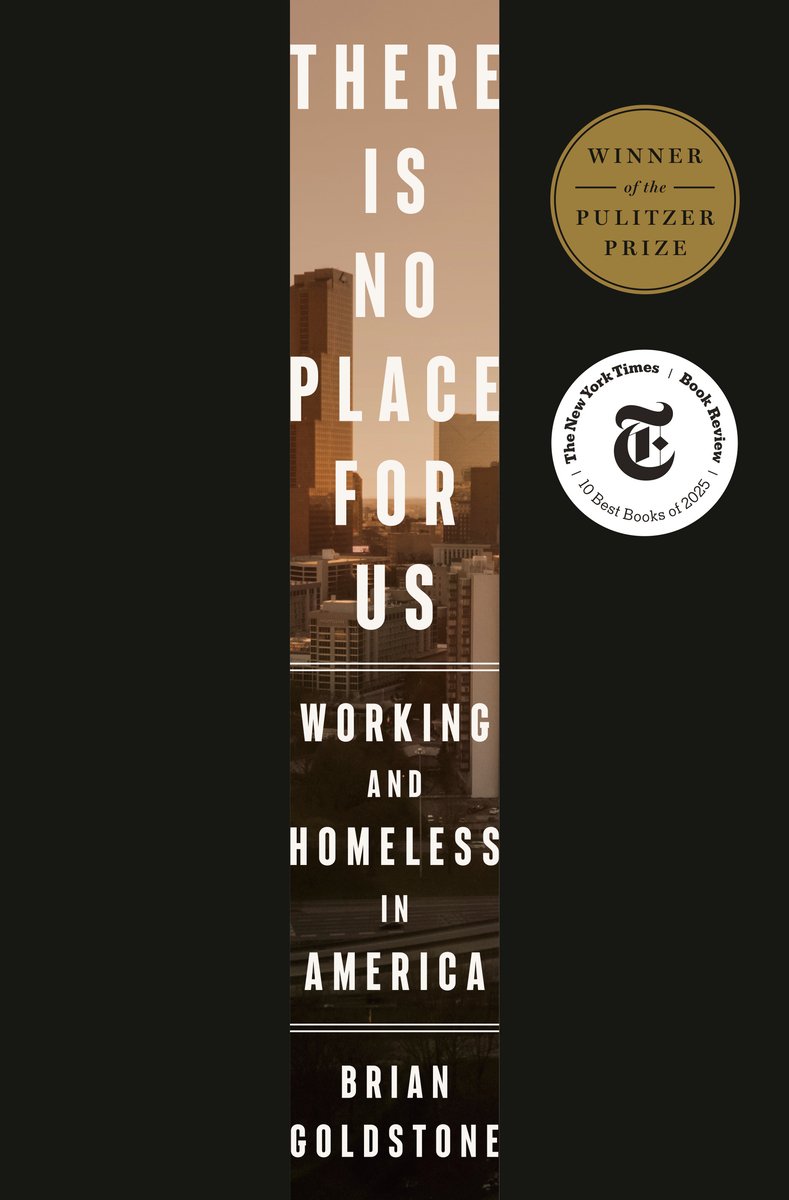
Working And Homeless In America
Working And Homeless In America
In this gripping and deeply reported book, Brian Goldstone plunges readers into the lives of five Atlanta families struggling to remain housed in a gentrifying, increasingly unequal city. Maurice and Natalia make a fresh start in the country's "Black Mecca" after being priced out of DC. Kara dreams of starting her own cleaning business while mopping floors at a public hospital. Britt scores a coveted housing voucher. Michelle is in school to become a social worker. Celeste toils at her warehouse job while undergoing treatment for ovarian cancer. Each of them aspires to provide a decent life for their children—and each of them, one by one, joins the ranks of the nation's working homeless.
Through intimate, novelistic portraits, Goldstone reveals the human cost of this crisis, following parents and their kids as they go to sleep in cars, or in squalid extended-stay hotel rooms, and head out to their jobs and schools the next morning. These are the nation's hidden homeless—omitted from official statistics, and proof that overflowing shelters and street encampments are only the most visible manifestation of a far more pervasive problem.

When faith becomes a weapon, humanity bleeds. This book is a call to stop the wounding.
What happens when sacred words are twisted into slogans, pulpits become podiums, and compassion gets lost beneath the noise of power?
In Separation of Church and Hate: Reclaiming Truth, Compassion and Integrity in a World of Faith-Factions, the author takes readers on a fearless journey through the tangled intersection of religion, politics, and humanity.
With wit, empathy, and moral courage, this groundbreaking book explores:
- How political power hijacked the language of faith
- The psychology of "us versus them" religion - and why good people stay silent
- The machinery behind modern Christian nationalism and profit-driven belief
- How scripture has been misused to justify exclusion, fear, and control
- Most importantly - how to reclaim love, mercy, and service as the true marks of belief
Blending sharp cultural commentary with hopeful reconstruction, this book dismantles hypocrisy while rebuilding a vision of faith rooted in compassion.
It's not anti-religion - it's anti-abuse of religion.
For readers of John Fugelsang, Rachel Held Evans, and Brian McLaren, this is a manifesto for anyone who still believes love should have the last word.
Whether you are a believer, skeptic, or seeker, this is your invitation to a new covenant - one where faith and humanity finally stand on the same side.
Because the world doesn't need louder believers.
It needs kinder ones.
Dreams And Nightmares In Sam Altman's Openai
Dreams And Nightmares In Sam Altman's Openai
“A bestselling page-turner that has made waves not just in Silicon Valley but around the world . . . With Empire of AI, Hao is fundamentally shaping many people’s perceptions and understanding of the company at the center of the AI revolution.” —TIME Magazine, “TIME100 AI 2025”
“Excellent and deeply reported.” —Tim Wu, The New York Times
“Startling and intensely researched . . . an essential account of how OpenAI and ChatGPT came to be and the catastrophic places they will likely take us.” —Vulture
“Hao’s reporting inside OpenAI is exceptional, and she’s persuasive in her argument that the public should focus less on A.I.’s putative ‘sentience’ and more on its implications for labor and the environment.” —Benjamin Wallace-Wells, New Yorker
From a brilliant longtime AI insider with intimate access to the world of Sam Altman's OpenAI from the beginning, an eye-opening account of arguably the most fateful tech arms race in history, reshaping the planet in real time, from the cockpit of the company that is driving the frenzy
When AI expert and investigative journalist Karen Hao first began covering OpenAI in 2019, she thought they were the good guys. Founded as a nonprofit with safety enshrined as its core mission, the organization was meant, its leader Sam Altman told us, to act as a check against more purely mercantile, and potentially dangerous, forces. What could go wrong?
Over time, Hao began to wrestle ever more deeply with that question. Increasingly, she realized that the core truth of this massively disruptive sector is that its vision of success requires an almost unprecedented amount of resources: the “compute” power of high-end chips and the processing capacity to create massive large language models, the sheer volume of data that needs to be amassed at scale, the humans “cleaning up” that data for sweatshop wages throughout the Global South, and a truly alarming spike in the usage of energy and water underlying it all. The truth is that we have entered a new and ominous age of empire: only a small handful of globally scaled companies can even enter the field of play. At the head of the pack with its ChatGPT breakthrough, how would OpenAI resist such temptations?
Spoiler alert: it didn’t. Armed with Microsoft’s billions, OpenAI is setting a breakneck pace, chased by a small group of the most valuable companies in human history—toward what end, not even they can define. All this time, Hao has maintained her deep sourcing within the company and the industry, and so she was in intimate contact with the story that shocked the entire tech industry—Altman’s sudden firing and triumphant return. The behind-the-scenes story of what happened, told here in full for the first time, is revelatory of who the people controlling this technology really are. But this isn’t just the story of a single company, however fascinating it is. The g forces pressing down on the people of OpenAI are deforming the judgment of everyone else too—as such forces do. Naked power finds the ideology to cloak itself; no one thinks they’re the bad guy. But in the meantime, as Hao shows through intrepid reporting on the ground around the world, the enormous wheels of extraction grind on. By drawing on the viewpoints of Silicon Valley engineers, Kenyan data laborers, and Chilean water activists, Hao presents the fullest picture of AI and its impact we’ve seen to date, alongside a trenchant analysis of where things are headed. An astonishing eyewitness view from both up in the command capsule of the new economy and down where the real suffering happens, Empire of AI pierces the veil of the industry defining our era.
On October 25th, 2023, after just three weeks of the bombardment of Gaza, Omar El Akkad put out a tweet: “One day, when it's safe, when there's no personal downside to calling a thing what it is, when it's too late to hold anyone accountable, everyone will have always been against this.” This tweet was viewed more than ten million times.
One Day Everyone Will Have Always Been Against This chronicles the deep fracture that has occurred for Black, brown, Indigenous Americans, as well as the upcoming generation, many of whom had clung to a thread of faith in Western ideals, in the idea that their countries, or the countries of their adoption, actually attempted to live up to the values they espouse.
This book is a reckoning with what it means to live in the West, and what it means to live in a world run by a small group of countries—America, the UK, France, and Germany. It will be The Fire Next Time for a generation that understands we're undergoing a shift in the so-called “rules-based order,” a generation that understands the West can no longer be trusted to police and guide the world, or its own cities and campuses. It draws on intimate details of Omar's own story as an emigrant who grew up believing in the Western project, who was catapulted into journalism by the rupture of 9/11.
This book is El Akkad's heartsick breakup letter with the West. It is a breakup we are watching all over the United States, on college campuses, on city streets, and the consequences of this rupture will be felt by all of us. His book is for all the people who want something better than what the West has served up. This is the book for our time.

"[An] astonishing story…Powerful…Harrowing…Absorbing and lucid…You would have to harden your heart to be unmoved by the Abuelas' quest." —Jennifer Szalai, The New York Times Book Review (front-cover review)
"Inspiring…A triumphant saga of ordinary people doing extraordinary things in the face of pure malevolence." —Hampton Sides
"Enthralling…Written with the nail-biting verve of a thriller." —Publishers Weekly (starred review)
"Extraordinary...A harrowing and timely reminder of what happens when democracy succumbs to despotism." —Adam Higginbotham
"[A] cinematically detailed, deeply researched narrative." —The Washington Post
"Piercing, emotional...Will resonate for generations." —Kirkus Reviews (starred review)
A remarkable new talent in narrative nonfiction delivers the epic true story of a group of courageous grandmothers who fought to find their grandchildren who were stolen.
In the early hours of March 24, 1976, the streets of Buenos Aires rumble with tanks as soldiers seize the presidential palace and topple Argentina's leader. The country is now under the control of a military junta, with army chief Jorge Rafael Videla at the helm. With quiet support from the United States and tacit approval from much of Argentina's people, who are tired of constant bombings and gunfights, the junta swiftly launches the National Reorganization Process or El Proceso—a bland name masking their ruthless campaign to crush the political left and instill the country with "Western, Christian" values. The junta holds power until 1983 and decimates a generation.
One of the military's most diabolical acts is kidnapping hundreds of pregnant women. After giving birth in captivity, the women are "disappeared," and their babies secretly given to other families—many of them headed by police or military officers. For mothers of pregnant daughters and daughters-in-law, the source of their grief is twofold—the disappearances of their children, and the theft of their grandchildren.
A group of fierce grandmothers forms the Abuelas de Plaza de Mayo, dedicated to finding the stolen infants and seeking justice from a nation that betrayed them. At a time when speaking out could mean death, the Abuelas confront military officers and launch protests to reach international diplomats and journalists. They become detectives, adopting disguises to observe suspected grandchildren, and even work alongside a renowned American scientist to pioneer groundbreaking genetic tests.
A Flower Traveled in My Blood is the rarest of nonfiction that reads like a novel and puts your heart in your throat. It is the product of years of extensive archival research and meticulous, original reporting. It marks the arrival of a blazing new talent in narrative journalism. In these pages, a regime tries to terrorize a country, but love prevails. The grandmothers' stunning stories reveal new truths about memory, identity, and family.

Two Centuries Of Race, Resistance, And Forgiveness In One Charleston Church
Two Centuries Of Race, Resistance, And Forgiveness In One Charleston Church
"A masterpiece . . . a dense, rich, captivating narrative, featuring vivid prose . . . expansive, inspiring and hugely important."—The New York Times (Editors' Choice)
"Race, religion, and terror combine for an extraordinary story of America."—Eddie S. Glaude, Jr., bestselling author of Begin Again
A BEST BOOK OF THE YEAR: The New York Times Book Review, NPR, Kirkus Reviews
Few people beyond South Carolina's Lowcountry knew of Emanuel African Methodist Episcopal Church in Charleston—Mother Emanuel—before the night of June 17, 2015, when a twenty-one-year-old white supremacist walked into Bible study and slaughtered the church's charismatic pastor and eight other worshippers. Although the shooter had targeted Mother Emanuel—the first A.M.E. church in the South—to agitate racial strife, he did not anticipate the aftermath: an outpouring of forgiveness from the victims' families and a reckoning with the divisions of caste that have afflicted Charleston and the South since the earliest days of European settlement.
Mother Emanuel explores the fascinating history that brought the church to that moment and the depth of the desecration committed in its fellowship hall. It reveals how African Methodism was cultivated from the harshest American soil, and how Black suffering shaped forgiveness into both a religious practice and a survival tool. Kevin Sack, who has written about race in his native South for more than four decades, uses the church to trace the long arc of Black life in the city where nearly half of enslaved Africans disembarked in North America and where the Civil War began.
Through the microcosm of one congregation, he explores the development of a unique practice of Christianity, from its daring breakaway from white churches in 1817, through the traumas of Civil War and Reconstruction, to its critical role in the Civil Rights Movement and beyond. At its core, Mother Emanuel is an epic tale of perseverance, not just of a congregation but of a people who withstood enslavement, Jim Crow, and all manner of violence with an unbending faith.
A YALSA EXCELLENCE IN NONFICTION WINNER • A SCBWI GOLDEN KITE AWARD FINALIST • ONE OF THE BEST BOOKS OF THE YEAR: Publishers Weekly, BookPage, Horn Book, Booklist, The Bulletin of The Center for Children's Books, School Library Journal
Using riveting first-person accounts, award-winning author Candace Fleming reveals the makings of a monster: from Jones's humble origins as a child of the Depression… to his founding of a group whose idealistic promises of equality and justice attracted thousands of followers… to his relocation of Temple headquarters from California to an unsettled territory in Guyana, South America, which he dubbed "Jonestown"… to his transformation of Peoples Temple into a nefarious experiment in mind-control.
And Fleming heart-stoppingly depicts Jones's final act, persuading his followers to swallow fatal doses of cyanide—to "drink the kool-aid," as it became known—as a test of their ultimate devotion.
Here is a sweeping story that traces, step by step, the ways in which one man slowly indoctrinated, then murdered, 900 innocent, well-meaning people. And how a few members, Jones' own son included, stood up to him... but not before it was too late.
The History And Persistence Of Our Deadliest Infection
The History And Persistence Of Our Deadliest Infection
John Green, award-winning author and passionate advocate for global healthcare reform, tells a deeply human story illuminating the fight against the world’s deadliest infectious disease.
“The real magic of Green’s writing is the deeply considerate, human touch that goes into every word.” –The Associated Press
“Told with the intelligence, wit, and tragedy that have become hallmarks of the author’s work.... This is the story of us.” –Slate
“Earnest and empathetic.” –The New York Times
Tuberculosis has been entwined with humanity for millennia. Once romanticized as a malady of poets, today tuberculosis is seen as a disease of poverty that walks the trails of injustice and inequity we blazed for it.
In 2019, author John Green met Henry Reider, a young tuberculosis patient at Lakka Government Hospital in Sierra Leone. John became fast friends with Henry, a boy with spindly legs and a big, goofy smile. In the years since that first visit to Lakka, Green has become a vocal advocate for increased access to treatment and wider awareness of the healthcare inequities that allow this curable, preventable infectious disease to also be the deadliest, killing over a million people every year.
In Everything Is Tuberculosis, John tells Henry’s story, woven through with the scientific and social histories of how tuberculosis has shaped our world—and how our choices will shape the future of tuberculosis.

For the first time, director Rob Reiner and cocreators Christopher Guest, Michael McKean, and Harry Shearer provide the full behind-the-scenes story of the making of the groundbreaking mockumentary This Is Spinal Tap and its upcoming sequel.
Since its original release in 1984, This Is Spinal Tap has evolved from a beloved cult film into a cinematic landmark: an all-time comedy classic that pioneered an entire genre, the mockumentary. Now, director Rob Reiner and his cowriters and costars, Christopher Guest, Michael McKean, and Harry Shearer, tell the complete story of the movie and its fictitious band—how they met, how Spinal Tap came to be, and how their low-budget indie film took on a life of its own.
Years after the movie first came out, the Library of Congress selected This Is Spinal Tap for inclusion in the National Film Registry and Tap went on to play The Royal Albert Hall, Wembley Stadium, and to over 100,000 fans at the Glastonbury Festival in England.
Reiner, Guest, McKean, and Shearer provide the backstories to the movie's famous lines—among them "Hello, Cleveland!," "None more black," "You can't dust for vomit," and "These go to eleven"—and to such Tap anthems as "Big Bottom" and "Stonehenge." Featuring never-before-seen photographs, band memorabilia, and personal reminiscences of their enduring creative partnership, A Fine Line Between Stupid and Clever will delight Tap-heads of all ages—just as the long-awaited Spinal Tap sequel is hitting theaters.
A Fine Line Between Stupid and Clever also comes with a bonus memoir by Reiner's directorial alter ego, Marty DiBergi, in which he interviews Tap band members Nigel Tufnel, David St. Hubbins, and Derek Smalls about their musical journey and their drummers who paid the ultimate sacrifice to the rock gods.
Stow away with Rick Steves for a glimpse into the unforgettable moments, misadventures, and memories of his 1978 journey on the legendary Hippie Trail. In the 1970s, the ultimate trip for any backpacker was the storied "Hippie Trail" from Istanbul to Kathmandu. A 23-year-old Rick Steves made the trek, and like a travel writer in training, he documented everything along the way: jumping off a moving train, making friends in Tehran, getting lost in Lahore, getting high for the first time in Herat, battling leeches in Pokhara, and much more. The experience ignited his love of travel and forever broadened his perspective on the world.
This book contains edited selections from Rick's journal and travel photos with a 45-years-later preface and postscript reflecting on how the journey through Turkey, Iran, Afghanistan, Pakistan, India, and Nepal changed his life.
You know Rick Steves. Now discover the adventure of a lifetime that made him the travel writer he is today.
NAMED ONE OF THE 10 BEST BOOKS OF 2025 BY THE WASHINGTON POST
NAMED ONE OF THE 100 NOTABLE BOOKS OF 2025 BY THE NEW YORK TIMES
A GUARDIAN BEST BOOK OF 2025
NAMED ONE OF THE BEST BOOKS OF FALL 2025 BY ELLE
ONE OF CHICAGO PUBLIC LIBRARY'S MUST-READ BOOKS OF 2025
Acclaimed journalist Julia Ioffe tells the story of modern Russia through the history of its women, from revolution to utopia to autocracy.
In 1990, seven-year-old Julia Ioffe and her family fled the Soviet Union. Nearly twenty years later, Ioffe returned to Moscow—only to discover just how much Russian society had changed while she had been living in America. The Soviet women she had known growing up—doctors, engineers, scientists—seemed to have been replaced by women desperate to marry rich and become stay-at-home moms. How had Russia gone from portraying itself as the vanguard of world feminism to becoming a bastion of conservative Christian values?
In Motherland, Ioffe turns modern Russian history on its head, telling it exclusively through the stories of its women. From her own physician great-grandmothers to Lenin's lover, a feminist revolutionary; from the hundreds of thousands of Soviet girls who fought in World War II to the millions of single mothers who rebuilt and repopulated a devastated country; from the members of Pussy Riot to Yulia Navalnaya, the wife of opposition leader Alexey Navalny, Ioffe chronicles one of the most audacious social experiments in history and documents how it failed the very women it was meant to liberate—and how that failure paved the way for the revanche of Vladimir Putin.
Part memoir, part journalistic exploration, part history, Motherland paints a portrait of modern Russia through the women who shaped it. With deep emotion, Ioffe reveals what it means to live through the cataclysms of revolution, war, idealism, and heartbreak—and how the story of Russia today is inextricably tied to the sacrifices of its women.
This meticulously researched history interweaves the personal and the political to explore:
The Russian Revolution: Discover the forgotten women who started the revolution, from textile workers on strike to feminist revolutionaries like Alexandra Kollontai.
A Grand Social Experiment: Trace the audacious Soviet attempt to emancipate women—and document how its failure paved the way for Vladimir Putin.
World War II Through Women's Eyes: Meet the hundreds of thousands of Soviet girls who served as snipers, medics, and fighter pilots in all-female squadrons during the war.
Four Generations of a Family: Follow the author's own remarkable family history, from her great-grandmothers—pioneering female physicians—to her own journey from Soviet refugee to acclaimed journalist.
Modern Russia's Matriarchs: From the members of Pussy Riot to Yulia Navalnaya, understand the present through the women shaping Russia's turbulent political landscape today.

Finalist for the National Book Award for Nonfiction
Winner of the Andrew Carnegie Medal for Excellence in Nonfiction
Finalist for the PEN/Jean Stein Book Award
Long-listed for the National Book Critics Circle Award for Autobiography
One of the New York Times Notable Books of the Year
Yiyun Li’s remarkable, defiant work of radical acceptance as she considers the loss of her son James.
“There is no good way to say this,” Yiyun Li writes at the beginning of this book.
“There is no good way to state these facts, which must be acknowledged . . . My husband and I had two children and lost them both: Vincent in 2017, at sixteen, James in 2024, at nineteen. Both chose suicide, and both died not far from home.”
There is no good way to say this—because words fall short. It takes only an instant for death to become fact, “a single point in a time line.” Living now on this single point, Li turns to thinking and reasoning and searching for words that might hold a place for James. Li does what she can: doing “things that work,” including not just writing but gardening, reading Camus and Wittgenstein, learning the piano, and living thinkingly alongside death.
This is a book for James, but it is not a book about grieving or mourning. As Li writes, “The verb that does not die is ‘to be.’ Vincent was and is and will always be Vincent. James was and is and will always be James. We were and are and will always be their parents. There is no now and then, now and later; only now and now and now and now.” Things in Nature Merely Grow is a testament to Li’s indomitable spirit.
"An immersive, devastating look at foster children's lives." (Seattle Times)
A compelling exploration of the broken American foster care system, told through the stories of six former foster youth. This powerful narrative nonfiction book delves into the systemic failures that lead many foster children into the criminal justice system, highlighting the urgent need for reform. This book is a must-read for anyone interested in child welfare, social justice, and the transformative power of the best narrative nonfiction.
In Wards of the State, award-winning journalist Claudia Rowe's storytelling is both vivid and unflinching, offering readers a deep understanding of the foster care-to-prison pipeline. Through interviews with psychologists, advocates, judges, and the former foster children themselves, Rowe paints a heartbreaking picture of the lives shaped by this broken system.
By the time Maryanne was 16 years old, she had been arrested for murder. In and out of foster and adoptive homes since age 10, she'd run away, been trafficked and assaulted, and finally pointed a gun at a man and pulled the trigger. She fled, but it didn't take long for the police to catch up with her. In court, the defense blamed neither traffickers, nor Maryanne, but Washington state itself—or rather, its foster care system, which parents thousands of children every year. The courts didn't listen to that argument, but award-winning journalist Claudia Rowe did.
Washington state isn't alone. Each year, hundreds of thousands of children grow up in America's $30 billion foster care system, only to leave and enter its prisons, where a quarter of all inmates are former foster youth. Weaving Maryanne's story with those of five other foster kids across the country—including an 18-year-old sleeping on the New York City subways; a dropout turned graduate student; and a foster child who is now a policy advisor to the White House—Rowe paints a visceral survival narrative showing exactly where, when, and how the system channels children into locked cells.
Rowe brings her extensive experience and investigative prowess to this eye-opening work. With a career spanning over 25 years, Rowe has written for publications such as The New York Times and Mother Jones, and her reporting has influenced policy changes in Washington State. Her previous book, The Spider and the Fly, was a gripping true-crime memoir that showcased her ability to blend personal narrative with broader social issues.
Fighting Fire In A Transformed World
Fighting Fire In A Transformed World
“Exceptional. . . . When It All Burns is one of those books that immerses the reader in the nuances of a world most of us know only through the lens of tragedy and destruction. Thomas’ visceral, crystalline prose only adds fuel to the fire.” —Los Angeles Times
A hotshot firefighter’s gripping firsthand account of a record-setting fire season
Eighteen of California’s largest wildfires on record have burned in the past two decades. Scientists recently invented the term “megafire” to describe wildfires that behave in ways that would have been nearly impossible just a generation ago, burning through winter, exploding in the night, and devastating landscapes historically impervious to incendiary destruction.
In When It All Burns, wildland firefighter and anthropologist Jordan Thomas recounts a single, brutal six-month fire season with the Los Padres Hotshots—the special forces of America’s firefighters. Being a hotshot is among the most difficult jobs on earth. Thomas viscerally renders his crew’s attempts to battle flames that are often too destructive to contain. He uncovers the hidden cultural history of megafires, revealing how humanity’s symbiotic relationship with wildfire became a war—and what can be done to change it back.
Thomas weaves ecology and the history of Indigenous peoples' oppression, federal forestry, and the growth of the fire industrial complex into a riveting narrative about a new phase in the climate crisis. It's an immersive story of community in the most perilous of circumstances, told with humor, humility, and affection.

The Schuyler Sisters In An Age Of Revolution
The Schuyler Sisters In An Age Of Revolution
A NEW YORK TIMES BOOK REVIEW EDITORS’ CHOICE
FINALIST FOR THE NATIONAL BOOK CRITICS CIRCLE AWARD IN BIOGRAPHY
FINALIST FOR THE LOS ANGELES TIMES BOOK PRIZE IN BIOGRAPHY
“Marvelous . . . An act not only of recovery, but of world building.” —The Atlantic
“A thoroughly fascinating biography, filled with Vaill’s signature warmth, humor and insight.” —The New York Times Book Review
“Elegantly written, intimately detailed and infused with feeling, a gripping account of these two remarkable women, their elite family and their tumultuous era.” —The Wall Street Journal
“One of our great biographers takes the sisters out of Hamilton’s supporting cast and puts them front and center.” —Town & Country
America’s founding era reconsidered through the lives of two women as formidable as, and in some respects stronger than, the men they loved, married, and mothered.
If it hadn’t been for the Revolutionary War, things might have been very different for the two women Alexander Hamilton came to describe as his “dear brunettes.” Angelica and Elizabeth Schuyler, daughters of colonial Hudson Valley aristocracy, would have followed their family’s expectations, making dynastic marriages and supervising substantial households—but they didn’t. Instead, they became embroiled in the turmoil of America’s insurrection against Great Britain, and rebelled themselves, in ways as different as each sister was from the other, against the destiny mapped out for them.
Glamorous Angelica, who sought fulfillment in attachments to powerful men, eloped with a war profiteer and led a luxurious life, charming Benjamin Franklin, Thomas Jefferson, and the Prince of Wales. Eliza, too candid for flirtation and uninterested in influence or intrigue, married a penniless outsider, Alexander Hamilton, and devoted herself to his career; but after his appointment as America’s first treasury secretary, she was challenged by the public and private controversies that plagued him—not least of all the attraction that grew between him and her adored sister.
When tragedy followed, everything changed for both women: one was deprived of her animating spirit, while the other gained a new, self-determined life.
Drawing on deep archival research, Amanda Vaill interweaves this family drama with its historical context, creating a narrative with the sweep and intimacy of a nineteenth-century novel. Full of battles and dinner parties, murky politics and transparent frocks, fierce loyalties and betrayals both public and personal, Pride and Pleasure brings two extraordinary American heroines to life.
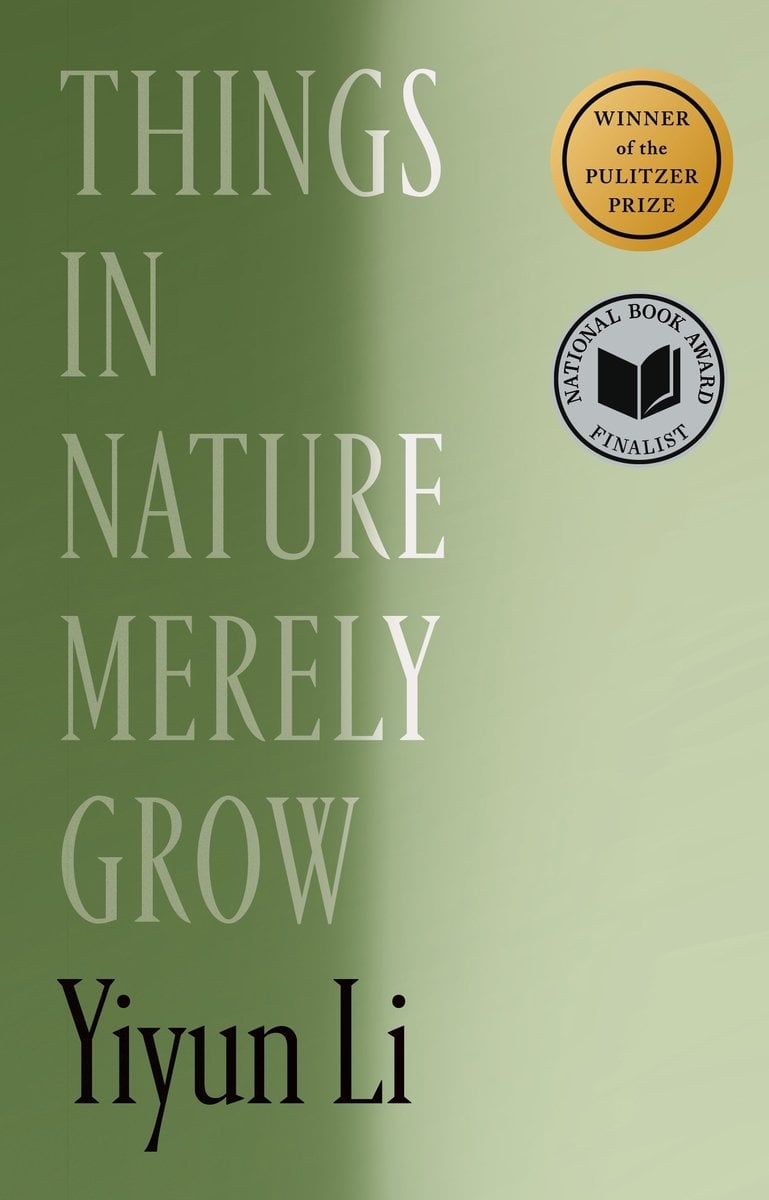
Finalist for the National Book Award for Nonfiction
Winner of the Andrew Carnegie Medal for Excellence in Nonfiction
Finalist for the PEN/Jean Stein Book Award
Long-listed for the National Book Critics Circle Award for Autobiography
One of the New York Times Notable Books of the Year
Yiyun Li’s remarkable, defiant work of radical acceptance as she considers the loss of her son James.
“There is no good way to say this,” Yiyun Li writes at the beginning of this book.
“There is no good way to state these facts, which must be acknowledged . . . My husband and I had two children and lost them both: Vincent in 2017, at sixteen, James in 2024, at nineteen. Both chose suicide, and both died not far from home.”
There is no good way to say this—because words fall short. It takes only an instant for death to become fact, “a single point in a time line.” Living now on this single point, Li turns to thinking and reasoning and searching for words that might hold a place for James. Li does what she can: doing “things that work,” including not just writing but gardening, reading Camus and Wittgenstein, learning the piano, and living thinkingly alongside death.
This is a book for James, but it is not a book about grieving or mourning. As Li writes, “The verb that does not die is ‘to be.’ Vincent was and is and will always be Vincent. James was and is and will always be James. We were and are and will always be their parents. There is no now and then, now and later; only now and now and now and now.” Things in Nature Merely Grow is a testament to Li’s indomitable spirit.
(Autobiography/memoir)
"A beautiful and brave story of strong women, fierce mothering, and the power of continued evolution."—Michelle Obama
"A fascinating memoir of Tina Knowles's journey to become the global figure she is today."—Oprah Winfrey
"Told in rich color with flourishes so detailed . . . they conjure a fully realized world the reader can inhabit."—The Washington Post
Here is a page-turning chronicle of family love and heartbreak, loss and perseverance, and the kind of creativity, audacity, and will it takes for a girl from Galveston to change the world.
Matriarch is one brilliant woman's intimate and revealing story, and a multigenerational family saga that carries within it the story of America—and the wisdom that women pass on to each other, mothers to daughters, across generations.
A Love Story
(History/biography)
A Love Story
A TIME TOP 10 BOOK OF 2025
AN ATLANTIC TOP 10 BOOK OF 2025
A NEW YORK TIMES NOTABLE BOOK OF 2025
AN INSTANT NEW YORK TIMES BESTSELLER
AN AMAZON BEST BOOK OF THE YEAR
FINALIST FOR THE NBCC JOHN LEONARD PRIZE
Drawing on new archival material, original research, and interviews, this spellbinding book is the first major biography of James Baldwin in three decades, revealing how profoundly his personal relationships shaped his life and work.
Baldwin: A Love Story, the first major biography of James Baldwin in three decades, reveals how profoundly the writer’s personal relationships shaped his life and work. Drawing on newly uncovered archival material and original research and interviews, this spellbinding book tells the overlapping stories of Baldwin’s most sustaining intimate and artistic relationships: with his mentor, the Black American painter Beauford Delaney; with his lover and muse, the Swiss painter Lucien Happersberger; and with his collaborators, the famed Turkish actor Engin Cezzar and the iconoclastic French artist Yoran Cazac, whose long-overlooked significance as Baldwin’s last great love is explored in these pages for the first time.
Nicholas Boggs shows how Baldwin drew on all the complex forces within these relationships—geographical, cultural, political, artistic, and erotic—and alchemized them into novels, essays, and plays that speak truth to power and had an indelible impact on the civil rights movement and on Black and queer literary history. Richly immersive, Baldwin: A Love Story follows the writer’s creative journey between Harlem, Paris, Switzerland, the southern United States, Istanbul, Africa, the South of France, and beyond. In so doing, it magnifies our understanding of the public and private lives of one of the major literary figures of the twentieth century, whose contributions only continue to grow in influence.
One of the best-reviewed books of the year, a raw and deeply moving memoir that "pulses with compassion and moral outrage" (The Wall Street Journal) from the legendary author of The God of Small Things and The Ministry of Utmost Happiness.
In this, her first work of memoir, Arundhati Roy traces her complex relationship with her mother, Mary Roy, a fierce and formidable force who shaped Arundhati's life both as a woman and a writer. Mother Mary Comes to Me is an intimate chronicle, "full of precise imagery and blistering emotional intelligence" (The Washington Post), of the relationship between two women, a school teacher and a writer, who happen to be mother and daughter.
Roy writes with a novelist's unsettling ability to be inside her own story as well as outside it, simultaneously child and adult, attached and detached, protagonist and narrator. She describes how she came to be the writer she is, shaped by circumstance, but above all by her relationship to her extraordinary, singular mother Mary, who she describes as "my shelter and my storm."
"Heart-smashed" by Mary's death, yet puzzled and "more than a little ashamed" by the intensity of her response, Roy began to write, to make sense of her feelings about the mother she ran from at age eighteen, "not because I didn't love her, but in order to be able to continue to love her." Roy writes, "Perhaps even more than a daughter mourning the passing of her mother, I mourn her as a writer who has lost her most enthralling subject."
With the scale, sweep, and depth of her novels and the passion, political clarity, and warmth of her essays, Mother Mary Comes to Me "builds worlds that are revolutionary, made from the darkness that she spins into purpose" (The New Republic). An ode to freedom, a tribute to thorny love and savage grace—Mother Mary Comes to Me is a memoir like no other.
The rise, fall, and redemption of the doctor behind America's first public school for mentally disabled people
From the moment he became superintendent of the nation's oldest public school for intellectually and developmentally disabled children in 1887 until his death in 1924, Dr. Walter E. Fernald led a wholesale transformation of our understanding of disabilities in ways that continue to influence our views today.
How did the man who designed the first special education class in America, shaped the laws of entire nations, and developed innovative medical treatments for the disabled slip from idealism into the throes of eugenics before emerging as an opponent of mass institutionalization? Based on a decade of research, A Perfect Turmoil is the story of a doctor, educator, and policymaker who was unafraid to reverse course when convinced by the evidence, even if it meant going up against some of the most powerful forces of his time.
In this landmark work, Alex Green has drawn upon extensive, unexamined archives to unearth the hidden story of one of America's largely forgotten, but most complex, conflicted, and significant figures.

—Kirkus Starred Review, April 2025
"McWilliams does a remarkable job connecting Stanford’s poetry with his personal life, particularly his lifelong friendship with Irv Broughton, owner of a small press and Stanford’s first publisher; his penchant for love triangles; and how his need for connection fueled his poetry. The end of Stanford’s life, which saw him cohabiting with two women in different towns and running an independent press before his death by suicide at age 29, is rendered here in spellbinding detail. It’s a page-turner."
—Publishers Weekly Starred Review, July 2025
When twenty-nine-year-old Frank Stanford put three bullets in his chest on June 3, 1978, he ended a life that had been inextricably linked with poetry since childhood. Deeply influential but largely unknown outside his corner of the poetry world, this prodigy of the American South inspired a cult following that has kept his reputation and work flickering on the periphery of the American literary tradition ever since.
The Life and Poetry of Frank Stanford offers for the first time a comprehensive study of Stanford’s life and work, introducing to a broad readership poetry that remains both captivating to poets and, in its celebration of everyday experience over academic erudition, accessible to those who rarely read poetry.
Stanford’s poems range from one line to his 15,283-line epic, The Battlefield Where the Moon Says I Love You. The vital thread running through all of his poetry is an ear for language that vies with Walt Whitman in its expansiveness and generosity. Stanford’s omnivorous attraction to vernacular, particularly Black and rural vernacular, centered on an admiration for the marginalized and eccentric. Blending the Southern Gothic of Faulkner and O’Connor with a racially egalitarian vision, his poetry thrives on the stories and traditions of the oppressed and forgotten.
The themes that preoccupied Stanford’s prolific output—language, sex, death, class, geography, commercialism, surrealism, film, race—also preoccupied the poet in his daily life, which was marked by heavy drinking, philandering, mental instability, emotional abuse, and, through it all, an inveterate desire for beauty. Constantly attentive to this tension, biographer James McWilliams traces the short and painfully complicated life of this hidden talent who left a lifetime’s worth of poetry that, through its grounding in the mundane, achieved a vision of the transcendent.

The Pilgrimage Of Peter Matthiessen
The Pilgrimage Of Peter Matthiessen
The first biography of Peter Matthiessen, the novelist, naturalist, and Zen roshi, whose trailblazing work championed Native American rights and helped usher in the modern environmental movement, by award-winning writer Lance Richardson.
"A stunning, formidable achievement by a brilliant biographer. Lance Richardson takes his readers on a wild ride with Peter Matthiessen." —Kai Bird, Pulitzer Prize-winning co-author of American Prometheus
"A fair-minded, grippingly paced, and tremendously readable narrative." —Pico Iyer, Air Mail
Peter Matthiessen (1927-2014), a towering figure of twentieth-century American letters, achieved so much during his lifetime, in so many different areas, that people have struggled to pin him down. While ambivalent about his WASP privilege—as a teenager he demanded that his name be removed from the New York Social Register—he attended Yale and cut his teeth in postwar Paris, co-founding The Paris Review as he worked undercover for the CIA.
But then, after a rebellious stint as a Long Island fisherman, he escaped into a series of wild expeditions: floating through the Amazon to recover a prehistorical fossil; embedding with a tribe in Netherlands New Guinea; swimming with sharks off the coast of Australia. His novels, inspired by his travels, were unclassifiable meditations about Caymanian turtle hunters and frontier outlaws in the Florida Everglades. Meanwhile, his nonfiction became legendary: nature books like Wildlife in America—"key parts of the canon of emergent environmental writing," says Bill McKibben—as well as advocacy journalism supporting Cesar Chavez, Leonard Peltier, and Native American land claims.
Underlying all Matthiessen's disparate pursuits was the same existential search—to find a cure for "deep restlessness." This search was most profoundly articulated in The Snow Leopard, his famous account of a 250-mile wildlife survey across the Himalayas. In True Nature, Lance Richardson reconstructs the full scope of a spiritual quest that ultimately led Matthiessen, even as he inflicted great pain on his family, to the highest ranks of Zen.
Drawing on rich primary sources and hundreds of interviews, Richardson depicts Matthiessen's life with page-turning immediacy, while also illuminating how the writer's uncanny gifts enabled him to sense connections between ecological decline, racism, and labor exploitation—to express, eloquently and presciently, that "in a damaged human habitat, all problems merge."
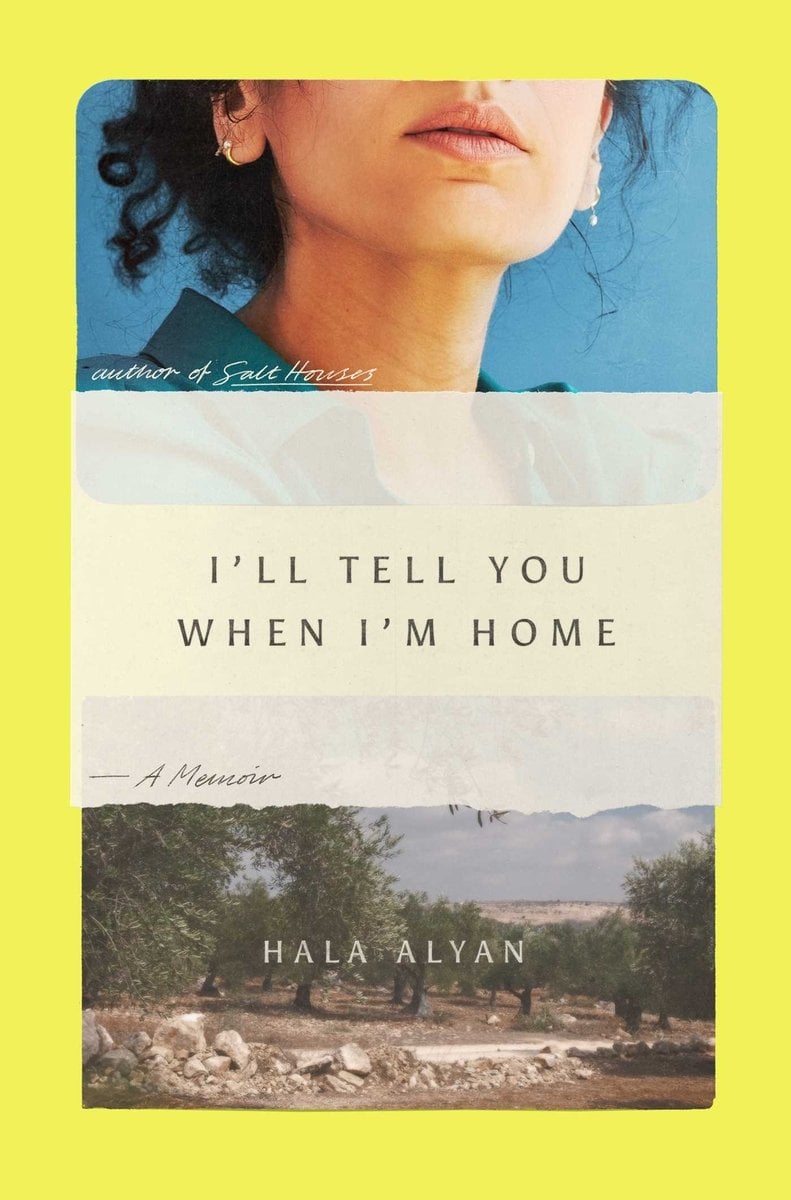
One of TIME's 100 Must-Read Books of 2025 and Electric Lit's Best Nonfiction of 2025
At first, Hala's baby is the size of a poppyseed. Then a grain of rice, then a lime. After years of trying for a baby, Hala watches from afar as her daughter grows in the body of another woman, in another country.
Hala is not just awaiting news from the surrogate. She also holds her breath as Palestine and Lebanon, her estranged homelands, are under fire. She remembers family stories of grandmothers mapping their lives through a tangle of borders; of eradicated villages, invading armies and places of refuge that proved only temporary; of men who left, women who stayed, and the legacies passed down from one to another.
Stunningly lyrical and unflinchingly honest, I'll Tell You When I'm Home is a powerful story of unravelling and becoming, of homelands lost and reimagined, and of the intimate ways we learn to make a life when the ground beneath us shifts.

"A marvel and a delight . . . This is a book that will stay with me forever."—Leslie Jamison, author of Splinters
ONE OF CHICAGO TRIBUNE'S TEN BEST BOOKS OF THE YEAR • A BEST BOOK OF THE YEAR: VULTURE, ELECTRIC LIT, SHELF AWARENESS
We've all heard the story about waking up as a cockroach—but what if a crisis turned you into a clam? After the dissolution of her marriage, a writer is transformed into a "clam" via typo after her mother keeps texting her to "clam down." The funny if unhelpful command forces her to ask what it means to "clam down"—to retreat, hide, close up, and stay silent. Idiomatically, we are said to "clam up" when we can't speak, and to "come out of our shell" when we reemerge, transformed.
In order to understand her path, the clam digs into examples of others who have embraced lives of reclusiveness and extremity. Finally, she confronts her own "clam genealogy" to interview her dad, who disappeared for a decade to write a mysterious accounting software called Shell Computing. By excavating his past to better understand his decisions, she learns not only how to forgive him but also how to move on from her own wounds of abandonment and insecurity.
Using a genre-defying structure and written in novelistic prose that draws from art, literature, and natural history, Anelise Chen unfolds a complex story of interspecies connectedness, in which humans learn lessons of adaptation and survival from their mollusk kin.
While it makes sense in certain situations to retreat behind fortified walls, the choice to do so also exacts a price. What is the price of building up walls? How can one take them back down when they are no longer necessary?

Books can seduce you. They can, Sarah Chihaya believes, annihilate, reveal, and provoke you. And anyone incurably obsessed with books understands this kind of unsettling literary encounter. Sarah calls books that have this effect "Life Ruiners". Her Life Ruiner, Toni Morrison's The Bluest Eye, became a talisman for her in high school when its electrifying treatment of race exposed Sarah's deepest feelings about being Japanese American in a predominantly white suburb of Cleveland.
But Sarah had always lived through her books, seeking escape, self-definition, and rules for living. She built her life around reading, wrote criticism, and taught literature at an Ivy League University. Then she was hospitalized for a nervous breakdown, and the world became an unreadable blank page. In the aftermath, she was faced with a question. Could we ever truly rewrite the stories that govern our lives?
Bibliophobia is an alternately searing and darkly humorous story of breakdown and survival told through books. Delving into texts such as Anne of Green Gables, Possession, A Tale for the Time Being, The Last Samurai, Chihaya interrogates her cultural identity, her relationship with depression, and the intoxicating, sometimes painful, ways books push back on those who love them.

(Autobiography/memoir)
The extraordinary life of Cher can be told by only one person . . . Cher herself. After more than seventy years of fighting to live her life on her own terms, Cher finally reveals her true story in intimate detail, in a two-part memoir.
Her remarkable career is unique and unparalleled. The only woman to top Billboard charts in seven consecutive decades, she is the winner of an Academy Award, an Emmy, a Grammy, and a Cannes Film Festival Award, and an inductee to the Rock and Roll Hall of Fame who has been lauded by the Kennedy Center. She is a lifelong activist and philanthropist.
As a dyslexic child who dreamed of becoming famous, Cher was raised in often-chaotic circumstances, surrounded by singers, actors, and a mother who inspired her in spite of their difficult relationship. With her trademark honesty and humor, Cher: The Memoir traces how this diamond in the rough succeeded with no plan and little confidence to become the trailblazing superstar the world has been unable to ignore for more than half a century.
Cher: The Memoir, Part One follows her extraordinary beginnings through childhood to meeting and marrying Sonny Bono—and reveals the highly complicated relationship that made them world-famous, but eventually drove them apart.
Cher: The Memoir reveals the daughter, the sister, the wife, the lover, the mother, and the superstar. It is a life too immense for only one book.

Pale Horse How I Went Undercover To Expose America's Nazis
(Autobiography/memoir)
Pale Horse How I Went Undercover To Expose America's Nazis
When Scott Payne was growing up, an ‘80s kid with a big attitude and a taste for sleeveless shirts, he could never have envisioned where he’d find himself on Halloween night 2019. Having transformed into “Pale Horse” and infiltrated the nation’s most dangerous, fastest-growing white supremacy group, The Base, he was huddled with a cell of neo-Nazis in the backwoods of Georgia as they slaughtered a goat and drank its blood in a ritual sacrifice.
A decorated agent dubbed the “Hillbilly Donnie Brasco,” Payne takes readers along with him on some of the most terrifying and riskiest assignments in FBI history. He went deep undercover with the lethal Outlaw Motorcycle Club in Massachusetts; to the front lines of the opioid epidemic in Tennessee; and infiltrated the Ku Klux Klan in Alabama. Through it all, he stayed married to the love of his life, raised two girls, and spent his Sundays at church, sustained by family and faith.
Timely and unputdownable, Code Name: Pale Horse is a hard look at some of the most pressing threats facing America today. Honest and inspiring, it’s the story of a hero determined to take down a hateful army—before the unthinkable could come to pass.

(Autobiography/memoir)
Reflecting on her many roles--from northern coordinator of Martin Luther King's history-making quest to mother of a rebellious teenage son--Angelou eloquently speaks to an awareness of the heart within us all.
A Memoir Of Surviving Abuse And Fighting For Justice
(Autobiography/memoir)
A Memoir Of Surviving Abuse And Fighting For Justice
“Make no mistake: this is a book about power, corruption, industrial-scale sex abuse and the way in which institutions sided with the perpetrator over his victims. . . . But it is also a book about how a young woman becomes a hero. . . . Important [and] courageous.” —The Guardian
The world knows Virginia Roberts Giuffre as Jeffrey Epstein and Ghislaine Maxwell’s most outspoken victim: the woman whose decision to speak out helped send both serial abusers to prison, whose photograph with Prince Andrew catalyzed his fall from grace. But her story has never been told in full, in her own words—until now.
In April 2025, Giuffre took her own life. She left behind a memoir written in the years preceding her death and stated unequivocally that she wanted it published. Nobody’s Girl is the riveting and powerful story of an ordinary girl who would grow up to confront extraordinary adversity.
Here, Giuffre offers an unsparing and definitive account of her time with Epstein and Maxwell, who trafficked her and others to numerous prominent men. She also details the molestation she suffered as a child, as well as her daring escape from Epstein and Maxwell’s grasp at nineteen. Giuffre remade her life from scratch and summoned the courage to not only hold her abusers to account but also advocate for other victims. The pages of Nobody’s Girl preserve her voice—and her legacy—forever.
Nobody’s Girl is an astonishing affirmation of Giuffre’s unshakable will—first, to claw her way out of victimhood, and then to shine light on wrongdoing and fight for a safer, fairer world. Equal parts intimate and fierce, it is a remarkable narrative of fortitude in the face of depravity and despair.
(History/biography)
One of Barack Obama's Summer Reading List Picks
“Comprehensive, enthralling . . . Mark Twain flows like the Mississippi River, its prose propelled by Mark Twain’s own exuberance.” —The Boston Globe
“Chernow writes with such ease and clarity . . . For all its length and detail, [Mark Twain] is deeply absorbing throughout.” — The Washington Post
Pulitzer Prize-winning biographer Ron Chernow illuminates the full, fascinating, and complex life of the writer long celebrated as the father of American literature, Mark Twain
Before he was Mark Twain, he was Samuel Langhorne Clemens. Born in 1835, the man who would become America’s first, and most influential, literary celebrity spent his childhood dreaming of piloting steamboats on the Mississippi. But when the Civil War interrupted his career on the river, the young Twain went west to the Nevada Territory and accepted a job at a local newspaper, writing dispatches that attracted attention for their brashness and humor. It wasn’t long before the former steamboat pilot from Missouri was recognized across the country for his literary brilliance, writing under a pen name that he would immortalize.
In this richly nuanced portrait of Mark Twain, acclaimed biographer Ron Chernow brings his considerable powers to bear on a man who shamelessly sought fame and fortune, and crafted his persona with meticulous care. After establishing himself as a journalist, satirist, and lecturer, he eventually settled in Hartford with his wife and three daughters, where he went on to write The Adventures of Tom Sawyer and Adventures of Huckleberry Finn. He threw himself into the hurly-burly of American culture, and emerged as the nation’s most notable political pundit. At the same time, his madcap business ventures eventually bankrupted him; to economize, Twain and his family spent nine eventful years in exile in Europe. He suffered the death of his wife and two daughters, and the last stage of his life was marked by heartache, political crusades, and eccentric behavior that sometimes obscured darker forces at play.
Drawing on Twain’s bountiful archives, including thousands of letters and hundreds of unpublished manuscripts, Chernow masterfully captures the man whose career reflected the country’s westward expansion, industrialization, and foreign wars, and who was the most important white author of his generation to grapple so fully with the legacy of slavery. Today, more than one hundred years after his death, Twain’s writing continues to be read, debated, and quoted. In this brilliant work of scholarship, a moving tribute to the writer’s talent and humanity, Chernow reveals the magnificent and often maddening life of one of the most original characters in American history.
The Rise And Fall Of An American Dynasty
(History/biography)
The Rise And Fall Of An American Dynasty
The riveting saga of the Seabrook Family, by one of The New Yorker’s most acclaimed storytellers.
“Having left this material for his writer son, my father must have wanted the story told, even if he couldn’t bear to tell it himself.” So begins the story of a forgotten American dynasty, a farming family from the bean fields of southern New Jersey who became as wealthy and powerful as aristocrats—only to implode in a storm of lies.
The patriarch, C. F. Seabrook, was hailed as the “Henry Ford of Agriculture.” His son Jack, a keen businessman, was poised to take over what Life called “the biggest vegetable factory on earth.” But the carefully cultivated facade—glamorous outings by horse-drawn carriage, hidden wine cellars, and movie star girlfriends—hid dark secrets that led to the implosion of the family business.
At the heart of the narrative is a multi-generational succession battle. It’s a tale of family secrets and Swiss bank accounts, of half-truths, of hatred and passion—and lots and lots of liquor. The Seabrooks’ colorful legal and moral failings took place amid the trappings of extraordinary privilege. But the story of where that money came from is not so pretty.
They say behind every great fortune there is a great crime. At Seabrook Farms, the troubling American histories of race, immigration, and exploitation arise like weeds from the soil. Great Migration Black laborers struck against the company for better wages in the 1930s, and Japanese Americans helped found a “global village” on the farm after World War II. Revealing both C. F. and Jack Seabrook’s corruption, The Spinach King undermines the “great man” theory of industrial progress. It also shows how American farms evolved from Jeffersonian smallholdings to gigantic agribusinesses, and what such enormous firms do to the families whose fate is bound up in the land.
A compulsively readable story of class and privilege, betrayal and revenge—three decades in the making—The Spinach King explores the author’s complicated family legacy and the dark corners of the American Dream.

A History Of The U.s. Constitution
A History Of The U.s. Constitution
New York Times • 21 New Nonfiction Books Coming This Fall
From the best-selling author of These Truths comes We the People, a stunning new history of the U.S. Constitution, for a troubling new era.
The U.S. Constitution is among the oldest constitutions in the world but also one of the most difficult to amend. Jill Lepore, Harvard professor of history and law, explains why in We the People, the most original history of the Constitution in decades—and an essential companion to her landmark history of the United States, These Truths.
Published on the occasion of the 250th anniversary of the nation’s founding—the anniversary, too, of the first state constitutions—We the People offers a wholly new history of the Constitution. “One of the Constitution’s founding purposes was to prevent change,” Lepore writes. “Another was to allow for change without violence.” Relying on the extraordinary database she has assembled at the Amendments Project, Lepore recounts centuries of attempts, mostly by ordinary Americans, to realize the promise of the Constitution. Yet nearly all those efforts have failed. Although nearly twelve thousand amendments have been introduced in Congress since 1789, and thousands more have been proposed outside its doors, only twenty-seven have ever been ratified. More troubling, the Constitution has not been meaningfully amended since 1971. Without recourse to amendment, she argues, the risk of political violence rises. So does the risk of constitutional change by presidential or judicial fiat.
Challenging both the Supreme Court’s monopoly on constitutional interpretation and the flawed theory of “originalism,” Lepore contends in this “gripping and unfamiliar story of our own past” that the philosophy of amendment is foundational to American constitutionalism. The framers never intended for the Constitution to be preserved, like a butterfly, under glass, Lepore argues, but expected that future generations would be forever tinkering with it, hoping to mend America by amending its Constitution through an orderly deliberative and democratic process.
Lepore’s remarkable history seeks, too, to rekindle a sense of constitutional possibility. Congressman Jamie Raskin writes that Lepore “has thrown us a lifeline, a way of seeing the Constitution neither as an authoritarian straitjacket nor a foolproof magic amulet but as the arena of fierce, logical, passionate, and often deadly struggle for a more perfect union.” At a time when the Constitution’s vulnerability is all too evident, and the risk of political violence all too real, We the People, with its shimmering prose and pioneering research, hints at the prospects for a better constitutional future, an amended America.

The Iranian Revolution: A Story Of Hubris, Delusion And Catastrophic Miscalculation
The Iranian Revolution: A Story Of Hubris, Delusion And Catastrophic Miscalculation
On November 16th, 1977, at a state dinner in the White House, President Jimmy Carter toasted Shah Mohammad Reza Pahlavi, King of Kings, Light of the Aryans, Shadow of God on Earth, praising his “enlightened leadership” and extolling Iran as “a stabilizing influence in that part of the world.” Iran had the world’s fifth largest army and was awash in billions of dollars in oil revenues. Construction cranes dotted the skyline of its booming capital, Tehran. The regime’s feared secret police force SAVAK had crushed communist opposition, and the Shah had bought off the conservative Muslim clergy inside the country. He seemed invulnerable, and invaluable to the United States as an ally in the Cold War. Fourteen months later the Shah fled Iran into exile, forced from the throne by a volcanic religious revolution led by a fiery cleric named Ayatollah Khomeini. How could the United States (and other Western allies), which had one of the largest CIA stations in the world and thousands of military personnel in Iran, have been so blind?
The spellbinding story Scott Anderson weaves is one of a dictator oblivious to the disdain of his subjects and a superpower blundering into disaster. The Shah emerges as a fascinating, Shakespearean character – a wannabe Richard III unaware of the depth of dissent to his rule, indecisive like Hamlet when action was called for, and at the end Lear-like as he raged against his fate. The Americans made terrible decisions at almost every juncture, from a secret pact designed by Kissinger and Nixon, to dismissing reports from the one diplomat who saw how hated the Shah was by the Iranian people (unlike almost all his colleagues, he spoke Farsi), to Jimmy Carter allowing the Shah to come to America for medical treatment, which set off the hostage crisis which forever damaged American influence in the world.
Scott Anderson tells this astonishing tale with the narrative brio, mordant wit, and keen analysis that made his bestselling Lawrence in Arabia one of the key texts in understanding the modern Middle East. Based on voluminous research and dozens of interviews, King of Kings is driven by penetrating portraits of the people involved – the Iranian-American doctor who convinced American officials Khomeini was a moderate; the American teacher who learned of Khomeini’s influence long before the cleric was even mentioned in official reports; the Shah’s court minister who kept a detailed diary of all their interactions; the Shah’s wife Farah who still mourns her lost kingdom; the hypocritical and misguided Jimmy Carter; and the implacable Khomeini who outmaneuvered his foes at every turn.
The Iranian Revolution, Anderson convincingly argues, was as world-shattering an event as the French and Russian revolutions. In the Middle East, in India, in Southeast Asia, in Europe, and the United States, the hatred of economically-marginalized, religiously-fervent masses for a wealthy secular elite has led to violence and upheaval – and Iran was the template. King of Kings is a bravura work of history, and a warning.

The Business Of Arson And The Remaking Of The American City
The Business Of Arson And The Remaking Of The American City
“[R]evelatory…Deeply researched and masterfully told.” —Brian Goldstone, New York Times Book Review
The explosive account of the arson wave that hit the Bronx and other American cities in the 1970s—and its legacy today.
“Ladies and gentlemen, the Bronx is burning!” That legendary and apocryphal phrase, allegedly uttered by announcers during the 1977 World Series as flames rose above Yankee Stadium, seemed to encapsulate an entire era in this nation’s urban history. Across that decade, a wave of arson coursed through American cities, destroying entire neighborhoods home to poor communities of color.
Yet as historian Bench Ansfield demonstrates in Born in Flames, the vast majority of the fires were not set by residents, as is commonly assumed, but by landlords looking to collect insurance payouts. Driven by perverse incentives—new government-sponsored insurance combined with tanking property values—landlords hired “torches,” mostly Black and Brown youth, to set fires in the buildings, sometimes with people still living in them. Tens of thousands of families lost their homes to these blazes, yet for much of the 1970s, tenant vandalism and welfare fraud stood as the prevailing explanations for the arson wave, effectively indemnifying landlords.
Ansfield’s book, based on a decade of research, introduces the term “brownlining” for the destructive insurance practices imposed on poor communities of color under the guise of racial redress. Ansfield shows that as the FIRE industries—finance, insurance, and real estate— eclipsed manufacturing in the 1970s, they began profoundly reshaping Black and Brown neighborhoods, seeing them as easy sources of profit. At every step, Ansfield charts the tenant-led resistance movements that sprung up in the Bronx and elsewhere, as well as the explosion of popular culture around the fires, from iconic movies like The Towering Inferno to hit songs such as “Disco Inferno.” Ultimately, they show how similarly pernicious dynamics around insurance and race are still at play in our own era, especially in regions most at risk of climate shocks.
(History/biography)
"This is great history . . . compulsively readable . . . There is no better writer of narrative history than the Pulitzer Prize–winning Atkinson."—The New York Times (Editors' Choice)
ONE OF THE WASHINGTON POST'S TEN BEST BOOKS OF THE YEAR • A BEST BOOK OF THE YEAR: The New York Times Book Review, NPR, Kirkus Reviews
The first twenty-one months of the American Revolution—which began at Lexington and ended at Princeton—was the story of a ragged group of militiamen and soldiers fighting to forge a new nation. By the winter of 1777, the exhausted Continental Army could claim only that it had barely escaped annihilation by the world's most formidable fighting force. Two years into the war, George III is as determined as ever to bring his rebellious colonies to heel. But the king's task is now far more complicated: fighting a determined enemy on the other side of the Atlantic has become ruinously expensive, and spies tell him that the French and Spanish are threatening to join forces with the Americans.
Prize-winning historian Rick Atkinson provides a riveting narrative covering the middle years of the Revolution. Stationed in Paris, Benjamin Franklin woos the French; in Pennsylvania, George Washington pleads with Congress to deliver the money, men, and materiel he needs to continue the fight. In New York, General William Howe, the commander of the greatest army the British have ever sent overseas, plans a new campaign against the Americans—even as he is no longer certain that he can win this searing, bloody war. The months and years that follow bring epic battles at Brandywine, Saratoga, Monmouth, and Charleston, a winter of misery at Valley Forge, and yet more appeals for sacrifice by every American committed to the struggle for freedom.
Timed to coincide with the 250th anniversary of the beginning of the Revolution, Atkinson's brilliant account of the lethal conflict between the Americans and the British offers not only deeply researched and spectacularly dramatic history, but also a new perspective on the demands that a democracy makes on its citizens.

A Tale Of Greed And Murder That Inspired The Abolition Of Slavery
(History/biography)
A Tale Of Greed And Murder That Inspired The Abolition Of Slavery
From the New York Times bestselling author of Cobalt Red, discover the incredible true story and page-turning account of the 18th century slave ship, often known as the Zong yet actually named the Zorg, that sparked the human rights campaign to end the slave trade. Perfect for fans of David Grann's The Wager and The Wide, Wide Sea by Hampton Sides.
'Remarkable, riveting', Adam Hochschild, historian and bestselling author of King Leopold's Ghost and Bury the Chains
In 1781, the Zorg set off from The Netherlands to West Africa and from there onto the Caribbean. The fateful voyage would alter the course of history forever.
By the time its journey ends, the Zorg would become the first undeniable argument against slavery.
When a series of unpredictable weather events and navigational errors led to the Zorg sailing off course and running low on supplies, the ship's captain threw more than a hundred slaves overboard in order to save the crew and the most valuable slaves. The ship's owners then claimed their loss on insurance, a first for slaves who had not been killed due to insurrection or died of natural causes.
The insurers refused to pay due to the higher than usual mortality rate of the slaves on board, leading to a trial which initially found in their favour, in which Chief Justice Mansfield compared the slaves to horses. Thanks to the outrage of one man present in court that day, a retrial was held. For the first time, concepts such as human rights and morality entered the discourse on slavery in a courtroom case that boiled down to a simple yet profound question- Were the Africans on board people or cargo?
In his riveting new book, bestselling author and Pulitzer Prize finalist Siddharth Kara brings history to life, showcasing how the Zorg's fateful voyage exposed the harsh reality of the slave trade.
The case catapulted the emerging anti-slavery movement to one of the most consequential moral campaigns that changed the course of history.
The Zorg is the astonishing yet little-known true story of one of the most consequential ships that ever crossed the Atlantic.

In the six ars poeticas that Spahr writes, she sings of the dark times but also of coral, the pop song's possible liberation, and the love of comrades. She writes not only of the rich history of what politics and poetry have done with each other, but what they might yet do together.
[Sample Poem]
from ARS POETICA 1: CORAL
To write poetry after Castle Bravo.
Then to write poetry after 1500 feet.
After high-quality steel frame buildings
not completely collapsed, except
all panels and roofs blown in.
After 2,000 feet.
After reinforced concrete buildings collapsed
or standing but badly damaged.
After 3,500 feet.
After church buildings completely destroyed.
After brick walls severely cracked.
After 4,400 feet.
After 5,300 feet.
After roof tiles bubbled and melted.
After 6,500 feet.
After mass distortion of large steel buildings.
To write the Cold War and doves.
The Cold War and tapeworms.
The Cold War and sails of ships.
The Cold War and the steel of bridges.
To write poetry after that.
To write in a world with few nutrients,
one that rocks back and forth.
The same beginning in both the sea and the land.
To write poetry that knows a hard, cup-shaped skeleton.
And then poetry that knows
the long, stinging tentacles capturing.
Knows the water.
The Atlantic and the Pacific.
The connections between.
The one moving into the other.
To develop poetry in the stomach
that then exits through the mouth
which is the anus.
To write poetry in the blue
that is the absence of green.
Light penetration.
Whorls of tentacles.
The slime earth too.
Hunters and farmers.
Shallow water.
Few nutrients.
High fecundity.
Rapid growth.
Multiarmed morphology and tube feet.
To write tube feet.
To write the exact place.
Seaward slope place.
Sea terrace place.
Algal ridge place.
Coral algal zone place.
Seaward reef flat place.
Islet or interisland reef crest place.
Lagoon reef flat place.
Lagoon terrace place.
Lagoon floor or basin place.
Coral knolls, pinnacle and patch reefs place.
To write poetry after.
“Kevin Young is a poet of exceptional depth and sensitivity. . . . Let yourself focus on every phrase.” —Ron Charles, The Washington Post
"Night Watch continues one of the most vital currents in contemporary poetry, transforming history and its silences into lyric through the poet’s eloquent invitation: ‘O wounded soul,/ speak.’” —The New York Times
Following on his exquisite Stones, Kevin Young’s new collection, written over the span of sixteen years, shapes stories of loss and legacy, inspired in part by other lives. After starting in the bayous of his family's Louisiana, Young journeys to further states of mind in “All Souls,” evoking “The whale / who finds the shore / & our poor prayers.” Another central sequence, “The Two-Headed Nightingale,” is spoken by Millie-Christine McCoy, the famous conjoined African American “Carolina Twins.” Born into enslavement, stolen, and then displayed by P. T. Barnum and others, the twins later toured the world as free women, their alto and soprano voices harmonizing their own way. Young’s poem explores their evolving philosophical selfhood and pluralities: “As one we sang, /we spake— / She was the body / I the soul / Without one / Perishes the whole.”
In “Darkling,” a cycle of poems inspired by Dante’s Divine Comedy, Young expands and embroiders the circles of Hell, drawing a cosmology of both loneliness and accompaniment, where “the dead don’t know / what to do / with themselves.” Young writes of grief and hope as familiar yet surprising states: “It’s like a language, / loss—,” he writes, “learnt only / by living—there—.” Evoking the history of poetry, from the darkling thrush to the darkling plain, Young is defiant and playful on the way through purgatory to a kind of paradise. When he goes, he warns, “don't dare sing Amazing Grace”—that “National / Anthem of Suffering.” Instead, he suggests, “When I Fly Away, / Don't dare hold no vigil . . . Just burn the whole / Town on down.”
This collection will stand as one of Young’s best—his voice shaping sorrow with music, wisdom, heartache, and wit.

“Patricia Smith is the greatest living poet. Every book is better than the last.” —Danez Smith, The Guardian
A collection of the finest new and selected poems from one of the most groundbreaking voices in contemporary poetry, a “masterful performer and poet of voices too little heard” (Poetry Foundation).
The Intentions of Thunder gathers, for the first time, the essential work from across Patricia Smith’s decorated career. Here, Smith’s poems, affixed with her remarkable gift of insight, present a rapturous ode to life. With careful yet vaulting movement, these poems traverse the redeeming landscape of pain, confront the frightening revelations of history, and disclose the joyous possibilities of the future. The result is a profound testament to the necessity of poetry—all the careful witness, embodied experience, and bristling pleasure that it bestows—and of Smith’s necessary voice.
Lyrical and sly, meditative and volcanic, The Intentions of Thunder stunningly explores the fullness of living. The inimitable poetry of Patricia Smith radiates in The Intentions of Thunder—reaffirming Smith’s place as one of the indispensable poets of our time.

On the heels of Sho (winner, Griffin Poetry Prize) and Optic Subwoof (Pegasus Award in Poetry Criticism), Douglas Kearney's visual poetry masterpiece, I Imagine I Been Science Fiction Always, pushes further into Kearney's long-time practices of performance typography, collaging pre-existing media sources to create singular, multiplicitous texts that defy neat categorization.
Through AfroFuturistic exploration of these techniques, Kearney presents a sustained consideration of precarious Black subjectivity, cultural production as self-defense, the transhistoric emancipatory logics of the preposition over, Anarcho-Black temporal disruption, and seriocomic meditations on the material and metaphysical nature of shadow. Engaging a rich history of visual poetics, I Imagine I Been Science Fiction Always almost predicts its endurance as a visionary work of genius.

New And Selected Poems
New And Selected Poems
“Patricia Smith is the greatest living poet. Every book is better than the last.” —Danez Smith, The Guardian
A collection of the finest new and selected poems from one of the most groundbreaking voices in contemporary poetry, a “masterful performer and poet of voices too little heard” (Poetry Foundation).
The Intentions of Thunder gathers, for the first time, the essential work from across Patricia Smith’s decorated career. Here, Smith’s poems, affixed with her remarkable gift of insight, present a rapturous ode to life. With careful yet vaulting movement, these poems traverse the redeeming landscape of pain, confront the frightening revelations of history, and disclose the joyous possibilities of the future. The result is a profound testament to the necessity of poetry—all the careful witness, embodied experience, and bristling pleasure that it bestows—and of Smith’s necessary voice.
Lyrical and sly, meditative and volcanic, The Intentions of Thunder stunningly explores the fullness of living. The inimitable poetry of Patricia Smith radiates in The Intentions of Thunder—reaffirming Smith’s place as one of the indispensable poets of our time.
In Gabrielle Calvocoressi's latest collection, The New Economy, poems are haunted by the ghosts of loved ones and childhood memories, by changing landscapes and bodies. Calvocoressi's own figure is examined—investigating the desire to protect the body one is born with and the longing to have been born in another. Cisterns sing with the musicality of a poet who understands both the power of sound and silence—those quiet spaces inviting us to consider the words we cannot hear.
"The days I don't kill myself are extraordinary" one poem says. "Why don't we have a name for it?" Lyrical and unafraid, The New Economy invites us to name our fears and sorrows, to write to who or what has left us, to create practices that can hold both the darkness and light of this (in)finite life.

Ms. Magazine’s Best Poetry of 2024 and 2025
The long-awaited sophomore poetry collection by award-winning writer Cathy Linh Che, on familial estrangement, the Vietnam War, and Francis Ford Coppola’s Apocalypse Now.
The follow-up to her acclaimed poetry debut Split, Becoming Ghost documents Cathy Linh Che’s parents’ experiences as refugees who escaped the Vietnam War and then were cast as extras in Francis Ford Coppola’s film Apocalypse Now, placing them at the margins of their own story. The poetry collection uses persona, speculation, and the golden shovel form as a means of moving Vietnamese voices from the periphery to the center. The speaker’s disownment raises questions about the challenges of using parents as poetic subjects, telling familial stories to a broader public, and the meaning of forgiveness.

Dive between the borders of ruined and radical love with this lyrical poetry collection that explores topics as expansive as divorce, the first Black Bachelorette, and the art world. Stanzas shift between reverence to irreverence as they take us on a journey through institutional and historical pains alongside sensuality and queer, Black joys.
From a generational voice that "earns a place among the pantheon of such emerging black poets as Eve L. Ewing, Nicole Sealey, and Airea D. Matthews" (Booklist, starred review), Scorched Earth is a transcendent anthology for our times.
I Do Know Some Things is a brave book, both in content and method. It is brave to write about childhood scars and the heartbreak the dead leave behind. It is brave to reconfigure one's life in the aftermath of a stroke. Richard Siken presents these subjects directly, without ornament, and with nothing to hide behind, confronting the fact that he can no longer manipulate the constructions of form, or speak lies that tell the truth. In spite of these limitations, Siken chooses to write these poems and release them into a dangerous world.
Each image, each sentence, is as direct as the American artist Jasper Johns's shooting targets. Each poem is like a small room in a house, a room where you will be punched in the throat. As he claws himself back into a self, into a body, Siken has written a book that is unsettling and autobiographical by necessity, and its seventy-seven prose poems invite the reader to risk a difficult intimacy in search of yet deeper truths.
“A thunderous gallop of a war novel, a new classic, a best-in-class example of speculative fiction.” —The New York Times Book Review
The critically acclaimed author of the “crazily enjoyable” (The New York Times) Whalefall returns with an immersive, cinematic novel about five World War I soldiers who stumble upon a fallen angel that could hold the key to ending the war.
Private Cyril Bagger has managed to survive the unspeakable horrors of the Great War through his wits and deception, swindling fellow soldiers at every opportunity. But his survival instincts are put to the ultimate test when he and four other grunts are given a deadly mission: venture into the perilous No Man’s Land to euthanize a wounded comrade.
What they find amid the ruined battlefield, however, is not a man in need of mercy but a fallen angel, seemingly struck down by artillery fire. This celestial being may hold the key to ending the brutal conflict, but only if the soldiers can suppress their individual desires and work together. As jealousy, greed, and paranoia take hold, the group is torn apart by their inner demons, threatening to turn their angelic encounter into a descent into hell.
Angel Down plunges you into the heart of World War I and weaves a polyphonic tale of survival, supernatural wonder, and moral conflict.
SHORTLISTED FOR THE 2025 BOOKER PRIZE
INSTANT NATIONAL BESTSELLER
“A tightly wound family drama that reads like a psychological thriller."—NPR
“Bold, stark, genre-bending, Audition will haunt your dreams.”—The Boston Globe
One woman, the performance of a lifetime. Or two. An exhilarating, destabilizing Möbius strip of a novel that asks whether we ever really know the people we love.
Two people meet for lunch in a Manhattan restaurant. She’s an accomplished actress in rehearsals for an upcoming premiere. He’s attractive, troubling, young—young enough to be her son. Who is he to her, and who is she to him? In this compulsively readable, brilliantly constructed novel, two competing narratives unspool, rewriting our understanding of the roles we play every day – partner, parent, creator, muse – and the truths every performance masks, especially from those who think they know us most intimately.
Taut and hypnotic, Audition is Katie Kitamura at her virtuosic best.
“Hot, heartbreaking, and thrillingly victorious.”—Miranda July, New York Times bestselling author of All Fours
NEW YORK TIMES BOOK REVIEW EDITORS’ CHOICE • A VULTURE BEST BOOK OF THE YEAR (SO FAR)
In this collection of one novel and three stories, bestselling author Torrey Peters’s keen eye for the rough edges of community and desire push the limits of trans writing.
In Stag Dance, the titular novel, a group of restless lumberjacks working in an illegal winter logging outfit plan a dance that some of them will volunteer to attend as women. When the broadest, strongest, plainest of the axmen announces his intention to dance as a woman, he finds himself caught in a strange rivalry with a pretty young jack, provoking a cascade of obsession, jealousy, and betrayal that will culminate on the big night in an astonishing vision of gender and transition.
Three startling stories surround Stag Dance: “Infect Your Friends and Loved Ones” imagines a gender apocalypse brought about by an unstable ex-girlfriend. In “The Chaser,” a secret romance between roommates at a Quaker boarding school brings out intrigue and cruelty. In the last story, “The Masker,” a party weekend on the Las Vegas strip turns dark when a young crossdresser must choose between two guides: a handsome mystery man who objectifies her in thrilling ways, or a cynical veteran trans woman offering unglamorous sisterhood.
Acidly funny and breathtaking in its scope, with the inventive audacity of George Saunders or Jennifer Egan, Stag Dance provokes, unsettles, and delights.
A History Of The U.s. Constitution
A History Of The U.s. Constitution
New York Times • 21 New Nonfiction Books Coming This Fall
From the best-selling author of These Truths comes We the People, a stunning new history of the U.S. Constitution, for a troubling new era.
The U.S. Constitution is among the oldest constitutions in the world but also one of the most difficult to amend. Jill Lepore, Harvard professor of history and law, explains why in We the People, the most original history of the Constitution in decades—and an essential companion to her landmark history of the United States, These Truths.
Published on the occasion of the 250th anniversary of the nation’s founding—the anniversary, too, of the first state constitutions—We the People offers a wholly new history of the Constitution. “One of the Constitution’s founding purposes was to prevent change,” Lepore writes. “Another was to allow for change without violence.” Relying on the extraordinary database she has assembled at the Amendments Project, Lepore recounts centuries of attempts, mostly by ordinary Americans, to realize the promise of the Constitution. Yet nearly all those efforts have failed. Although nearly twelve thousand amendments have been introduced in Congress since 1789, and thousands more have been proposed outside its doors, only twenty-seven have ever been ratified. More troubling, the Constitution has not been meaningfully amended since 1971. Without recourse to amendment, she argues, the risk of political violence rises. So does the risk of constitutional change by presidential or judicial fiat.
Challenging both the Supreme Court’s monopoly on constitutional interpretation and the flawed theory of “originalism,” Lepore contends in this “gripping and unfamiliar story of our own past” that the philosophy of amendment is foundational to American constitutionalism. The framers never intended for the Constitution to be preserved, like a butterfly, under glass, Lepore argues, but expected that future generations would be forever tinkering with it, hoping to mend America by amending its Constitution through an orderly deliberative and democratic process.
Lepore’s remarkable history seeks, too, to rekindle a sense of constitutional possibility. Congressman Jamie Raskin writes that Lepore “has thrown us a lifeline, a way of seeing the Constitution neither as an authoritarian straitjacket nor a foolproof magic amulet but as the arena of fierce, logical, passionate, and often deadly struggle for a more perfect union.” At a time when the Constitution’s vulnerability is all too evident, and the risk of political violence all too real, We the People, with its shimmering prose and pioneering research, hints at the prospects for a better constitutional future, an amended America.
The Iranian Revolution: A Story Of Hubris, Delusion And Catastrophic Miscalculation
The Iranian Revolution: A Story Of Hubris, Delusion And Catastrophic Miscalculation
On November 16th, 1977, at a state dinner in the White House, President Jimmy Carter toasted Shah Mohammad Reza Pahlavi, King of Kings, Light of the Aryans, Shadow of God on Earth, praising his “enlightened leadership” and extolling Iran as “a stabilizing influence in that part of the world.” Iran had the world’s fifth largest army and was awash in billions of dollars in oil revenues. Construction cranes dotted the skyline of its booming capital, Tehran. The regime’s feared secret police force SAVAK had crushed communist opposition, and the Shah had bought off the conservative Muslim clergy inside the country. He seemed invulnerable, and invaluable to the United States as an ally in the Cold War. Fourteen months later the Shah fled Iran into exile, forced from the throne by a volcanic religious revolution led by a fiery cleric named Ayatollah Khomeini. How could the United States (and other Western allies), which had one of the largest CIA stations in the world and thousands of military personnel in Iran, have been so blind?
The spellbinding story Scott Anderson weaves is one of a dictator oblivious to the disdain of his subjects and a superpower blundering into disaster. The Shah emerges as a fascinating, Shakespearean character – a wannabe Richard III unaware of the depth of dissent to his rule, indecisive like Hamlet when action was called for, and at the end Lear-like as he raged against his fate. The Americans made terrible decisions at almost every juncture, from a secret pact designed by Kissinger and Nixon, to dismissing reports from the one diplomat who saw how hated the Shah was by the Iranian people (unlike almost all his colleagues, he spoke Farsi), to Jimmy Carter allowing the Shah to come to America for medical treatment, which set off the hostage crisis which forever damaged American influence in the world.
Scott Anderson tells this astonishing tale with the narrative brio, mordant wit, and keen analysis that made his bestselling Lawrence in Arabia one of the key texts in understanding the modern Middle East. Based on voluminous research and dozens of interviews, King of Kings is driven by penetrating portraits of the people involved – the Iranian-American doctor who convinced American officials Khomeini was a moderate; the American teacher who learned of Khomeini’s influence long before the cleric was even mentioned in official reports; the Shah’s court minister who kept a detailed diary of all their interactions; the Shah’s wife Farah who still mourns her lost kingdom; the hypocritical and misguided Jimmy Carter; and the implacable Khomeini who outmaneuvered his foes at every turn.
The Iranian Revolution, Anderson convincingly argues, was as world-shattering an event as the French and Russian revolutions. In the Middle East, in India, in Southeast Asia, in Europe, and the United States, the hatred of economically-marginalized, religiously-fervent masses for a wealthy secular elite has led to violence and upheaval – and Iran was the template. King of Kings is a bravura work of history, and a warning.
The Business Of Arson And The Remaking Of The American City
The Business Of Arson And The Remaking Of The American City
“[R]evelatory…Deeply researched and masterfully told.” —Brian Goldstone, New York Times Book Review
The explosive account of the arson wave that hit the Bronx and other American cities in the 1970s—and its legacy today.
“Ladies and gentlemen, the Bronx is burning!” That legendary and apocryphal phrase, allegedly uttered by announcers during the 1977 World Series as flames rose above Yankee Stadium, seemed to encapsulate an entire era in this nation’s urban history. Across that decade, a wave of arson coursed through American cities, destroying entire neighborhoods home to poor communities of color.
Yet as historian Bench Ansfield demonstrates in Born in Flames, the vast majority of the fires were not set by residents, as is commonly assumed, but by landlords looking to collect insurance payouts. Driven by perverse incentives—new government-sponsored insurance combined with tanking property values—landlords hired “torches,” mostly Black and Brown youth, to set fires in the buildings, sometimes with people still living in them. Tens of thousands of families lost their homes to these blazes, yet for much of the 1970s, tenant vandalism and welfare fraud stood as the prevailing explanations for the arson wave, effectively indemnifying landlords.
Ansfield’s book, based on a decade of research, introduces the term “brownlining” for the destructive insurance practices imposed on poor communities of color under the guise of racial redress. Ansfield shows that as the FIRE industries—finance, insurance, and real estate— eclipsed manufacturing in the 1970s, they began profoundly reshaping Black and Brown neighborhoods, seeing them as easy sources of profit. At every step, Ansfield charts the tenant-led resistance movements that sprung up in the Bronx and elsewhere, as well as the explosion of popular culture around the fires, from iconic movies like The Towering Inferno to hit songs such as “Disco Inferno.” Ultimately, they show how similarly pernicious dynamics around insurance and race are still at play in our own era, especially in regions most at risk of climate shocks.
The Schuyler Sisters In An Age Of Revolution
The Schuyler Sisters In An Age Of Revolution
A NEW YORK TIMES BOOK REVIEW EDITORS’ CHOICE
FINALIST FOR THE NATIONAL BOOK CRITICS CIRCLE AWARD IN BIOGRAPHY
FINALIST FOR THE LOS ANGELES TIMES BOOK PRIZE IN BIOGRAPHY
“Marvelous . . . An act not only of recovery, but of world building.” —The Atlantic
“A thoroughly fascinating biography, filled with Vaill’s signature warmth, humor and insight.” —The New York Times Book Review
“Elegantly written, intimately detailed and infused with feeling, a gripping account of these two remarkable women, their elite family and their tumultuous era.” —The Wall Street Journal
“One of our great biographers takes the sisters out of Hamilton’s supporting cast and puts them front and center.” —Town & Country
America’s founding era reconsidered through the lives of two women as formidable as, and in some respects stronger than, the men they loved, married, and mothered.
If it hadn’t been for the Revolutionary War, things might have been very different for the two women Alexander Hamilton came to describe as his “dear brunettes.” Angelica and Elizabeth Schuyler, daughters of colonial Hudson Valley aristocracy, would have followed their family’s expectations, making dynastic marriages and supervising substantial households—but they didn’t. Instead, they became embroiled in the turmoil of America’s insurrection against Great Britain, and rebelled themselves, in ways as different as each sister was from the other, against the destiny mapped out for them.
Glamorous Angelica, who sought fulfillment in attachments to powerful men, eloped with a war profiteer and led a luxurious life, charming Benjamin Franklin, Thomas Jefferson, and the Prince of Wales. Eliza, too candid for flirtation and uninterested in influence or intrigue, married a penniless outsider, Alexander Hamilton, and devoted herself to his career; but after his appointment as America’s first treasury secretary, she was challenged by the public and private controversies that plagued him—not least of all the attraction that grew between him and her adored sister.
When tragedy followed, everything changed for both women: one was deprived of her animating spirit, while the other gained a new, self-determined life.
Drawing on deep archival research, Amanda Vaill interweaves this family drama with its historical context, creating a narrative with the sweep and intimacy of a nineteenth-century novel. Full of battles and dinner parties, murky politics and transparent frocks, fierce loyalties and betrayals both public and personal, Pride and Pleasure brings two extraordinary American heroines to life.
—Kirkus Starred Review, April 2025
"McWilliams does a remarkable job connecting Stanford’s poetry with his personal life, particularly his lifelong friendship with Irv Broughton, owner of a small press and Stanford’s first publisher; his penchant for love triangles; and how his need for connection fueled his poetry. The end of Stanford’s life, which saw him cohabiting with two women in different towns and running an independent press before his death by suicide at age 29, is rendered here in spellbinding detail. It’s a page-turner."
—Publishers Weekly Starred Review, July 2025
When twenty-nine-year-old Frank Stanford put three bullets in his chest on June 3, 1978, he ended a life that had been inextricably linked with poetry since childhood. Deeply influential but largely unknown outside his corner of the poetry world, this prodigy of the American South inspired a cult following that has kept his reputation and work flickering on the periphery of the American literary tradition ever since.
The Life and Poetry of Frank Stanford offers for the first time a comprehensive study of Stanford’s life and work, introducing to a broad readership poetry that remains both captivating to poets and, in its celebration of everyday experience over academic erudition, accessible to those who rarely read poetry.
Stanford’s poems range from one line to his 15,283-line epic, The Battlefield Where the Moon Says I Love You. The vital thread running through all of his poetry is an ear for language that vies with Walt Whitman in its expansiveness and generosity. Stanford’s omnivorous attraction to vernacular, particularly Black and rural vernacular, centered on an admiration for the marginalized and eccentric. Blending the Southern Gothic of Faulkner and O’Connor with a racially egalitarian vision, his poetry thrives on the stories and traditions of the oppressed and forgotten.
The themes that preoccupied Stanford’s prolific output—language, sex, death, class, geography, commercialism, surrealism, film, race—also preoccupied the poet in his daily life, which was marked by heavy drinking, philandering, mental instability, emotional abuse, and, through it all, an inveterate desire for beauty. Constantly attentive to this tension, biographer James McWilliams traces the short and painfully complicated life of this hidden talent who left a lifetime’s worth of poetry that, through its grounding in the mundane, achieved a vision of the transcendent.
The Pilgrimage Of Peter Matthiessen
The Pilgrimage Of Peter Matthiessen
The first biography of Peter Matthiessen, the novelist, naturalist, and Zen roshi, whose trailblazing work championed Native American rights and helped usher in the modern environmental movement, by award-winning writer Lance Richardson.
"A stunning, formidable achievement by a brilliant biographer. Lance Richardson takes his readers on a wild ride with Peter Matthiessen." —Kai Bird, Pulitzer Prize-winning co-author of American Prometheus
"A fair-minded, grippingly paced, and tremendously readable narrative." —Pico Iyer, Air Mail
Peter Matthiessen (1927-2014), a towering figure of twentieth-century American letters, achieved so much during his lifetime, in so many different areas, that people have struggled to pin him down. While ambivalent about his WASP privilege—as a teenager he demanded that his name be removed from the New York Social Register—he attended Yale and cut his teeth in postwar Paris, co-founding The Paris Review as he worked undercover for the CIA.
But then, after a rebellious stint as a Long Island fisherman, he escaped into a series of wild expeditions: floating through the Amazon to recover a prehistorical fossil; embedding with a tribe in Netherlands New Guinea; swimming with sharks off the coast of Australia. His novels, inspired by his travels, were unclassifiable meditations about Caymanian turtle hunters and frontier outlaws in the Florida Everglades. Meanwhile, his nonfiction became legendary: nature books like Wildlife in America—"key parts of the canon of emergent environmental writing," says Bill McKibben—as well as advocacy journalism supporting Cesar Chavez, Leonard Peltier, and Native American land claims.
Underlying all Matthiessen's disparate pursuits was the same existential search—to find a cure for "deep restlessness." This search was most profoundly articulated in The Snow Leopard, his famous account of a 250-mile wildlife survey across the Himalayas. In True Nature, Lance Richardson reconstructs the full scope of a spiritual quest that ultimately led Matthiessen, even as he inflicted great pain on his family, to the highest ranks of Zen.
Drawing on rich primary sources and hundreds of interviews, Richardson depicts Matthiessen's life with page-turning immediacy, while also illuminating how the writer's uncanny gifts enabled him to sense connections between ecological decline, racism, and labor exploitation—to express, eloquently and presciently, that "in a damaged human habitat, all problems merge."
Finalist for the National Book Award for Nonfiction
Winner of the Andrew Carnegie Medal for Excellence in Nonfiction
Finalist for the PEN/Jean Stein Book Award
Long-listed for the National Book Critics Circle Award for Autobiography
One of the New York Times Notable Books of the Year
Yiyun Li’s remarkable, defiant work of radical acceptance as she considers the loss of her son James.
“There is no good way to say this,” Yiyun Li writes at the beginning of this book.
“There is no good way to state these facts, which must be acknowledged . . . My husband and I had two children and lost them both: Vincent in 2017, at sixteen, James in 2024, at nineteen. Both chose suicide, and both died not far from home.”
There is no good way to say this—because words fall short. It takes only an instant for death to become fact, “a single point in a time line.” Living now on this single point, Li turns to thinking and reasoning and searching for words that might hold a place for James. Li does what she can: doing “things that work,” including not just writing but gardening, reading Camus and Wittgenstein, learning the piano, and living thinkingly alongside death.
This is a book for James, but it is not a book about grieving or mourning. As Li writes, “The verb that does not die is ‘to be.’ Vincent was and is and will always be Vincent. James was and is and will always be James. We were and are and will always be their parents. There is no now and then, now and later; only now and now and now and now.” Things in Nature Merely Grow is a testament to Li’s indomitable spirit.
One of TIME's 100 Must-Read Books of 2025 and Electric Lit's Best Nonfiction of 2025
At first, Hala's baby is the size of a poppyseed. Then a grain of rice, then a lime. After years of trying for a baby, Hala watches from afar as her daughter grows in the body of another woman, in another country.
Hala is not just awaiting news from the surrogate. She also holds her breath as Palestine and Lebanon, her estranged homelands, are under fire. She remembers family stories of grandmothers mapping their lives through a tangle of borders; of eradicated villages, invading armies and places of refuge that proved only temporary; of men who left, women who stayed, and the legacies passed down from one to another.
Stunningly lyrical and unflinchingly honest, I'll Tell You When I'm Home is a powerful story of unravelling and becoming, of homelands lost and reimagined, and of the intimate ways we learn to make a life when the ground beneath us shifts.
"A marvel and a delight . . . This is a book that will stay with me forever."—Leslie Jamison, author of Splinters
ONE OF CHICAGO TRIBUNE'S TEN BEST BOOKS OF THE YEAR • A BEST BOOK OF THE YEAR: VULTURE, ELECTRIC LIT, SHELF AWARENESS
We've all heard the story about waking up as a cockroach—but what if a crisis turned you into a clam? After the dissolution of her marriage, a writer is transformed into a "clam" via typo after her mother keeps texting her to "clam down." The funny if unhelpful command forces her to ask what it means to "clam down"—to retreat, hide, close up, and stay silent. Idiomatically, we are said to "clam up" when we can't speak, and to "come out of our shell" when we reemerge, transformed.
In order to understand her path, the clam digs into examples of others who have embraced lives of reclusiveness and extremity. Finally, she confronts her own "clam genealogy" to interview her dad, who disappeared for a decade to write a mysterious accounting software called Shell Computing. By excavating his past to better understand his decisions, she learns not only how to forgive him but also how to move on from her own wounds of abandonment and insecurity.
Using a genre-defying structure and written in novelistic prose that draws from art, literature, and natural history, Anelise Chen unfolds a complex story of interspecies connectedness, in which humans learn lessons of adaptation and survival from their mollusk kin.
While it makes sense in certain situations to retreat behind fortified walls, the choice to do so also exacts a price. What is the price of building up walls? How can one take them back down when they are no longer necessary?
Books can seduce you. They can, Sarah Chihaya believes, annihilate, reveal, and provoke you. And anyone incurably obsessed with books understands this kind of unsettling literary encounter. Sarah calls books that have this effect "Life Ruiners". Her Life Ruiner, Toni Morrison's The Bluest Eye, became a talisman for her in high school when its electrifying treatment of race exposed Sarah's deepest feelings about being Japanese American in a predominantly white suburb of Cleveland.
But Sarah had always lived through her books, seeking escape, self-definition, and rules for living. She built her life around reading, wrote criticism, and taught literature at an Ivy League University. Then she was hospitalized for a nervous breakdown, and the world became an unreadable blank page. In the aftermath, she was faced with a question. Could we ever truly rewrite the stories that govern our lives?
Bibliophobia is an alternately searing and darkly humorous story of breakdown and survival told through books. Delving into texts such as Anne of Green Gables, Possession, A Tale for the Time Being, The Last Samurai, Chihaya interrogates her cultural identity, her relationship with depression, and the intoxicating, sometimes painful, ways books push back on those who love them.
In the six ars poeticas that Spahr writes, she sings of the dark times but also of coral, the pop song's possible liberation, and the love of comrades. She writes not only of the rich history of what politics and poetry have done with each other, but what they might yet do together.
[Sample Poem]
from ARS POETICA 1: CORAL
To write poetry after Castle Bravo.
Then to write poetry after 1500 feet.
After high-quality steel frame buildings
not completely collapsed, except
all panels and roofs blown in.
After 2,000 feet.
After reinforced concrete buildings collapsed
or standing but badly damaged.
After 3,500 feet.
After church buildings completely destroyed.
After brick walls severely cracked.
After 4,400 feet.
After 5,300 feet.
After roof tiles bubbled and melted.
After 6,500 feet.
After mass distortion of large steel buildings.
To write the Cold War and doves.
The Cold War and tapeworms.
The Cold War and sails of ships.
The Cold War and the steel of bridges.
To write poetry after that.
To write in a world with few nutrients,
one that rocks back and forth.
The same beginning in both the sea and the land.
To write poetry that knows a hard, cup-shaped skeleton.
And then poetry that knows
the long, stinging tentacles capturing.
Knows the water.
The Atlantic and the Pacific.
The connections between.
The one moving into the other.
To develop poetry in the stomach
that then exits through the mouth
which is the anus.
To write poetry in the blue
that is the absence of green.
Light penetration.
Whorls of tentacles.
The slime earth too.
Hunters and farmers.
Shallow water.
Few nutrients.
High fecundity.
Rapid growth.
Multiarmed morphology and tube feet.
To write tube feet.
To write the exact place.
Seaward slope place.
Sea terrace place.
Algal ridge place.
Coral algal zone place.
Seaward reef flat place.
Islet or interisland reef crest place.
Lagoon reef flat place.
Lagoon terrace place.
Lagoon floor or basin place.
Coral knolls, pinnacle and patch reefs place.
To write poetry after.
On the heels of Sho (winner, Griffin Poetry Prize) and Optic Subwoof (Pegasus Award in Poetry Criticism), Douglas Kearney's visual poetry masterpiece, I Imagine I Been Science Fiction Always, pushes further into Kearney's long-time practices of performance typography, collaging pre-existing media sources to create singular, multiplicitous texts that defy neat categorization.
Through AfroFuturistic exploration of these techniques, Kearney presents a sustained consideration of precarious Black subjectivity, cultural production as self-defense, the transhistoric emancipatory logics of the preposition over, Anarcho-Black temporal disruption, and seriocomic meditations on the material and metaphysical nature of shadow. Engaging a rich history of visual poetics, I Imagine I Been Science Fiction Always almost predicts its endurance as a visionary work of genius.
New And Selected Poems
New And Selected Poems
“Patricia Smith is the greatest living poet. Every book is better than the last.” —Danez Smith, The Guardian
A collection of the finest new and selected poems from one of the most groundbreaking voices in contemporary poetry, a “masterful performer and poet of voices too little heard” (Poetry Foundation).
The Intentions of Thunder gathers, for the first time, the essential work from across Patricia Smith’s decorated career. Here, Smith’s poems, affixed with her remarkable gift of insight, present a rapturous ode to life. With careful yet vaulting movement, these poems traverse the redeeming landscape of pain, confront the frightening revelations of history, and disclose the joyous possibilities of the future. The result is a profound testament to the necessity of poetry—all the careful witness, embodied experience, and bristling pleasure that it bestows—and of Smith’s necessary voice.
Lyrical and sly, meditative and volcanic, The Intentions of Thunder stunningly explores the fullness of living. The inimitable poetry of Patricia Smith radiates in The Intentions of Thunder—reaffirming Smith’s place as one of the indispensable poets of our time.
Working And Homeless In America
Working And Homeless In America
In this gripping and deeply reported book, Brian Goldstone plunges readers into the lives of five Atlanta families struggling to remain housed in a gentrifying, increasingly unequal city. Maurice and Natalia make a fresh start in the country's "Black Mecca" after being priced out of DC. Kara dreams of starting her own cleaning business while mopping floors at a public hospital. Britt scores a coveted housing voucher. Michelle is in school to become a social worker. Celeste toils at her warehouse job while undergoing treatment for ovarian cancer. Each of them aspires to provide a decent life for their children—and each of them, one by one, joins the ranks of the nation's working homeless.
Through intimate, novelistic portraits, Goldstone reveals the human cost of this crisis, following parents and their kids as they go to sleep in cars, or in squalid extended-stay hotel rooms, and head out to their jobs and schools the next morning. These are the nation's hidden homeless—omitted from official statistics, and proof that overflowing shelters and street encampments are only the most visible manifestation of a far more pervasive problem.
"[An] astonishing story…Powerful…Harrowing…Absorbing and lucid…You would have to harden your heart to be unmoved by the Abuelas' quest." —Jennifer Szalai, The New York Times Book Review (front-cover review)
"Inspiring…A triumphant saga of ordinary people doing extraordinary things in the face of pure malevolence." —Hampton Sides
"Enthralling…Written with the nail-biting verve of a thriller." —Publishers Weekly (starred review)
"Extraordinary...A harrowing and timely reminder of what happens when democracy succumbs to despotism." —Adam Higginbotham
"[A] cinematically detailed, deeply researched narrative." —The Washington Post
"Piercing, emotional...Will resonate for generations." —Kirkus Reviews (starred review)
A remarkable new talent in narrative nonfiction delivers the epic true story of a group of courageous grandmothers who fought to find their grandchildren who were stolen.
In the early hours of March 24, 1976, the streets of Buenos Aires rumble with tanks as soldiers seize the presidential palace and topple Argentina's leader. The country is now under the control of a military junta, with army chief Jorge Rafael Videla at the helm. With quiet support from the United States and tacit approval from much of Argentina's people, who are tired of constant bombings and gunfights, the junta swiftly launches the National Reorganization Process or El Proceso—a bland name masking their ruthless campaign to crush the political left and instill the country with "Western, Christian" values. The junta holds power until 1983 and decimates a generation.
One of the military's most diabolical acts is kidnapping hundreds of pregnant women. After giving birth in captivity, the women are "disappeared," and their babies secretly given to other families—many of them headed by police or military officers. For mothers of pregnant daughters and daughters-in-law, the source of their grief is twofold—the disappearances of their children, and the theft of their grandchildren.
A group of fierce grandmothers forms the Abuelas de Plaza de Mayo, dedicated to finding the stolen infants and seeking justice from a nation that betrayed them. At a time when speaking out could mean death, the Abuelas confront military officers and launch protests to reach international diplomats and journalists. They become detectives, adopting disguises to observe suspected grandchildren, and even work alongside a renowned American scientist to pioneer groundbreaking genetic tests.
A Flower Traveled in My Blood is the rarest of nonfiction that reads like a novel and puts your heart in your throat. It is the product of years of extensive archival research and meticulous, original reporting. It marks the arrival of a blazing new talent in narrative journalism. In these pages, a regime tries to terrorize a country, but love prevails. The grandmothers' stunning stories reveal new truths about memory, identity, and family.
Two Centuries Of Race, Resistance, And Forgiveness In One Charleston Church
Two Centuries Of Race, Resistance, And Forgiveness In One Charleston Church
"A masterpiece . . . a dense, rich, captivating narrative, featuring vivid prose . . . expansive, inspiring and hugely important."—The New York Times (Editors' Choice)
"Race, religion, and terror combine for an extraordinary story of America."—Eddie S. Glaude, Jr., bestselling author of Begin Again
A BEST BOOK OF THE YEAR: The New York Times Book Review, NPR, Kirkus Reviews
Few people beyond South Carolina's Lowcountry knew of Emanuel African Methodist Episcopal Church in Charleston—Mother Emanuel—before the night of June 17, 2015, when a twenty-one-year-old white supremacist walked into Bible study and slaughtered the church's charismatic pastor and eight other worshippers. Although the shooter had targeted Mother Emanuel—the first A.M.E. church in the South—to agitate racial strife, he did not anticipate the aftermath: an outpouring of forgiveness from the victims' families and a reckoning with the divisions of caste that have afflicted Charleston and the South since the earliest days of European settlement.
Mother Emanuel explores the fascinating history that brought the church to that moment and the depth of the desecration committed in its fellowship hall. It reveals how African Methodism was cultivated from the harshest American soil, and how Black suffering shaped forgiveness into both a religious practice and a survival tool. Kevin Sack, who has written about race in his native South for more than four decades, uses the church to trace the long arc of Black life in the city where nearly half of enslaved Africans disembarked in North America and where the Civil War began.
Through the microcosm of one congregation, he explores the development of a unique practice of Christianity, from its daring breakaway from white churches in 1817, through the traumas of Civil War and Reconstruction, to its critical role in the Civil Rights Movement and beyond. At its core, Mother Emanuel is an epic tale of perseverance, not just of a congregation but of a people who withstood enslavement, Jim Crow, and all manner of violence with an unbending faith.
When you've been set up to lose everything you love, what is there left to fight for?
As the day dawns on the fiftieth annual Hunger Games, fear grips the districts of Panem. This year, in honor of the Quarter Quell, twice as many tributes will be taken from their homes.
Back in District 12, Haymitch Abernathy is trying not to think too hard about his chances. All he cares about is making it through the day and being with the girl he loves.
When Haymitch's name is called, he can feel all his dreams break. He's torn from his family and his love, shuttled to the Capitol with the three other District 12 tributes: a young friend who's nearly a sister to him, a compulsive oddsmaker, and the most stuck-up girl in town. As the Games begin, Haymitch understands he's been set up to fail. But there's something in him that wants to fight . . . and have that fight reverberate far beyond the deadly arena.

On the 80th anniversary of the Hiroshima and Nagasaki bombings, the Pulitzer Prize finalist whose work is "oral history at its finest" (Pittsburgh Post-Gazette) delivers an epic narrative of the atomic bomb's creation and deployment, woven from the voices of hundreds of scientists, generals, soldiers, and civilians.
The building of the atomic bomb is the most audacious undertaking in human history: a rush by a small group of scientists and engineers in complete secrecy to unlock the most fundamental power of the universe. Even today, the Manhattan Project evokes boldness, daring, and the grandest of dreams: bringing an end to World War II in the Pacific. As Marines, soldiers, sailors, and airmen fight overseas, men and women strive to discover the atom's secrets in places like Chicago, Berkeley, Oak Ridge, Hanford, and Los Alamos.
On August 6, 1945, the world discovers what the end of the war—and the new global age—will look like. The road to the first atomic bomb ends in Hiroshima, Japan, but it begins in Hitler's Europe, where brilliant physicists are forced to flee fascism and antisemitism—bringing to America their determination to harness atomic power before it falls into the Führer's arsenal.
The Devil Reached Toward the Sky traces the breakthroughs and the breakneck pace of atomic development in the years leading up to 1945, then takes us inside the B-29 bombers carrying Little Boy and Fat Man and finally to ground zero at Hiroshima and Nagasaki. From Pulitzer Prize finalist Garrett M. Graff comes a panoramic narrative of how ordinary people grapple with extraordinary wartime risks, sacrifices, and choices that will transform the course of history.
Engineers experiment with forces of terrifying power, knowing each passing day costs soldiers' lives—but fearing too the consequences of their creation. Hundreds of thousands of workers toil around the clock to produce uranium and plutonium in an endeavor so classified that most people involved learn the reality of their effort only when it is announced on the radio by President Truman. The 509th Composite Group trains for a mission whose details are kept a mystery until shortly before takeoff, when the Enola Gay and Bockscar are loaded with bombs the crew has never seen. And the civilians of two Japanese cities that have been spared American attacks—preserved for the sake of judging the bomb's power—escape their pulverized homes into a greater hellscape.
Drawing from dozens of oral history archives and hundreds of books, reports, letters, and diaries, Graff masterfully blends the memories and perspectives from the known and unknown—key figures like J. Robert Oppenheimer, General Leslie Groves, and President Truman; the crews of the B-29 bombers; and the haunting stories of the Hibakusha—the "bomb-affected people." Both a testament to human ingenuity and resilience and a compelling drama told by the participants who lived it, this book is a singular, profound, and searing work about the inception of our most powerful weapon and its haunting legacy.

A Novel
A Novel
“Narrator Adam Lazarre-White masterfully voices a wide range of characters. Listeners will be captivated by the layered storytelling, morally complex characters, and the powerful interpretation of a narrative steeped in pain, violence, and family loyalty.”—AudioFile
Award-winning, New York Times bestselling author S. A. Cosby returns with King of Ashes, a Godfather-inspired Southern crime epic and dazzling family drama.
When eldest son Roman Carruthers is summoned home after his father’s car accident, he finds his younger brother, Dante, in debt to dangerous criminals and his sister, Neveah, exhausted from holding the family—and the family business—together. Neveah and their father, who run the Carruthers Crematorium in the run-down central Virginia town of Jefferson Run, see death up close every day. But mortality draws even closer when it becomes clear that the crash that landed their father in a coma was no accident and Dante’s recklessness has placed them all in real danger.
Roman, a financial whiz with a head for numbers and a talent for making his clients rich, has some money to help buy his brother out of trouble. But in his work with wannabe tough guys, he’s forgotten that there are real gangsters out there. As his bargaining chips go up in smoke, Roman realizes that he has only one thing left to offer to save his brother: himself, and his own particular set of skills.
Roman begins his work for the criminals while Neveah tries to uncover the long-ago mystery of what happened to their mother, who disappeared when they were teenagers. But Roman is far less of a pushover than the gangsters realize. He is willing to do anything to save his family. Anything.
Because everything burns.
"Lazarre-White brings a nuanced portrayal to a full cast of complex characters. The rich details are given depth with Lazarre-White’s lyrical qualities." —Booklist on All the Sinners Bleed (Starred Review)
"Adam Lazarre-White’s Southern drawl drips slow as molasses..." —Library Journal on All The Sinners Bleed (Starred review)
A Macmillan Audio production from Pine & Cedar Books.

RITES OF THE STARLING is the epic, heart-pounding sequel to Devney Perry’s #1 New York Times bestselling SHIELD OF SPARROWS. A princess journeys across a cursed realm to find the truth about her family, only to discover her quest intertwines with the fate of a lost warrior. Love, danger, and magic collide in a captivating romantasy perfect for fans of Sarah J. Maas and Rebecca Yarros.
Calandra’s five kingdoms are on the verge of destruction. The crux migration is coming. And in the wake of a devastating attack, I’ve been separated from the man who owns my heart.
I’m lost. Terrified. Homesick. Hunted by monsters, driven to exhaustion, and kidnapped by a powerful priest, the only thing keeping me going is the little girl counting on me to keep her safe.
It’s my turn to become the Guardian.
Our lives change one fateful night. A night of death. A night of monsters. A night of truths. That night, I learn the real meaning of fear—and the depth of my own strength.
Everyone wants me to be something I’m not—a queen, a spy, a sacrifice. But what if I embrace my crown? What if the secrets I uncover save our realm?
What if my sacrifice means salvation for the man I love?
For too long, I’ve feared the monsters we make.
It’s time to discover the monster within.
The Shield of Sparrows trilogy is an epic slow-burn romantasy best enjoyed in order.
Reading Order:
Book #1 Shield of Sparrows
Book #2 Rites of the Starling
Book #3 Coming Soon
REESE'S BOOK CLUB PICK • INSTANT NEW YORK TIMES BESTSELLER • BOOK OF THE MONTH CLUB'S BOOK OF THE YEAR • LONGLISTED FOR THE WOMEN'S PRIZE FOR FICTION
A BEST BOOK OF THE YEAR (NPR, TIME, USA Today, The Economist, Scientific American, Good Housekeeping, Reader's Digest,BuzzFeed, BookRiot, HuffPost, Jezebel, The Globe and Mail, Kirkus, and more!)
"A breathtaking novel of ROMANCE, MYSTERY, AND TWISTS that will shock you...I love this book so much." —Reese Witherspoon
"A WILDLY TALENTED writer." ―Emily St. John Mandel
“Absolutely ASTONISHING. McConaghy's writing knocks me over every time.” —Fredrik Backman
“SPELLBINDING...Exceptionally imagined, thoroughly humane.” —Washington Post
A family on a remote island. A mysterious woman washed ashore. A rising storm on the horizon.
Dominic Salt and his three children are caretakers of Shearwater, a tiny island not far from Antarctica. Home to the world’s largest seed bank, Shearwater was once full of researchers, but with sea levels rising, the Salts are now its final inhabitants. Until, during the worst storm the island has ever seen, a woman mysteriously washes ashore.
Isolation has taken its toll on the Salts, but as they nurse the woman, Rowan, back to strength, it begins to feel like she might just be what they need. Rowan, long accustomed to protecting herself, starts imagining a future where she could belong to someone again.
But Rowan isn’t telling the whole truth about why she set out for Shearwater. And when she discovers sabotaged radios and a freshly dug grave, she realizes Dominic is keeping his own secrets. As the storms on Shearwater gather force, they all must decide if they can trust each other enough to protect the precious seeds in their care before it’s too late—and if they can finally put the tragedies of the past behind them to create something new, together.
A novel of breathtaking twists, dizzying beauty, and ferocious love, Wild Dark Shore is about the impossible choices we make to protect the people we love, even as the world around us disappears.
"A beautiful and brave story of strong women, fierce mothering, and the power of continued evolution."—Michelle Obama
"A fascinating memoir of Tina Knowles's journey to become the global figure she is today."—Oprah Winfrey
"Told in rich color with flourishes so detailed . . . they conjure a fully realized world the reader can inhabit."—The Washington Post
Here is a page-turning chronicle of family love and heartbreak, loss and perseverance, and the kind of creativity, audacity, and will it takes for a girl from Galveston to change the world.
Matriarch is one brilliant woman's intimate and revealing story, and a multigenerational family saga that carries within it the story of America—and the wisdom that women pass on to each other, mothers to daughters, across generations.
The extraordinary life of Cher can be told by only one person . . . Cher herself. After more than seventy years of fighting to live her life on her own terms, Cher finally reveals her true story in intimate detail, in a two-part memoir.
Her remarkable career is unique and unparalleled. The only woman to top Billboard charts in seven consecutive decades, she is the winner of an Academy Award, an Emmy, a Grammy, and a Cannes Film Festival Award, and an inductee to the Rock and Roll Hall of Fame who has been lauded by the Kennedy Center. She is a lifelong activist and philanthropist.
As a dyslexic child who dreamed of becoming famous, Cher was raised in often-chaotic circumstances, surrounded by singers, actors, and a mother who inspired her in spite of their difficult relationship. With her trademark honesty and humor, Cher: The Memoir traces how this diamond in the rough succeeded with no plan and little confidence to become the trailblazing superstar the world has been unable to ignore for more than half a century.
Cher: The Memoir, Part One follows her extraordinary beginnings through childhood to meeting and marrying Sonny Bono—and reveals the highly complicated relationship that made them world-famous, but eventually drove them apart.
Cher: The Memoir reveals the daughter, the sister, the wife, the lover, the mother, and the superstar. It is a life too immense for only one book.
Pale Horse How I Went Undercover To Expose America's Nazis
Pale Horse How I Went Undercover To Expose America's Nazis
When Scott Payne was growing up, an ‘80s kid with a big attitude and a taste for sleeveless shirts, he could never have envisioned where he’d find himself on Halloween night 2019. Having transformed into “Pale Horse” and infiltrated the nation’s most dangerous, fastest-growing white supremacy group, The Base, he was huddled with a cell of neo-Nazis in the backwoods of Georgia as they slaughtered a goat and drank its blood in a ritual sacrifice.
A decorated agent dubbed the “Hillbilly Donnie Brasco,” Payne takes readers along with him on some of the most terrifying and riskiest assignments in FBI history. He went deep undercover with the lethal Outlaw Motorcycle Club in Massachusetts; to the front lines of the opioid epidemic in Tennessee; and infiltrated the Ku Klux Klan in Alabama. Through it all, he stayed married to the love of his life, raised two girls, and spent his Sundays at church, sustained by family and faith.
Timely and unputdownable, Code Name: Pale Horse is a hard look at some of the most pressing threats facing America today. Honest and inspiring, it’s the story of a hero determined to take down a hateful army—before the unthinkable could come to pass.
Reflecting on her many roles--from northern coordinator of Martin Luther King's history-making quest to mother of a rebellious teenage son--Angelou eloquently speaks to an awareness of the heart within us all.
A Memoir Of Surviving Abuse And Fighting For Justice
A Memoir Of Surviving Abuse And Fighting For Justice
“Make no mistake: this is a book about power, corruption, industrial-scale sex abuse and the way in which institutions sided with the perpetrator over his victims. . . . But it is also a book about how a young woman becomes a hero. . . . Important [and] courageous.” —The Guardian
The world knows Virginia Roberts Giuffre as Jeffrey Epstein and Ghislaine Maxwell’s most outspoken victim: the woman whose decision to speak out helped send both serial abusers to prison, whose photograph with Prince Andrew catalyzed his fall from grace. But her story has never been told in full, in her own words—until now.
In April 2025, Giuffre took her own life. She left behind a memoir written in the years preceding her death and stated unequivocally that she wanted it published. Nobody’s Girl is the riveting and powerful story of an ordinary girl who would grow up to confront extraordinary adversity.
Here, Giuffre offers an unsparing and definitive account of her time with Epstein and Maxwell, who trafficked her and others to numerous prominent men. She also details the molestation she suffered as a child, as well as her daring escape from Epstein and Maxwell’s grasp at nineteen. Giuffre remade her life from scratch and summoned the courage to not only hold her abusers to account but also advocate for other victims. The pages of Nobody’s Girl preserve her voice—and her legacy—forever.
Nobody’s Girl is an astonishing affirmation of Giuffre’s unshakable will—first, to claw her way out of victimhood, and then to shine light on wrongdoing and fight for a safer, fairer world. Equal parts intimate and fierce, it is a remarkable narrative of fortitude in the face of depravity and despair.
A Love Story
A Love Story
From the #1 New York Times bestselling author of The Seven Husbands of Evelyn Hugo and Daisy Jones & The Six comes an epic new novel set against the backdrop of the 1980s space shuttle program, about the extraordinary lengths we go to live and love beyond our limits.
Joan Goodwin has been obsessed with the stars for as long as she can remember. She is content with her life as a professor of physics and astronomy and as aunt to her precocious niece, Frances, until she comes across an advertisement seeking the first women scientists to join NASA's space shuttle program. Suddenly, Joan burns to go to space.
Selected from a pool of thousands of applicants in the summer of 1980, Joan begins training at Houston's Johnson Space Center, alongside an exceptional group of fellow candidates: Top Gun pilot Hank Redmond and scientist John Griffin, easygoing even when the stakes are high; mission specialist Lydia Danes, who has worked too hard to play nice; warmhearted Donna Fitzgerald, navigating her own secrets; and Vanessa Ford, the magnetic and mysterious aeronautical engineer who can fix any engine and fly any plane.
As they become unlikely friends and prepare for their first flights, Joan finds a love she never imagined. In this new light, Joan begins to question everything she thinks she knows about her place in the observable universe.
Then, in December of 1984, on mission STS-LR9, it all changes in an instant.
Fast-paced, thrilling, and emotional, Atmosphere is Taylor Jenkins Reid at her best: telling a passionate and soaring story about the transformative power of love–this time among the stars.
A REESE'S BOOK CLUB PICK | A NEW YORK TIMES BESTSELLER
"Broken Country by Clare Leslie Hall is an unforgettable story of love, loss, and the choices that shape our lives…but it's also a masterfully crafted mystery that will keep you guessing until the very last page. Seriously, that ending?! I did not see it coming." —Reese Witherspoon
"Stirring and mysterious…fires directly at the human heart and hits the mark." —Delia Owels, New York Times bestselling author of Where the Crawdads Sing
A love triangle unearths dangerous, deadly secrets from the past in this thrilling tale perfect for fans of The Paper Palace and Where the Crawdads Sing.
"The farmer is dead. He is dead, and all anyone wants to know is who killed him."
Beth and her gentle, kind husband Frank are happily married, but their relationship relies on the past staying buried. But when Beth's brother-in-law shoots a dog going after their sheep, Beth doesn't realize that the gunshot will alter the course of their lives. For the dog belonged to none other than Gabriel Wolfe, the man Beth loved as a teenager—the man who broke her heart years ago.
Gabriel has returned to the village with his young son Leo, a boy who reminds Beth very much of her own son, who died in a tragic accident. As Beth is pulled back into Gabriel's life, tensions around the village rise and dangerous secrets and jealousies from the past resurface, this time with deadly consequences. Beth is forced to make a choice between the woman she once was, and the woman she has become.
A sweeping love story with the pace and twists of a thriller, Broken Country is a novel of simmering passion, impossible choices, and explosive consequences that toggles between the past and present to explore the far-reaching legacy of first love.
A Novel
A Novel
“Masterful is the pace at which Evans fills in the blanks of her protagonist’s life.”—Frank Bruni, The New York Times
“I cried more than once as I witnessed this brilliant woman come to understand herself more deeply.”—Florence Knapp, author of The Names
LONGLISTED FOR THE CENTER FOR FICTION FIRST NOVEL PRIZE • A PBS TOP SUMMER BOOK • LIBRARYREADS PICK OF THE MONTH
“Imagine, the letters one has sent out into the world, the letters received back in turn, are like the pieces of a magnificent puzzle. . . . Isn’t there something wonderful in that, to think that a story of one’s life is preserved in some way, that this very letter may one day mean something, even if it is a very small thing, to someone?”
Filled with knowledge that only comes from a life fully lived, The Correspondent is a gem of a novel about the power of finding solace in literature and connection with people we might never meet in person. It is about the hubris of youth and the wisdom of old age, and the mistakes and acts of kindness that occur during a lifetime.
Sybil Van Antwerp has throughout her life used letters to make sense of the world and her place in it. Most mornings, around half past ten, Sybil sits down to write letters—to her brother, to her best friend, to the president of the university who will not allow her to audit a class she desperately wants to take, to Joan Didion and Larry McMurtry to tell them what she thinks of their latest books, and to one person to whom she writes often yet never sends the letter.
Sybil expects her world to go on as it always has—a mother, grandmother, wife, divorcee, distinguished lawyer, she has lived a very full life. But when letters from someone in her past force her to examine one of the most painful periods of her life, she realizes that the letter she has been writing over the years needs to be read and that she cannot move forward until she finds it in her heart to offer forgiveness.
Sybil Van Antwerp’s life of letters might be “a very small thing,” but she also might be one of the most memorable characters you will ever read.
A Novel
A Novel
NATIONAL BESTSELLER • An epic love story set in the sparkling, savage sphere of elite figure skating, starring a woman determined to carve her own path on and off the ice
“Part Wuthering Heights and part Daisy Jones & The Six, this novel is as brilliantly choreographed as a gold medal performance and will keep you guessing until its last page.”—Jodi Picoult, New York Times bestselling author of By Any Other Name
She might not have a famous name, funding, or her family’s support, but Katarina Shaw has always known that she was destined to become an Olympic skater. When she meets Heath Rocha, a lonely kid stuck in the foster care system, their instant connection makes them a formidable duo on the ice. Clinging to skating—and each other—to escape their turbulent lives, Kat and Heath go from childhood sweethearts to champion ice dancers, captivating the world with their scorching chemistry, rebellious style, and roller-coaster relationship.
Until a shocking incident at the Olympic Games brings their partnership to a sudden end.
As the ten-year anniversary of their final skate approaches, an unauthorized documentary reignites the public obsession with Shaw and Rocha, claiming to uncover the “real story” through interviews with their closest friends and fiercest rivals. Kat wants nothing to do with the documentary, but she can’t stand the thought of someone else defining her legacy. So, after a decade of silence, she’s telling her story: from the childhood tragedies that created her all-consuming bond with Heath to the clash of desires that tore them apart. Sensational rumors have haunted their every step for years, but the truth may be even more shocking than the headlines.
A Novel
A Novel
“An enrapturing tale of survival . . . Eckstine has poured a ton of heart into her characters.”—The Atlanta Journal-Constitution
“The richly textured prose quickly pulled me into [Junie’s] treacherous yet magical world.”—Charmaine Wilkerson, New York Times bestselling author of Black Cake
Sixteen years old and enslaved since she was born, Junie has spent her life on Bellereine Plantation in Alabama, cooking and cleaning alongside her family, and tending to the white master’s daughter, Violet. Her daydreams are filled with poetry and faraway worlds, while she spends her nights secretly roaming through the forest, consumed with grief over the sudden death of her older sister, Minnie.
When wealthy guests arrive from New Orleans, hinting at marriage for Violet and upending Junie’s life, she commits a desperate act—one that rouses Minnie’s spirit from the grave, tethered to this world unless Junie can free her. She enlists the aid of Caleb, the guests’ coachman, and their friendship soon becomes something more. Yet as long-held truths begin to crumble, she realizes Bellereine is harboring dark and horrifying secrets that can no longer be ignored.
With time ticking down, Junie begins to push against the harsh current that has controlled her entire life. As she grapples with an increasingly unfamiliar world in which she has little control, she is forced to ask herself: When we choose love and liberation, what must we leave behind?
A Novel
A Novel
“Nothing short of brilliant.” —The Wall Street Journal
From “a surpassingly gifted storyteller” (The New York Times), a visionary novel inspired by the life of film director G.W. Pabst, who fled to Hollywood to resist the Nazis only to return to his homeland to create propaganda films for the German Reich.
An artist’s life, a pact with the devil, and the dangerous illusions of the silver screen.
G.W. Pabst, one of cinema’s greatest directors of the 20th century, was filming in France when the Nazis seized power. To escape the horrors of the new and unrecognizable Germany, he fled to Hollywood. But now, under the blinding California sun, the world-famous director suddenly looks like a nobody. Not even Greta Garbo, the Hollywood actress whom he made famous, can help him.
When he receives word that his elderly mother is ill, he finds himself back in his homeland of Austria, which is now called Ostmark. Pabst, his wife, and his young son are suddenly confronted with the barbaric nature of the regime. So, when Joseph Goebbels—the minister of propaganda in Berlin—sees the potential for using the European film icon for his directorial genius and makes big promises to Pabst and his family, Pabst must consider Goebbels’s thinly veiled order. While Pabst still believes that he will be able to resist these advances, that he will not submit to any dictatorship other than art, he has already taken the first steps into a hopeless entanglement.
Kehlmann’s latest oeuvre explores the complicated relationships and distinctions between art and power, beauty and barbarism, cog and conspirator.
**The international bestseller**
An unforgettable historical debut set in Second World War Brussels: exploring love, resistance and courage in all their forms
'I adored it ... It finds courage and love amidst the ruins, and I read with my heart in my mouth' Rachel Joyce
'Intimate and ambitious, lyrical and moving' Observer
'A beautiful and deeply engaging novel' Ann Patchett
'A richly textured, finely written, deeply thoughtful novel' William Boyd
___________________________________
Charlotte Sauvin has always seen the world differently. At home on 33 Place Brugmann, in the heart of Brussels, her father and her closest friends and neighbours - the Raphaëls from the fourth floor, and Masha from the fifth - have ensured her secret is safe. But when the Nazis invade Belgium, and Masha and the Raphaëls disappear, Charlotte must navigate her new world alone.
Over the border and across the sea, in occupied Paris and battered Blitz London, Masha and the Raphaels are reinventing themselves - as refugees, nurses, soldiers, heroes. Though scattered far and wide, they dream of only one place, one home: 33 Place Brugmann.
But back at Place Brugmann, Charlotte feels impending danger closing in. Who can she trust in this world - where everyone is watching, and everyone is harbouring their own secrets? As the months pass, and the shadow of war darkens, Charlotte and her neighbours must face what - and who - truly matters to them most - and summon the courage to fight for more than just survival.
With soaring imagination and profound intimacy, 33 Place Brugmann is a captivating and devastating celebration of the power of love, courage and art in times of great threat.
"Stunning . . . A heartfelt and powerful examination of those living on the fringes of society, and the unique challenges they face to survive and thrive." —Oprah Winfrey
Ocean Vuong returns with a bighearted novel about chosen family, unexpected friendship, and the stories we tell ourselves in order to survive.
The hardest thing in the world is to live only once…
One late summer evening in the post-industrial town of East Gladness, Connecticut, nineteen-year-old Hai stands on the edge of a bridge in pelting rain, ready to jump, when he hears someone shout across the river. The voice belongs to Grazina, an elderly widow succumbing to dementia, who convinces him to take another path. Bereft and out of options, he quickly becomes her caretaker. Over the course of the year, the unlikely pair develops a life-altering bond, one built on empathy, spiritual reckoning, and heartbreak, with the power to transform Hai's relationship to himself, his family, and a community on the brink.
Following the cycles of history, memory, and time, The Emperor of Gladness shows the profound ways in which love, labor, and loneliness form the bedrock of American life. At its heart is a brave epic about what it means to exist on the fringes of society and to reckon with the wounds that haunt our collective soul. Hallmarks of Ocean Vuong's writing—formal innovation, syntactic dexterity, and the ability to twin grit with grace through tenderness—are on full display in this story of loss, hope, and how far we would go to possess one of life's most fleeting mercies: a second chance.
Perfect for fans of The Dead Poets Society, It's A Wonderful Life, and A Man Called Ove.
A lifetime ago, Ray "Spike" Thorns was a well-regarded caretaker on a boarding school's grounds. These days, he lives the life of a recluse in a house rammed with hoarded junk, alone and disconnected from family or anyone he might have at one time considered a friend.
When his next-door neighbor drops dead on Spike's doorstep, a case of mistaken identity ensues: according to the police, the hospital, the doctors—everyone—Spike is dead. Spike wants to correct the mistake, really he does, but when confronted with those who knew him best, he hesitates, forced to face whatever impression he's left on the world.
It's a discovery that brings him up close to ghosts from his past, and to the only woman he ever loved. Could it be that in coming face-to-face with his own demise, Spike is able to really live again? And will he be able to put things straight before the inevitable happens—his own funeral?
The result is a beautiful look at life and what we would all do if given a second chance.
"A warm, funny, loving novel. . . . It's an American original."—Ann Patchett, New York Times bestselling author of Tom Lake
"Searing and sublime … Walter is a slyly adept social critic, and has clearly invested his protagonist with all of the outrage and heartbreak he himself feels about the dark course our world has taken ... What gets us all through … are novels like this one." Leigh Haber, Los Angeles Times
From the #1 New York Times bestselling author of Beautiful Ruins—and in the propulsive spirit of Charles Portis' True Grit—comes a hilarious, empathetic, and brilliantly provocative adventure through life in modern America, about a reclusive journalist forced back into the world to rescue his kidnapped grandchildren.
Rhys Kinnick has gone off the grid. At Thanksgiving a few years back, a fed-up Rhys punched his conspiracy-theorist son-in-law in the mouth, chucked his smartphone out a car window and fled for a cabin in the woods, with no one around except a pack of hungry raccoons. Now Kinnick's old life is about to land right back on his crumbling doorstep.
Can this failed husband and father, a man with no internet and a car that barely runs, reemerge into a broken world to track down his missing daughter and save his sweet, precocious grandchildren from the members of a dangerous militia? With the help of his caustic ex-girlfriend, a bipolar retired detective, and his only friend (who happens to be furious with him), Kinnick heads off on a wild journey through cultural lunacy and the rubble of a life he thought he'd left behind.
So Far Gone is a rollicking, razor-sharp, and moving road trip through a fractured nation, from a writer who has been called "a genius of the modern American moment" (Philadelphia Inquirer).
Told from four distinct perspectives, Faulkner’s stream-of-consciousness technique immerses readers in the fragmented minds of his unforgettable characters. From the innocent yet heartbreaking thoughts of Benjy, to Quentin’s tormented reflections on time and honor, to Jason’s bitter cynicism, the novel weaves a complex and mesmerizing portrait of a family in decline.
Set in the American South during the early 20th century, "The Sound and the Fury" explores themes of memory, identity, and the struggle between past and present. Faulkner masterfully captures the weight of history, the burdens of family expectations, and the inescapable pull of fate. His poetic prose and daring narrative structure make this novel not only a gripping read but also one of the most significant literary achievements of the 20th century.
A challenging yet deeply rewarding experience, "The Sound and the Fury" is a must-read for lovers of literature who crave profound storytelling, emotional depth, and groundbreaking writing techniques. Step into the mind of Faulkner and discover why this novel continues to captivate and inspire generations of readers.
ABOUT THE AUTHOR
William Faulkner (1897–1962) was a literary giant and a master of modernist storytelling. Born in Mississippi, he captured the complexities of the American South with his rich, experimental prose. Best known for "The Sound and the Fury", "As I Lay Dying", and "Light in August", Faulkner’s works explore themes of time, memory, and the decline of Southern aristocracy. His groundbreaking use of stream-of-consciousness narration and intricate character studies earned him the Nobel Prize in Literature in 1949. A true innovator, his legacy continues to shape literature today.
A Love Story
A Love Story
A TIME TOP 10 BOOK OF 2025
AN ATLANTIC TOP 10 BOOK OF 2025
A NEW YORK TIMES NOTABLE BOOK OF 2025
AN INSTANT NEW YORK TIMES BESTSELLER
AN AMAZON BEST BOOK OF THE YEAR
FINALIST FOR THE NBCC JOHN LEONARD PRIZE
Drawing on new archival material, original research, and interviews, this spellbinding book is the first major biography of James Baldwin in three decades, revealing how profoundly his personal relationships shaped his life and work.
Baldwin: A Love Story, the first major biography of James Baldwin in three decades, reveals how profoundly the writer’s personal relationships shaped his life and work. Drawing on newly uncovered archival material and original research and interviews, this spellbinding book tells the overlapping stories of Baldwin’s most sustaining intimate and artistic relationships: with his mentor, the Black American painter Beauford Delaney; with his lover and muse, the Swiss painter Lucien Happersberger; and with his collaborators, the famed Turkish actor Engin Cezzar and the iconoclastic French artist Yoran Cazac, whose long-overlooked significance as Baldwin’s last great love is explored in these pages for the first time.
Nicholas Boggs shows how Baldwin drew on all the complex forces within these relationships—geographical, cultural, political, artistic, and erotic—and alchemized them into novels, essays, and plays that speak truth to power and had an indelible impact on the civil rights movement and on Black and queer literary history. Richly immersive, Baldwin: A Love Story follows the writer’s creative journey between Harlem, Paris, Switzerland, the southern United States, Istanbul, Africa, the South of France, and beyond. In so doing, it magnifies our understanding of the public and private lives of one of the major literary figures of the twentieth century, whose contributions only continue to grow in influence.
"This is great history . . . compulsively readable . . . There is no better writer of narrative history than the Pulitzer Prize–winning Atkinson."—The New York Times (Editors' Choice)
ONE OF THE WASHINGTON POST'S TEN BEST BOOKS OF THE YEAR • A BEST BOOK OF THE YEAR: The New York Times Book Review, NPR, Kirkus Reviews
The first twenty-one months of the American Revolution—which began at Lexington and ended at Princeton—was the story of a ragged group of militiamen and soldiers fighting to forge a new nation. By the winter of 1777, the exhausted Continental Army could claim only that it had barely escaped annihilation by the world's most formidable fighting force. Two years into the war, George III is as determined as ever to bring his rebellious colonies to heel. But the king's task is now far more complicated: fighting a determined enemy on the other side of the Atlantic has become ruinously expensive, and spies tell him that the French and Spanish are threatening to join forces with the Americans.
Prize-winning historian Rick Atkinson provides a riveting narrative covering the middle years of the Revolution. Stationed in Paris, Benjamin Franklin woos the French; in Pennsylvania, George Washington pleads with Congress to deliver the money, men, and materiel he needs to continue the fight. In New York, General William Howe, the commander of the greatest army the British have ever sent overseas, plans a new campaign against the Americans—even as he is no longer certain that he can win this searing, bloody war. The months and years that follow bring epic battles at Brandywine, Saratoga, Monmouth, and Charleston, a winter of misery at Valley Forge, and yet more appeals for sacrifice by every American committed to the struggle for freedom.
Timed to coincide with the 250th anniversary of the beginning of the Revolution, Atkinson's brilliant account of the lethal conflict between the Americans and the British offers not only deeply researched and spectacularly dramatic history, but also a new perspective on the demands that a democracy makes on its citizens.
One of Barack Obama's Summer Reading List Picks
“Comprehensive, enthralling . . . Mark Twain flows like the Mississippi River, its prose propelled by Mark Twain’s own exuberance.” —The Boston Globe
“Chernow writes with such ease and clarity . . . For all its length and detail, [Mark Twain] is deeply absorbing throughout.” — The Washington Post
Pulitzer Prize-winning biographer Ron Chernow illuminates the full, fascinating, and complex life of the writer long celebrated as the father of American literature, Mark Twain
Before he was Mark Twain, he was Samuel Langhorne Clemens. Born in 1835, the man who would become America’s first, and most influential, literary celebrity spent his childhood dreaming of piloting steamboats on the Mississippi. But when the Civil War interrupted his career on the river, the young Twain went west to the Nevada Territory and accepted a job at a local newspaper, writing dispatches that attracted attention for their brashness and humor. It wasn’t long before the former steamboat pilot from Missouri was recognized across the country for his literary brilliance, writing under a pen name that he would immortalize.
In this richly nuanced portrait of Mark Twain, acclaimed biographer Ron Chernow brings his considerable powers to bear on a man who shamelessly sought fame and fortune, and crafted his persona with meticulous care. After establishing himself as a journalist, satirist, and lecturer, he eventually settled in Hartford with his wife and three daughters, where he went on to write The Adventures of Tom Sawyer and Adventures of Huckleberry Finn. He threw himself into the hurly-burly of American culture, and emerged as the nation’s most notable political pundit. At the same time, his madcap business ventures eventually bankrupted him; to economize, Twain and his family spent nine eventful years in exile in Europe. He suffered the death of his wife and two daughters, and the last stage of his life was marked by heartache, political crusades, and eccentric behavior that sometimes obscured darker forces at play.
Drawing on Twain’s bountiful archives, including thousands of letters and hundreds of unpublished manuscripts, Chernow masterfully captures the man whose career reflected the country’s westward expansion, industrialization, and foreign wars, and who was the most important white author of his generation to grapple so fully with the legacy of slavery. Today, more than one hundred years after his death, Twain’s writing continues to be read, debated, and quoted. In this brilliant work of scholarship, a moving tribute to the writer’s talent and humanity, Chernow reveals the magnificent and often maddening life of one of the most original characters in American history.
The Rise And Fall Of An American Dynasty
The Rise And Fall Of An American Dynasty
The riveting saga of the Seabrook Family, by one of The New Yorker’s most acclaimed storytellers.
“Having left this material for his writer son, my father must have wanted the story told, even if he couldn’t bear to tell it himself.” So begins the story of a forgotten American dynasty, a farming family from the bean fields of southern New Jersey who became as wealthy and powerful as aristocrats—only to implode in a storm of lies.
The patriarch, C. F. Seabrook, was hailed as the “Henry Ford of Agriculture.” His son Jack, a keen businessman, was poised to take over what Life called “the biggest vegetable factory on earth.” But the carefully cultivated facade—glamorous outings by horse-drawn carriage, hidden wine cellars, and movie star girlfriends—hid dark secrets that led to the implosion of the family business.
At the heart of the narrative is a multi-generational succession battle. It’s a tale of family secrets and Swiss bank accounts, of half-truths, of hatred and passion—and lots and lots of liquor. The Seabrooks’ colorful legal and moral failings took place amid the trappings of extraordinary privilege. But the story of where that money came from is not so pretty.
They say behind every great fortune there is a great crime. At Seabrook Farms, the troubling American histories of race, immigration, and exploitation arise like weeds from the soil. Great Migration Black laborers struck against the company for better wages in the 1930s, and Japanese Americans helped found a “global village” on the farm after World War II. Revealing both C. F. and Jack Seabrook’s corruption, The Spinach King undermines the “great man” theory of industrial progress. It also shows how American farms evolved from Jeffersonian smallholdings to gigantic agribusinesses, and what such enormous firms do to the families whose fate is bound up in the land.
A compulsively readable story of class and privilege, betrayal and revenge—three decades in the making—The Spinach King explores the author’s complicated family legacy and the dark corners of the American Dream.
A Tale Of Greed And Murder That Inspired The Abolition Of Slavery
A Tale Of Greed And Murder That Inspired The Abolition Of Slavery
From the New York Times bestselling author of Cobalt Red, discover the incredible true story and page-turning account of the 18th century slave ship, often known as the Zong yet actually named the Zorg, that sparked the human rights campaign to end the slave trade. Perfect for fans of David Grann's The Wager and The Wide, Wide Sea by Hampton Sides.
'Remarkable, riveting', Adam Hochschild, historian and bestselling author of King Leopold's Ghost and Bury the Chains
In 1781, the Zorg set off from The Netherlands to West Africa and from there onto the Caribbean. The fateful voyage would alter the course of history forever.
By the time its journey ends, the Zorg would become the first undeniable argument against slavery.
When a series of unpredictable weather events and navigational errors led to the Zorg sailing off course and running low on supplies, the ship's captain threw more than a hundred slaves overboard in order to save the crew and the most valuable slaves. The ship's owners then claimed their loss on insurance, a first for slaves who had not been killed due to insurrection or died of natural causes.
The insurers refused to pay due to the higher than usual mortality rate of the slaves on board, leading to a trial which initially found in their favour, in which Chief Justice Mansfield compared the slaves to horses. Thanks to the outrage of one man present in court that day, a retrial was held. For the first time, concepts such as human rights and morality entered the discourse on slavery in a courtroom case that boiled down to a simple yet profound question- Were the Africans on board people or cargo?
In his riveting new book, bestselling author and Pulitzer Prize finalist Siddharth Kara brings history to life, showcasing how the Zorg's fateful voyage exposed the harsh reality of the slave trade.
The case catapulted the emerging anti-slavery movement to one of the most consequential moral campaigns that changed the course of history.
The Zorg is the astonishing yet little-known true story of one of the most consequential ships that ever crossed the Atlantic.

The New York Times bestseller and "horror masterpiece" (NPR) from Stephen Graham Jones—the master of modern horror—is a chilling historical horror novel tracing the life of a vampire who haunts the fields of the Blackfeet reservation looking for justice.
"Jones has written his Interview with the Indigenous Vampire. A landmark of horror and historical fiction alike, perhaps the closest thing we have to horror's Moby-Dick." —Vulture
"Inventive and spine-tingling…a master class in voice. Queasy, uneasy, The Buffalo Hunter plays with the interplay between religion and historical guilt, identity and appetite." —The Washington Post
A diary, written in 1912 by a Lutheran pastor is discovered within a wall. What it unveils is a slow massacre, a chain of events that go back to 217 Blackfeet dead in the snow. Told in transcribed interviews by a Blackfeet named Good Stab, who shares the narrative of his peculiar life over a series of confessional visits, this is an American Indian revenge story written by one of the new masters of horror, Stephen Graham Jones.
Goodreads Choice Award Finalist for Horror
USA TODAY Best Books of 2025
Library Journal Best Books of 2025
Spotify Best Horror Books of 2025
Kobo Best Horror Books of 2025
Book Riot Best Books of 2025
Los Angeles Public Library Best Fiction of 2025
Google Play Best Horror Novel of 2025
"A compelling, gory, ghostly romp." —Paul Tremblay, New York Times bestselling author of Horror Movie
"This is what it felt like to live in New York City during lockdown: haunted, absurd, terrifying, ridiculous, and full of hungry ghosts." —Grady Hendrix, New York Times bestselling author of How to Sell a Haunted House
In this explosive horror novel, a woman is haunted by inner trauma, hungry ghosts, and a serial killer as she confronts the brutal violence experienced by East Asians during the pandemic.
Cora Zeng is a crime scene cleaner, washing away the remains of brutal murders and suicides in Chinatown. But none of that seems so terrible when she's already witnessed the most horrific thing possible: her sister, Delilah, being pushed in front of a train. Before fleeing the scene, the murderer shouted two words: bat eater.
So the bloody messes don't really bother Cora—she's more bothered by the germs on the subway railing, the bare hands of a stranger, the hidden viruses in every corner, and the bite marks on her coffee table. Of course, ever since Delilah was killed in front of her, Cora can't be sure what's real and what's in her head. She pushes away all feelings and ignores the advice of her aunt to prepare for the Hungry Ghost Festival, when the gates of hell open.
But she can't ignore the dread in her stomach as she keeps finding bat carcasses at crime scenes, or the scary fact that all her recent cleanups have been the bodies of East Asian women. As Cora will soon learn, you can't just ignore hungry ghosts.
For fans of Stephen Graham Jones and Gretchen Felker-Martin, Bat Eater and Other Names for Cora Zeng is a wildly original, darkly humorous, and subversive contemporary novel from a striking new voice in horror.
"Brian McAuley keeps you guessing the whole gory, satisfying way through this one. Come to this retreat for the blood. Stay for the healing." —Stephen Graham Jones, New York Times bestselling author of I Was a Teenage Slasher
It's a Midsommar night's Scream in this blood-soaked thriller set at a remote healing retreat from horror author Brian McAuley.
Hannah has been running from her demons ever since she emerged from a harrowing wilderness trip without her fiancé. No one knows exactly what happened the day Ben died, and Hannah would like to keep it that way... even if his ghost still haunts her with vivid waking nightmares that are ruining her life. So when her friend group gets an exclusive invitation to a restorative spiritual retreat in Joshua Tree, Hannah reluctantly agrees in search of a fresh start.
Despite her skepticism of the strange Guru Pax and his belief in the supernatural world, Hannah soon finds healing through all the yoga, sound baths, and hot springs offered at the tech-free haven. But this peaceful journey of self-discovery quickly descends into a violent fight for self-preservation when a mysterious killer starts picking off retreat attendees in increasingly gruesome ways.
As the body count rises and Hannah's sanity frays, she'll have to confront her dark past and uncover the true nature of a ruthless monster hellbent on killing her vibe for good.
A Novel
A Novel
From the author of Fever House and The Devil by Name: a Vietnam veteran and his adopted niece hunt—and are hunted by—the vampire that slaughtered their family.
“Grabs you by the throat and doesn’t relent.”—Cassandra Khaw, author of Nothing But Blackened Teeth
It’s the winter of 1975, and Portland, Oregon, is all sleet and neon. Duane Minor is back home after a tour in Vietnam, a bartender just trying to stay sober; save his marriage with his wife, Heidi; and connect with his thirteen-year-old niece, Julia, now that he’s responsible for raising her. Things aren’t easy, but Minor is scraping by.
Then a vampire walks into his bar and ruins his life.
When Minor crosses John Varley, a killer who sleeps during the day beneath loose drifts of earth and grows teeth in the light of the moon, Varley brutally retaliates by murdering Heidi, leaving Minor broken with guilt and Julia filled with rage. What’s left of their splintered family is united by only one desire: vengeance.
So begins a furious, frenzied pursuit across the Pacific Northwest and beyond. From grimy alleyways to desolate highways to snow-lashed plains, Minor and Julia are cast into the dark orbit of undead children, silver bullet casters, and the bevy of broken men transfixed by Varley’s ferocity. Everyone’s out for blood.
Gritty, unforgettable, and emotionally devastating, Coffin Moon asks what will be left of our humanity when grief transmutes into violence, when monsters wear human faces, and when our thirst for revenge eclipses everything else.
'Trang Thanh Tran has a story for everyone who wants to tear off their skin and craves the strange ache of becoming something new. This book molts and chews itself raw under your fingers. It's perfect' – Andrew Joseph White, New York Times bestselling author of Compound Fracture
'They Bloom at Night is a stunning exploration of healing from trauma in nature, relationships, and within ourselves. A mesmerizing novel' – Liselle Sambury, author of Delicious Monsters
Ever since a hurricane devastated the small town of Mercy, Louisiana, a red algae bloom has taken over. Mutated wildlife lurks in the water that rises by the day, but Mercy has always been a place where monsters walk in plain sight. Especially at its heart: the Cove, where Noon's life was upended long before the storm at a party her older boyfriend insisted on.
Now, Noon is stuck navigating the submerged town with her mom, who believes their family have been reincarnated as sea creatures. Alone with the pain of what happened that night at the cove, Noon buries the truth: she is not the right shape.
When Mercy's predatory leader demands Noon and her mum capture the creature drowning residents, she reluctantly finds an ally in his deadly hunter of a daughter and friends old and new. As the next storm approaches, Noon must confront the past and decide if it's time to answer the monster itching at her skin.
From New York Times bestselling author Christopher Moore comes a hilariously deranged tale of a mad scientist, a famous painter, and an undead woman's electrifying journey of self-discovery.
Vienna, 1911. Gustav Klimt, the most famous painter in the Austrian Empire, the darling of Viennese society, spots a woman's nude body in the Danube canal. He knows he should summon a policeman, but he can't resist stopping to make a sketch first. And as he draws, the woman coughs. She's alive!
Back at his studio, Klimt and his model-turned-muse Wally tend to the formerly-drowned girl. She's nearly feral and doesn't remember who she is, or how she came to be floating in the canal. Klimt names her Judith, after one of his most famous paintings, and resolves to help her find her memory. With a little help from Sigmund Freud and Carl Jung, Judith recalls being stranded in the arctic one hundred years ago, locked in a crate by a man named Victor Frankenstein, and visiting the Underworld.
So how did she get here? And why are so many people chasing her, including Geoff, the giant croissant-eating devil dog of the North? Poor Things meets Bride of Frankenstein in Anima Rising, Christopher Moore's most ingenious (and probably most hilarious) novel yet.
From V. E. Schwab, the #1 New York Times bestselling author of The Invisible Life of Addie LaRue: a new genre-defying novel about immortality and hunger.
This is a story about hunger.
1532. Santo Domingo de la Calzada.
A young girl grows up wild and wily—her beauty is only outmatched by her dreams of escape. But María knows she can only ever be a prize, or a pawn, in the games played by men. When an alluring stranger offers an alternate path, María makes a desperate choice. She vows to have no regrets.
This is a story about love.
1827. London.
A young woman lives an idyllic but cloistered life on her family’s estate, until a moment of forbidden intimacy sees her shipped off to London. Charlotte’s tender heart and seemingly impossible wishes are swept away by an invitation from a beautiful widow—but the price of freedom is higher than she could have imagined.
This is a story about rage.
2019. Boston.
College was supposed to be her chance to be someone new. That’s why Alice moved halfway across the world, leaving her old life behind. But after an out-of-character one-night stand leaves her questioning her past, her present, and her future, Alice throws herself into the hunt for answers . . . and revenge.
This is a story about life—
how it ends, and how it starts.
USA Today, 15 Most Anticipated of 2025
BookBub, Most Anticipated of 2025 (and Reader’s Pick)
Readers Digest, 20 Most Anticipated Books This Year
Paste Magazine, Most Anticipated Fantasy Books of 2025
BookRiot, Most Anticipated Books of 2025
Men's Health, 25 Best & Most Anticipated Books of 2025
The Nerd Daily, SFF to Devour in 2025
Goodreads, Readers' Most Anticipated Books of 2025
At the Publisher's request, this title is being sold without Digital Rights Management Software (DRM) applied.
From Alix E. Harrow, the New York Times bestselling author of Starling House, comes a moving and genre-defying quest about the lady-knight whose legend built a nation, and the cowardly historian sent back through time to make sure she plays her part–even if it breaks his heart.
Sir Una Everlasting was Dominion’s greatest hero: the orphaned girl who became a knight, who died for queen and country. Her legend lives on in songs and stories, in children’s books and recruiting posters—but her life as it truly happened has been forgotten.
Centuries later, Owen Mallory—failed soldier, struggling scholar—falls in love with the tale of Una Everlasting. Her story takes him to war, to the archives—and then into the past itself. Una and Owen are tangled together in time, bound to retell the same story over and over again, no matter what it costs.
But that story always ends the same way. If they want to rewrite Una’s legend—if they want to tell a different story--they’ll have to rewrite history itself.
"Alix E. Harrow is an exceptional, undeniable talent." —Olivie Blake, New York Times bestselling author of The Atlas Six
"An utter masterpiece... I loved every single page." —Rachel Gillig, New York Times and USA Today bestselling author of One Dark Window
At the Publisher's request, this title is being sold without Digital Rights Management Software (DRM) applied.
From New York Times bestselling author Rachel Gillig comes a sensational romantasy, a gothic, mist-cloaked tale of a young prophetess forced on an impossible quest with the one knight whose future is beyond her sight.
"Prepare to meet your next obsession." — Rebecca Ross, author of Divine Rivals
Sybil Delling has spent nine years dreaming of having no dreams at all. Like the other foundling girls who traded a decade of service for a home in the great cathedral, Sybil is a Diviner. In her dreams she receives visions from six unearthly figures known as Omens. From them, she can predict terrible things before they occur, and lords and common folk alike travel across the kingdom of Traum's windswept moors to learn their futures by her dreams.
Just as she and her sister Diviners near the end of their service, a mysterious knight arrives at the cathedral. Rude, heretical, and devilishly handsome, the knight Rodrick has no respect for Sybil's visions. But when Sybil's fellow Diviners begin to vanish one by one, she has no choice but to seek his help in finding them.
For the world outside the cathedral's cloister is wrought with peril. Only the gods have the answers she is seeking, and as much as she'd rather avoid Rodrick's dark eyes and sharp tongue, only a heretic can defeat a god.
A Novel
A Novel
From bestselling and award-winning author Cadwell Turnbull comes A Ruin, Great and Free, the stunning conclusion to the popular Convergence Saga.
It has been nearly two years since the anti-monster riots. The inhabitants of Moon have been very fortunate in the intervening months. Inside their hidden monster settlement, they've found peace, even as the world outside slips into increasing unrest. Monsters are being hunted everywhere, forced back into the shadows they once tried to escape from. Other secret settlements have offered a place to hide, but how long can this half-measure against fear and hatred last?
Over the course of three days, the inhabitants of Moon are tested. The Black Hand continues to search for them, and the Cult of the Zsouvox wants to make Moon the last stand in their war against the Order of Asha. This is more than enough to reckon with, but the gods have also placed their sights on Moon—and they bring with them a conflict that may either save or unravel the universe itself.
In this unforgettable suspense novel that combines the storytelling talents of Academy Award-winning actor Reese Witherspoon and internationally bestselling author Harlan Coben, a woman is trapped in a deadly conspiracy—where uncovering the truth could cost her everything.
"Reese Witherspoon and Harlan Coben have delivered a winner. Gone Before Goodbye is a dynamic, riveting and twisty thriller—complete with a heroine that you'll absolutely love." —Laura Dave, New York Times bestselling author of The Last Thing He Told Me
Maggie McCabe is teetering on the brink. A highly skilled and renowned Army combat surgeon, she has always lived life at the edge, where she could make the most impact. And it was all going to plan ... until it wasn't. Upside down after a devastating series of tragedies leads to her medical license being revoked, Maggie has lost her purpose, but not her nerve or her passion.
At her lowest point, she is thrown a lifeline by a former colleague, an elite plastic surgeon whose anonymous clientele demand the best care money can buy, as well as absolute discretion. Halfway across the globe, sequestered in the lap of luxury and cutting-edge technology, one of the world's most mysterious men requires unconventional medical assistance. Desperate, and one of the few surgeons in the world skilled enough to take this job, Maggie enters his realm of unspeakable opulence and fulfills her end of the agreement.
But when the patient suddenly disappears while still under her care, Maggie must become a fugitive herself—or she will be the next one who is ... Gone Before Goodbye.
"A tour de force thriller that delivers a killer premise and thundering plot with serious emotional punch. Maggie is flawed, compelling and utterly real. Coben and Witherspoon are a dream team!" —Lucy Foley, New York Times bestselling author of The Guest List
In this thrilling mystery from "master of craft and narrative" Walter Mosley (National Book Foundation), Detective Easy Rawlins has settled into the happy rhythm of his new life when a dark siren from his past returns and threatens to destroy the peace he's fought for.
The name Easy Rawlins stirs excitement in the hearts of readers and fear in the hearts of his foes. His success has bought him a thriving detective agency, with its first female detective; a remote home, shared with children and pets and lovers, high atop the hills overlooking gritty Los Angeles; and more trouble, more problems, and more threats to those he loves. In other words, he's still beset on all sides.
Nineteen-seventies Los Angeles is a transient city of delicate, violent balances. Rising in the city's criminal underground is a woman cannier than any card shark or kingpin, a woman feared by all, threatening the businesses of all, whom Easy must quickly locate and neutralize. She goes by the name Lutisha, but Easy will recognize her as the woman who set his entire adult life into motion. Lutisha has upended that careful balance—and she also has a secret that will upend Easy's own life, painfully close to home.
INSTANT USA TODAY BESTSELLER AND INDIE BESTSELLER!
From the New York Times bestselling author of The Mystery of Mrs. Christie—a thrilling story of the five greatest women writers of the Golden Age of Mystery and their bid to solve a real-life murder.
London, 1930. The five greatest women crime writers have banded together to form a secret society with a single goal: to show they are no longer willing to be treated as second class citizens by their male counterparts in the legendary Detection Club. Led by the formidable Dorothy L. Sayers, the group includes Agatha Christie, Ngaio Marsh, Margery Allingham and Baroness Emma Orczy. They call themselves the Queens of Crime. Their plan? Solve an actual murder, that of a young woman found strangled in a park in France who may have connections leading to the highest levels of the British establishment.
May Daniels, a young English nurse on an excursion to France with her friend, seemed to vanish into thin air as they prepared to board a ferry home. Months later, her body is found in the nearby woods. The murder has all the hallmarks of a locked room mystery for which these authors are famous: how did her killer manage to sneak her body out of a crowded train station without anyone noticing? If, as the police believe, the cause of death is manual strangulation, why is there is an extraordinary amount of blood at the crime scene? What is the meaning of a heartbreaking secret letter seeming to implicate an unnamed paramour? Determined to solve the highly publicized murder, the Queens of Crime embark on their own investigation, discovering they’re stronger together. But soon the killer targets Dorothy Sayers herself, threatening to expose a dark secret in her past that she would do anything to keep hidden.
Inspired by a true story in Sayers’ own life, New York Times bestselling author Marie Benedict brings to life the lengths to which five talented women writers will go to be taken seriously in the male-dominated world of letters as they unpuzzle a mystery torn from the pages of their own novels.
Faye Mathis has spent her life writing bestselling novels about identical twins who solve crimes together. But after she's diagnosed with early-onset dementia, her world begins to blur around the edges. Then a shocking photograph goes viral. It shows Faye wandering half-naked through the streets in the early hours. Her daughter insists it's her. Faye is certain it isn't. But how do you prove your innocence when you can't trust your own memory?
As disturbing coincidences mount—a woman claims to have seen her on the moors, her doors are found unlocked, and someone seems to be watching the house—Faye begins to wonder if she's losing her mind or if someone is deliberately driving her mad. When she uncovers a devastating secret about her past that shatters everything she thought she knew about herself, Faye must confront the terrifying possibility that the stranger haunting her might not be a stranger at all.
Perfect for fans of Freida McFadden, Shari Lapena, and Lisa Jewell, Secret Sister is a chilling psychological thriller about identity and ruthless obsession.
Ever since a man was found dead in Vera's teahouse, life has been good. For Vera that is. She’s surrounded by loved ones, her shop is bustling, and best of all, her son, Tilly, has a girlfriend! All thanks to Vera, because Tilly's girlfriend is none other than Officer Selena Gray. The very same Officer Gray that she had harassed while investigating the teahouse murder. Still, Vera wishes more dead bodies would pop up in her shop, but one mustn't be ungrateful, even if one is slightly...bored.
Then Vera comes across a distressed young woman who is obviously in need of her kindly guidance. The young woman is looking for a missing friend. Fortunately, while cat-sitting at Tilly and Selena's, Vera finds a treasure trove: Selena's briefcase. Inside is a file about the death of an enigmatic influencer—who also happens to be the friend that the young woman was looking for.
Online, Xander had it all: a parade of private jets, fabulous parties with socialites, and a burgeoning career as a social media influencer. The only problem is, after his body is fished out of Mission Bay, the police can't seem to actually identify him. Who is Xander Lin? Nobody knows. Every contact is a dead end. Everybody claims not to know him, not even his parents.
Vera is determined to solve Xander's murder. After all, doing so would surely be a big favor to Selena, and there is nothing she wouldn't do for her future daughter-in-law.
He had everything he could've wanted . . . except her.
Dangerous. Powerful. Reclusive.
Vuk Markovic is notorious for shunning human interactions. The scarred billionaire rarely talks, and he has no interest in relationships outside his small but trusted circle.
His only exception? Her. The beauty to his beast, the object of his obsession.
He saw her first. He wanted her first. But now, she's engaged to his oldest friend-and the closer the wedding looms, the more he's torn between loyalty and desire.
She should be his . . . and he might just risk it all to have her.
***
Beautiful. Successful. Glamorous.
To the world, supermodel Ayana Kidane leads the perfect life. Her career has skyrocketed, and she's engaged to one of New York's most eligible bachelors.
What people don't know is that the engagement is only a business arrangement. He gets his inheritance when they marry; she gets the money she needs to leave her abusive agency.
Pretending to be in love should be easy-until she finds herself increasingly drawn to her fiancé's enigmatic best man.
Vuk thrills and terrifies her in equal measure. She knows she should stay away, but when her wedding is thrown into chaos, he's the only person who makes her feel safe...
Until his past catches up with them and threatens everything they love.
Two writers compete for the chance to tell the larger-than-life story of a woman with more than a couple of plot twists up her sleeve in this dazzling and sweeping new novel from Emily Henry.
Alice Scott is an eternal optimist still dreaming of her big writing break. Hayden Anderson is a Pulitzer-prize winning human thundercloud. And they're both on balmy Little Crescent Island for the same reason: To write the biography of a woman no one has seen in years--or at least to meet with the octogenarian who claims to be the Margaret Ives. Tragic heiress, former tabloid princess, and daughter of one of the most storied (and scandalous) families of the 20th Century.
When Margaret invites them both for a one-month trial period, after which she'll choose the person who'll tell her story, there are three things keeping Alice's head in the game.
One: Alice genuinely likes people, which means people usually like Alice--and she has a whole month to win the legendary woman over.
Two: She's ready for this job and the chance to impress her perennially unimpressed family with a Serious Publication.
Three: Hayden Anderson, who should have no reason to be concerned about losing this book, is glowering at her in a shaken-to-the core way that suggests he sees her as competition.
But the problem is, Margaret is only giving each of them pieces of her story. Pieces they can't swap to put together because of an ironclad NDA and an inconvenient yearning pulsing between them every time they're in the same room.
And it's becoming abundantly clear that their story--just like the tale Margaret's spinning--could be a mystery, tragedy, or love ballad...depending on who's telling it.
"
From the USA Today bestselling author of BOYFRIEND MATERIAL and HUSBAND MATERIAL comes a charming New Adult LGBTQIA+ romance perfect for fans of Heartstopper.
Drew's always prided himself on being the "right" kind of nerd. He plays sports, has a solid group of friends, and never had any problem talking to girls. Sure, he spends time playing Heroes of Legend, the biggest MMORPG on the planet, but it's just a fun hobby, not his identity. Falling for someone in a video game? Not his style.
Until it is.
Enter Kit: witty, kind, razor-sharp, and a healer who's saved Drew's virtual skin more times than he can count. She's also, turns out, a boy in real life. The realization knocks Drew off-balance, but it doesn't take long for him to figure out the simple truth--he likes Kit, no matter Kit's gender.
The real challenge? Kit's reality is leagues apart from Drew's. Being online is his life, and while he's willing to come out of his shell an inch at a time, there's such a wide gulf between them that Drew's left wondering: can love truly bridge the distance...or are they fated to remain in separate worlds forever?
“No one does banter, humor, or spice as magnificently as Danielle Allen! She’s one of the most unique, sizzling voices in romance, and I am obsessed with the way she combines sexual tension, comedy and truly empowering stories...She’s a true gift to all romance readers!” --Ali Hazelwood, #1 New York Times bestselling author of Love, Theoretically
“Danielle Allen wowed in Curvy Girl Summer, and delivers your next book obsession in the follow up Plus Size Player. Her wit is sharp, her writing crisp and her spice - top tier!” --Kennedy Ryan, New York Times bestselling author of This Could Be Us
Nina Ford doesn’t like to put all her eggs in one basket. She works multiple jobs, she enjoys multiple hobbies, she dates multiple men.
In her thirty years of life, Nina has never come across a man who has all the things she’s looking for.
She loves fun and excitement—and she has a man for that.
She loves confidence and humor—and she has a man for that.
She loves intelligence and ambition—and she has a man for that.
She loves passion and romance—and she has a man for that.
She’s always been content rotating a few men in and out of her life to get her needs met. But when Russell Long, her designated “Fun Guy”, shows her that he’s good for more than just thrills, it seems too good to be true. Nina finds herself in a predicament.
She's found everything she's ever wanted in a career in one job.
She's found everything she's ever wanted in a partner in one man.
Inevitably, her eggs are bound to get cracked.
Like her back.
At the Publisher's request, this title is being sold without Digital Rights Management Software (DRM) applied.
There's no such thing as a perfect guy, but Xavier Rush comes disastrously close. A gorgeous veterinarian giving Greek god vibes--all while cuddling a tiny kitten? Immediate yes. That is until Xavier opens his mouth and proves that even sculpted gods can say the absolute wrong thing. Like, really wrong. Of course, there's nothing Samantha loves more than proving an asshole wrong . . . unless, of course, he can admit he made a mistake.
But after one incredible and seemingly endless date, Samantha is forced to admit the truth, that her family is in crisis and any kind of relationship would be impossible. Samantha begs Xavier to forget her. To remember their night together as a perfect moment, as crushing as that may be.
Only no amount of distance or time is enough to forget what's between them. And the only thing better than one single perfect memory is to make a life--and even a love--worth remembering.
A mind-bending speculative thriller where past lives collide with present danger and the
truth follows you across every timeline.
Federal agent Grant Lukather works in a shadow division of Homeland Security known only as Predictive Analytics, a unit trained to detect catastrophic events before they occur. When an anonymous tip warns of a deadly explosion in New Mexico, the case quickly spirals into something no model or agent has ever prepared for. Grant’s search leads him to Sarah Newcomb, a therapist whose unusual method of past-life hypnosis has revealed something impossible: a pattern connecting her patients to crimes happening right now.
As Grant investigates a disturbing copycat murder in Colorado, the two uncover a phenomenon that stretches across multiple states, multiple timelines, and multiple versions of the same lives. With the help of Sarah’s most troubled patient, they form an unlikely trio navigating shifting realities, fractured memories, and a killer who seems to exist everywhere at once.
Time is folding in on itself. Identities are merging. And every choice they make in one life echoes dangerously into the next.
From the Oscar-nominated screenwriter of "Arrival," Simultaneous delivers:
Stunning reveals and reality-bending twists
A tense, race-against-time serial-killer mystery
A supernatural edge rooted in fate, free will, and the weight of past lives
Characters whose connections deepen across lifetimes
Perfect for fans of early Dean Koontz, Blake Crouch, and mind-twisting supernatural thrillers. If your past is chasing you, how far can you run when it knows your future?
“A twisty, mind-bending thriller that will keep you guessing until the final gut punch.” —Leigh Bardugo
Superman goes toe-to-toe with Bizarro, his oddball twin, and the new character Zibarro, also from the Bizarro planet. There are even more exciting adventures that take Superman across the universe and back.
The inspiration for the Netflix series 3 Body Problem!
Over 1 million copies of the Three-Body Problem series sold in North America
PRAISE FOR THE THREE-BODY PROBLEM SERIES: “A mind-bending epic.”—The New York Times • “War of the Worlds for the 21st century.”—The Wall Street Journal • “Fascinating.”—TIME • “Extraordinary.”—The New Yorker • “Wildly imaginative.”—Barack Obama • “Provocative.”—Slate • “A breakthrough book.”—George R. R. Martin • “Impossible to put down.”—GQ • “Absolutely mind-unfolding.”—NPR • “You should be reading Liu Cixin.”—The Washington Post
The Dark Forest is the second novel in the groundbreaking, Hugo Award-winning series from China's most beloved science fiction author, Cixin Liu.
In The Dark Forest, Earth is reeling from the revelation of a coming alien invasion-in just four centuries' time. The aliens' human collaborators may have been defeated, but the presence of the sophons, the subatomic particles that allow Trisolaris instant access to all human information, means that Earth's defense plans are totally exposed to the enemy. Only the human mind remains a secret. This is the motivation for the Wallfacer Project, a daring plan that grants four men enormous resources to design secret strategies, hidden through deceit and misdirection from Earth and Trisolaris alike. Three of the Wallfacers are influential statesmen and scientists, but the fourth is a total unknown. Luo Ji, an unambitious Chinese astronomer and sociologist, is baffled by his new status. All he knows is that he's the one Wallfacer that Trisolaris wants dead.
The Three-Body Problem Series
The Three-Body Problem
The Dark Forest
Death's End
Other Books by Cixin Liu
Ball Lightning
Supernova Era
To Hold Up the Sky
The Wandering Earth
A View from the Stars
At the Publisher's request, this title is being sold without Digital Rights Management Software (DRM) applied.
Bobiverse: Book 1
Bobiverse: Book 1
The book that launched a thousand Bobs and the first novel in the Bobiverse series from Dennis E. Taylor, part space adventure, part philosophical voyage, We Are Legion (We Are Bob) is a captivating and hilarious exploration of the joys and dangers of artificial intelligence, the wonders of space, and everything that may await us out there. Deluxe edition, first print only!
Welcome to the Bobiverse. We are Bob. We are legion. And we never intended on this.
Bob Johansson had a plan. After selling his software business, a leisurely retirement awaited him. And, if the cryogenic lab freezing his head succeeds, an even longer retirement in the distant future when his corpsicle gets reawakened. Everything was looking up for Bob. That is, until he’s killed crossing the street just moments after signing the papers.
A century later, Bob wakes up, not in a utopia but an Earth on the precipice of war. America is run by a extremist government that stripped his rights as a frozen head, uploaded his consciousness into an AI, and selected him to search space for habitable planets as a self-replicating von Neumann probe. It’s not ideal, but if he declines, he’ll be switched off for good.
With Earth in turmoil, space may actually be the safest place for Bob. But the government failed to mention that he isn’t alone...at least three other countries are looking to claim the next Earth, and they play dirty. Using his new abilities and the von Neuman technology he does what any engineer would do: He makes more Bobs—and a virtual cat—and sets to save humanity before it’s too late.

Judgment Day
Judgment Day
Prime Beta Tester John Chambers has reinvented himself in New Arcadia as street-fighting hero Blaze. But John and his ragtag gang of friends have discovered that the virtual reality of New Arcadia was designed to be more than just entertainment. Secretly, the program is being used to test how effectively society can reintegrate once the pandemic restrictions are lifted. A sinister Chum executive, however, has plans to seize New Arcadia and shut everyone out forever.
John and his allies have been abruptly kicked from the New Arcadia server. Now, this unlikely band of heroes must face their deadliest challenge yet—a perilous trek through the real-life dystopia of post-pandemic California, battling deadly drones and sinister Scummers in their desperate fight not just for freedom, but for the chance to rebuild society itself.
Back inside New Arcadia, they must climb the tallest tower and take out all of the bad guys. But first, they've got to put on a show. And maybe find love, too.
New Arcadia: Judgment Day is the witty and pulse-pounding conclusion of the New Arcadia LitRPG trilogy by Eric Jason Martin—which blends the dystopian allure and nostalgic charm of Ready Player One with the sharp humor and intricate world-building of He Who Fights with Monsters.
The Black Celeste is a ghost story. A once-legendary spaceship collecting dust in a cosmic graveyard known as the Clutch. Only famed pirate Bitter Amandine knows better, and she'll do anything to never go near it again. No matter the cost.
Faven Sythe is crystborn, a member of the near-human species tasked with charting starpaths from station to station. She's trained to be a navigator her entire life. But when her mentor disappears, leaving behind a mysterious starpath terminating in the Clutch, she is determined to find the truth. And only Amandine has the answers.
What they will find is a conspiracy bigger than either of them. Their quest for the truth will uncover secrets Amandine has long fought to keep buried – secrets about how she survived her last encounter in the Clutch, and what's really hidden out there amongst the stars...

He's the perfect man. It's a perfect lie. Nick Radcliffe is a man of substance and good taste. He's exactly what newly widowed Nina Swann needs in her life. But to Nina's adult daughter, Ash, Nick seems too slick, too polished, too good to be true. When Ash begins digging into his past, she finds a trail of unsettling coincidences.
Martha lives in a neighboring town with her infant daughter and devoted husband Alistair. But lately, Alistair has been traveling more and more frequently for work, disappearing for days at a time, and Martha can't shake the feeling that something isn't right.
Nina, Martha, and Ash have no idea they are on a collision course with a shocking truth. And all three are about to wish they had heeded the same warning: Don't let him in.
INSTANT NEW YORK TIMES BESTSELLER from the author of His & Hers, now a #1 Netflix show, and the hit bestseller My Husband's Wife!
“Her best book yet.” —Harlan Coben
The million-copy bestselling Queen of Twists Alice Feeney returns with a gripping and deliciously dark thriller about marriage. . .
. . . and revenge.
Author Grady Green is having the worst best day of his life.
Grady calls his wife to share some exciting news as she is driving home. He hears Abby slam on the brakes, get out of the car, then nothing. When he eventually finds her car by the cliff edge the headlights are on, the driver door is open, her phone is still there. . . but his wife has disappeared.
A year later, Grady is still overcome with grief and desperate to know what happened to Abby. He can’t sleep, and he can’t write, so he travels to a tiny Scottish island to try to get his life back on track. Then he sees the impossible – a woman who looks exactly like his missing wife.
Wives think their husbands will change but they don’t.
Husbands think their wives won’t change but they do.
“Magnetic and jaw-dropping.” —Mary Kubica, bestselling author
"Unforgettable." —Chris Whitaker, bestselling author
The #tradwife murder mystery we’ve all been waiting for. From the bestselling author of The Sicilian Inheritance and the creator of the Under the Influence podcast comes an explosive thriller about two estranged friends, a grisly murder, a sudden disappearance, and the truly shocking revelation that everyone is lying to you about something . . .
Lizzie and Bex were best friends in college. After graduation, Bex vanished, leaving Lizzie confused and devastated.
Fifteen years later, Bex is now Rebecca Sommers, a “traditional” Instagram influencer with millions of followers who salivate over her perfect life on her ranch with her five children and handsome husband, Gray. Lizzie is a struggling magazine writer, watching reels while her young children demand her attention.
One night out of the blue, Bex calls Lizzie with a career-making proposition—an exclusive interview with her about her multimillion-dollar business venture and an invitation to MomBomb, the high-profile influencing conference.
At the conference, Bex goes missing and Gray is found brutally murdered on their ranch. Lizzie finds herself plunged into the dark side of the cutthroat world of social media that includes jealousy, sordid affairs, swingers, and backstabbing. She must learn who her old friend has become and who she has double-crossed to try to find her, clear her name, and maybe even save her life.
Piazza’s master storytelling and razor-sharp insight into the world of social media brings us a pulpy, juicy, and cleverly plotted read that will have you guessing all the way through and leave you gasping for more.
In the vein of The Bad Seed comes a twisty, atmospheric psychological suspense novel about a meddlesome elderly guest at a decadent luxury hotel who believes she has left her problematic past behind, until she decides to interfere in the lives of a young mother and her eight-year-old son, and finally meets her wicked match. The war between age and youth has never been so vicious.
Eighty-one-year-old widow Maggie Burkhardt came to the Royal Karnak to escape. But not in quite the same way as most other guests who are relaxing at this threadbare luxury hotel on the banks of the Nile. Maggie, a compulsive fixer of other people's lives, may have found herself in hot water at her last hotel in Switzerland and just might have needed to get out of there fast.
But here at the Royal Karnak, under the hot Saharan sun, she has a comfortable suite, a loyal confidante in the hotel manager, Ahmed, and a handful of sympathetic friends, similar "long-termers" who understand her still-vivid grief for her late husband, Peter. Here, she is merely the sweet old lady in Room 309.
One morning, however, Maggie notices a new arrival at check-in: a mournful-looking young mother named Tess and her impish eight-year-old, Otto. Eager to help, Maggie invites them into her world. But it isn't long before Maggie realizes that in her longing to be a part of their family, she has let in an enemy much stronger than she bargained for. In scrawny, homely Otto, Maggie Burkhardt has finally met her match.
A propulsive, addictively-readable breakout from the critically acclaimed author of A Beautiful Crime and The Lost Americans, Havoc is a brilliant, twisty standalone thriller and psychological suspense with an unforgettable unreliable narrator that will get under your skin like the most unforgettable Hitchcock classics.
Travis Devine has become a pro at accomplishing any mission he's given. But this time it's not his skills that send him to Seattle to aid the FBI in escorting orphaned, twelve-year-old Betsy Odom to a meeting with her uncle, who's under federal investigation. Instead, he's hoping to lay low and keep off the radar of an enemy—the girl on the train.
But as Devine gets to know Betsy, questions begin to arise around the death of her parents. Devine digs for answers, and what he finds points to a conspiracy bigger than he could've ever imagined. It might finally be time for Devine and the girl on the train to come face-to-face.
Devine is going to find out the difference between his friends and his enemies—and in some cases, they might well be both.
'Under the Same Stars will leave you shattered and wildly hopeful' E. Lockhart, author of We Were Liars and Genuine Fraud
'Stirring and absolutely unforgettable' Samira Ahmed, New York Times-bestselling author of Internment and Hollow Fires
'Full of banter, romance, humor and a little bit of magic' Gayle Forman, author of Not Nothing and After Life
From New York Times-bestselling author Libba Bray comes a propulsive historical mystery that examines truth, rebellion, reconciliation, and what must be sacrificed for a better world.
It was said that if you write to the Bridegroom's Oak, the love of your life will answer back. Now, the tree is giving up its secrets at last.
In 1940s Germany, Sophie is excited to discover a message waiting for her in the Bridegroom's Oak from a mysterious suitor. Meanwhile, her best friend, Hanna, is sending messages too-but not to find love. As World War II unfolds in their small town of Kleinwald, the oak may hold the key to resistance against the Nazis.
In 1980s West Germany, American teen transplant Jenny feels suffocated by her strict parents and is struggling to fit in. Until she finds herself falling for Lena, a punk-rock girl hell-bent on tearing down the wall separating West Germany from East Germany, and meeting Frau Hermann, a kind old lady with secrets of her own.
In Spring 2020, New York City, best friends Miles and Chloe are in the first weeks of COVID lockdown and hating Zoom school, when an unexpected package from Chloe's grandmother leads them to investigate a cold case about two unidentified teenagers who went missing under the Bridegroom's Oak eighty years ago.
"An evocative, ferocious exploration of darkness and truth—this one will come at you with a roar." —Kerri Maniscalco, #1 New York Times bestselling author of Stalking Jack the Ripper
A BOOKLIST BEST BOOK OF THE YEAR
Summer 1886—When nineteen-year-old Belle King turns herself in for murder, the last thing she expects to see is her abusive husband Reginald standing outside her Dodge City jail cell, impossibly alive. He's there to take her back, but Belle is not going without a fight. Reginald was the first man she ever meant to kill, but certainly not the last . . .
Now, while there are still bars between them, Belle is forced to resort to all the tricks in her arsenal to prevent her husband from ever being in control of her again. But in the 1880s, the last soul anyone will believe is a girl—even when she confesses to her own crimes.
With the seductive horror of a fairy tale, Lady or the Tiger is the dark, twisty story of how one mountain girl from Kentucky became the wickedest woman in the Wild West and an ode to girls with tigers in their hearts who can save themselves.
A dark academia fantasy filled with crumbing libraries, magical letters and a magnetic rivals-to-lovers romance.
Seven years ago, Maeve Abenthy lost everything when her father unleashed a terrible, world-destroying magic. Desperate to escape the stain of his crime, she lives under a fake name, never staying in one place long enough to risk discovery. That is until she receives a mysterious letter, containing four impossible words: Your father was innocent.
To uncover the truth, she must pose as an apprentice for the illustrious Otherwhere Post. Here, she'll be trained in the art of scriptomancy - the dangerous magic that allows couriers to deliver letters between worlds. But there are some who would prefer the past to stay buried.
A dark presence watches Maeve from the shadows, hindering her investigation at every turn. What's more, her infuriatingly handsome mentor knows she's lying about something and time is running out to win him over. It soon becomes clear that to uncover the past, Maeve may have to forfeit her heart - or worse, her future.
New York Times bestselling author Tiffany D. Jackson delivers another stunning, ripped-from-the-headlines thriller, following a freshman girl whose college life is turned upside down when her roommate's ex-convict brother moves into their dorm and starts controlling their every move.
Out from under her overprotective parents, Jordyn is ready to kill it in prelaw at a prestigious, historically Black university in Washington DC. When her new roommate's brother is released from prison, the last thing Jordyn expects is to come home and find the ex-convict on their dorm room sofa. But Devonte needs a place to stay while he gets back on his feet—and how could she say no to one of her new best friends?
Devonte is older, as charming as he is intelligent, pushing every student he meets to make better choices about their young lives. But Jordyn senses something sinister beneath his friendly advice and growing group of followers. When one of Jordyn's roommates goes missing, she must enlist the help of the university's lone white student to uncover the mystery—or become trapped at the center of a web of lies more tangled than she can imagine.
When you've been set up to lose everything you love, what is there left to fight for?
As the day dawns on the fiftieth annual Hunger Games, fear grips the districts of Panem. This year, in honor of the Quarter Quell, twice as many tributes will be taken from their homes.
Back in District 12, Haymitch Abernathy is trying not to think too hard about his chances. All he cares about is making it through the day and being with the girl he loves.
When Haymitch's name is called, he can feel all his dreams break. He's torn from his family and his love, shuttled to the Capitol with the three other District 12 tributes: a young friend who's nearly a sister to him, a compulsive oddsmaker, and the most stuck-up girl in town. As the Games begin, Haymitch understands he's been set up to fail. But there's something in him that wants to fight . . . and have that fight reverberate far beyond the deadly arena.
When faith becomes a weapon, humanity bleeds. This book is a call to stop the wounding.
What happens when sacred words are twisted into slogans, pulpits become podiums, and compassion gets lost beneath the noise of power?
In Separation of Church and Hate: Reclaiming Truth, Compassion and Integrity in a World of Faith-Factions, the author takes readers on a fearless journey through the tangled intersection of religion, politics, and humanity.
With wit, empathy, and moral courage, this groundbreaking book explores:
- How political power hijacked the language of faith
- The psychology of "us versus them" religion - and why good people stay silent
- The machinery behind modern Christian nationalism and profit-driven belief
- How scripture has been misused to justify exclusion, fear, and control
- Most importantly - how to reclaim love, mercy, and service as the true marks of belief
Blending sharp cultural commentary with hopeful reconstruction, this book dismantles hypocrisy while rebuilding a vision of faith rooted in compassion.
It's not anti-religion - it's anti-abuse of religion.
For readers of John Fugelsang, Rachel Held Evans, and Brian McLaren, this is a manifesto for anyone who still believes love should have the last word.
Whether you are a believer, skeptic, or seeker, this is your invitation to a new covenant - one where faith and humanity finally stand on the same side.
Because the world doesn't need louder believers.
It needs kinder ones.
A YALSA EXCELLENCE IN NONFICTION WINNER • A SCBWI GOLDEN KITE AWARD FINALIST • ONE OF THE BEST BOOKS OF THE YEAR: Publishers Weekly, BookPage, Horn Book, Booklist, The Bulletin of The Center for Children's Books, School Library Journal
Using riveting first-person accounts, award-winning author Candace Fleming reveals the makings of a monster: from Jones's humble origins as a child of the Depression… to his founding of a group whose idealistic promises of equality and justice attracted thousands of followers… to his relocation of Temple headquarters from California to an unsettled territory in Guyana, South America, which he dubbed "Jonestown"… to his transformation of Peoples Temple into a nefarious experiment in mind-control.
And Fleming heart-stoppingly depicts Jones's final act, persuading his followers to swallow fatal doses of cyanide—to "drink the kool-aid," as it became known—as a test of their ultimate devotion.
Here is a sweeping story that traces, step by step, the ways in which one man slowly indoctrinated, then murdered, 900 innocent, well-meaning people. And how a few members, Jones' own son included, stood up to him... but not before it was too late.
The History And Persistence Of Our Deadliest Infection
The History And Persistence Of Our Deadliest Infection
John Green, award-winning author and passionate advocate for global healthcare reform, tells a deeply human story illuminating the fight against the world’s deadliest infectious disease.
“The real magic of Green’s writing is the deeply considerate, human touch that goes into every word.” –The Associated Press
“Told with the intelligence, wit, and tragedy that have become hallmarks of the author’s work.... This is the story of us.” –Slate
“Earnest and empathetic.” –The New York Times
Tuberculosis has been entwined with humanity for millennia. Once romanticized as a malady of poets, today tuberculosis is seen as a disease of poverty that walks the trails of injustice and inequity we blazed for it.
In 2019, author John Green met Henry Reider, a young tuberculosis patient at Lakka Government Hospital in Sierra Leone. John became fast friends with Henry, a boy with spindly legs and a big, goofy smile. In the years since that first visit to Lakka, Green has become a vocal advocate for increased access to treatment and wider awareness of the healthcare inequities that allow this curable, preventable infectious disease to also be the deadliest, killing over a million people every year.
In Everything Is Tuberculosis, John tells Henry’s story, woven through with the scientific and social histories of how tuberculosis has shaped our world—and how our choices will shape the future of tuberculosis.
For the first time, director Rob Reiner and cocreators Christopher Guest, Michael McKean, and Harry Shearer provide the full behind-the-scenes story of the making of the groundbreaking mockumentary This Is Spinal Tap and its upcoming sequel.
Since its original release in 1984, This Is Spinal Tap has evolved from a beloved cult film into a cinematic landmark: an all-time comedy classic that pioneered an entire genre, the mockumentary. Now, director Rob Reiner and his cowriters and costars, Christopher Guest, Michael McKean, and Harry Shearer, tell the complete story of the movie and its fictitious band—how they met, how Spinal Tap came to be, and how their low-budget indie film took on a life of its own.
Years after the movie first came out, the Library of Congress selected This Is Spinal Tap for inclusion in the National Film Registry and Tap went on to play The Royal Albert Hall, Wembley Stadium, and to over 100,000 fans at the Glastonbury Festival in England.
Reiner, Guest, McKean, and Shearer provide the backstories to the movie's famous lines—among them "Hello, Cleveland!," "None more black," "You can't dust for vomit," and "These go to eleven"—and to such Tap anthems as "Big Bottom" and "Stonehenge." Featuring never-before-seen photographs, band memorabilia, and personal reminiscences of their enduring creative partnership, A Fine Line Between Stupid and Clever will delight Tap-heads of all ages—just as the long-awaited Spinal Tap sequel is hitting theaters.
A Fine Line Between Stupid and Clever also comes with a bonus memoir by Reiner's directorial alter ego, Marty DiBergi, in which he interviews Tap band members Nigel Tufnel, David St. Hubbins, and Derek Smalls about their musical journey and their drummers who paid the ultimate sacrifice to the rock gods.
Stow away with Rick Steves for a glimpse into the unforgettable moments, misadventures, and memories of his 1978 journey on the legendary Hippie Trail. In the 1970s, the ultimate trip for any backpacker was the storied "Hippie Trail" from Istanbul to Kathmandu. A 23-year-old Rick Steves made the trek, and like a travel writer in training, he documented everything along the way: jumping off a moving train, making friends in Tehran, getting lost in Lahore, getting high for the first time in Herat, battling leeches in Pokhara, and much more. The experience ignited his love of travel and forever broadened his perspective on the world.
This book contains edited selections from Rick's journal and travel photos with a 45-years-later preface and postscript reflecting on how the journey through Turkey, Iran, Afghanistan, Pakistan, India, and Nepal changed his life.
You know Rick Steves. Now discover the adventure of a lifetime that made him the travel writer he is today.
The History And Persistence Of Our Deadliest Infection
The History And Persistence Of Our Deadliest Infection
John Green, award-winning author and passionate advocate for global healthcare reform, tells a deeply human story illuminating the fight against the world’s deadliest infectious disease.
“The real magic of Green’s writing is the deeply considerate, human touch that goes into every word.” –The Associated Press
“Told with the intelligence, wit, and tragedy that have become hallmarks of the author’s work.... This is the story of us.” –Slate
“Earnest and empathetic.” –The New York Times
Tuberculosis has been entwined with humanity for millennia. Once romanticized as a malady of poets, today tuberculosis is seen as a disease of poverty that walks the trails of injustice and inequity we blazed for it.
In 2019, author John Green met Henry Reider, a young tuberculosis patient at Lakka Government Hospital in Sierra Leone. John became fast friends with Henry, a boy with spindly legs and a big, goofy smile. In the years since that first visit to Lakka, Green has become a vocal advocate for increased access to treatment and wider awareness of the healthcare inequities that allow this curable, preventable infectious disease to also be the deadliest, killing over a million people every year.
In Everything Is Tuberculosis, John tells Henry’s story, woven through with the scientific and social histories of how tuberculosis has shaped our world—and how our choices will shape the future of tuberculosis.

A Memoir Of Triumph Against All Odds
A Memoir Of Triumph Against All Odds
Her story is not only one of survival, but of aspirations realized, love found, and then lost, and how childhood trauma became a source of strength to be called upon. It is a harrowing tale of courage, resilience, and the enduring human spirit.
From cameraman to chef, musician to food scientist, Alton Brown has had a diverse and remarkable career. His work on the Food Network, including creating Good Eats and hosting Iron Chef America and Cutthroat Kitchen, has resonated with countless viewers and home cooks.
Now, he shares exactly what's on his mind, mixing compelling anecdotes from his personal and professional life with in-depth observations on the culinary world, film, personal style, defining meals of his lifetime, and much more. With his whip-smart and engaging voice, Brown explores everything from wrestling a dumpster full of dough to culinary appropriation to his ultimate quest for the perfect roast chicken.
Deliciously candid and full of behind-the-scenes stories fans will love, this "fabulous read" (Michael Ruhlman, New York Times bestselling author of The Soul of a Chef) is the ultimate reading experience for anyone who appreciates food and the people that prepare it.
"This work is vitally important and essential to understanding the magnitude of the impact of racism and violence."—Library Journal (starred review)
"Gripping, thought-provoking, and personal, I Am Nobody's Slave will inspire discussion and action in response to its powerful message of inner healing and social justice."—Booklist
A 2022 Pulitzer Prize finalist and former Wall Street Journal writer exhaustively examines his family's legacy of post-enslavement trauma and resilience, in this riveting social justice memoir—a soulful, shocking, and spellbinding read that blends the raw power of Natasha Tretheway's Memorial Drive and the insights of Clint Smith's How the Word is Passed.
I Am Nobody's Slave tells the story of one Black family's pursuit of the American Dream through the impacts of systemic racism and racial violence. This book examines how trauma from enslavement and the Jim Crow South shaped their outlook on thriving in America, influenced each generation, and how they succeeded despite these challenges.
To their suburban Minnesotan neighbors, the Hawkinses were an ideal American family, embodying strength and success. However, behind closed doors, they faced the legacy of enslavement and apartheid. Lee Hawkins, Sr. often exhibited rage, leaving his children anxious and curious about his protective view of the world. Thirty years later, his son uncovered the reasons for his father's anxiety and occasional violence, tracing a painful line of generational trauma.
Through research, he discovered violent deaths in his family for every generation since slavery, mostly due to white-on-Black murders, and how white enslavers impacted the family's customs. Hawkins explores the role of racism-triggered childhood trauma and chronic stress in shortening his ancestors' lives, using genetic testing, reporting, and historical data to craft a moving family portrait and a vital work of African American history.
This book shows how genealogical research can educate and heal Americans of all races, revealing through their story the story of America—a journey of struggle, resilience, and the heavy cost of ultimate success.
What happens when a son uncovers the harrowing secrets his father's generation was forced to bury?
A Son's Investigation: Follow a journalist's thirty-year quest to understand his father's rage, using genetic testing and historical data to connect the dots from a Minnesota suburb back to the brutality of enslavement.
The Shadow of the South: Discover how the trauma of enslavement and Jim Crow apartheid in Alabama shaped the Hawkins family, leading to a cycle of violent deaths in every generation.
Complex Father-Son Relationships: A raw and honest portrait of Lee Hawkins, Sr., a man wrestling with inner demons, and the son who sought to understand the historical forces that created them.
A Story of Resilience: Witness the journey of one family's pursuit of the American Dream, showing how they not only survived but ultimately thrived despite the heavy cost of success in a racially unjust America.
When faith becomes a weapon, humanity bleeds. This book is a call to stop the wounding.
What happens when sacred words are twisted into slogans, pulpits become podiums, and compassion gets lost beneath the noise of power?
In Separation of Church and Hate: Reclaiming Truth, Compassion and Integrity in a World of Faith-Factions, the author takes readers on a fearless journey through the tangled intersection of religion, politics, and humanity.
With wit, empathy, and moral courage, this groundbreaking book explores:
- How political power hijacked the language of faith
- The psychology of "us versus them" religion - and why good people stay silent
- The machinery behind modern Christian nationalism and profit-driven belief
- How scripture has been misused to justify exclusion, fear, and control
- Most importantly - how to reclaim love, mercy, and service as the true marks of belief
Blending sharp cultural commentary with hopeful reconstruction, this book dismantles hypocrisy while rebuilding a vision of faith rooted in compassion.
It's not anti-religion - it's anti-abuse of religion.
For readers of John Fugelsang, Rachel Held Evans, and Brian McLaren, this is a manifesto for anyone who still believes love should have the last word.
Whether you are a believer, skeptic, or seeker, this is your invitation to a new covenant - one where faith and humanity finally stand on the same side.
Because the world doesn't need louder believers.
It needs kinder ones.
One of the best-reviewed books of the year, a raw and deeply moving memoir that "pulses with compassion and moral outrage" (The Wall Street Journal) from the legendary author of The God of Small Things and The Ministry of Utmost Happiness.
In this, her first work of memoir, Arundhati Roy traces her complex relationship with her mother, Mary Roy, a fierce and formidable force who shaped Arundhati's life both as a woman and a writer. Mother Mary Comes to Me is an intimate chronicle, "full of precise imagery and blistering emotional intelligence" (The Washington Post), of the relationship between two women, a school teacher and a writer, who happen to be mother and daughter.
Roy writes with a novelist's unsettling ability to be inside her own story as well as outside it, simultaneously child and adult, attached and detached, protagonist and narrator. She describes how she came to be the writer she is, shaped by circumstance, but above all by her relationship to her extraordinary, singular mother Mary, who she describes as "my shelter and my storm."
"Heart-smashed" by Mary's death, yet puzzled and "more than a little ashamed" by the intensity of her response, Roy began to write, to make sense of her feelings about the mother she ran from at age eighteen, "not because I didn't love her, but in order to be able to continue to love her." Roy writes, "Perhaps even more than a daughter mourning the passing of her mother, I mourn her as a writer who has lost her most enthralling subject."
With the scale, sweep, and depth of her novels and the passion, political clarity, and warmth of her essays, Mother Mary Comes to Me "builds worlds that are revolutionary, made from the darkness that she spins into purpose" (The New Republic). An ode to freedom, a tribute to thorny love and savage grace—Mother Mary Comes to Me is a memoir like no other.
The rise, fall, and redemption of the doctor behind America's first public school for mentally disabled people
From the moment he became superintendent of the nation's oldest public school for intellectually and developmentally disabled children in 1887 until his death in 1924, Dr. Walter E. Fernald led a wholesale transformation of our understanding of disabilities in ways that continue to influence our views today.
How did the man who designed the first special education class in America, shaped the laws of entire nations, and developed innovative medical treatments for the disabled slip from idealism into the throes of eugenics before emerging as an opponent of mass institutionalization? Based on a decade of research, A Perfect Turmoil is the story of a doctor, educator, and policymaker who was unafraid to reverse course when convinced by the evidence, even if it meant going up against some of the most powerful forces of his time.
In this landmark work, Alex Green has drawn upon extensive, unexamined archives to unearth the hidden story of one of America's largely forgotten, but most complex, conflicted, and significant figures.

How neoliberals turned to nature to defend inequality after the end of the Cold War
Neoliberals should have seen the end of the Cold War as a total victory—but they didn't. Instead, they saw the chameleon of communism changing colors from red to green. The poison of civil rights, feminism, and environmentalism ran through the veins of the body politic and they needed an antidote.
To defy demands for equality, many neoliberals turned to nature. Race, intelligence, territory, and precious metal would be bulwarks against progressive politics. Reading and misreading the writings of their sages, Friedrich Hayek and Ludwig von Mises, they articulated a philosophy of three hards—hardwired human nature, hard borders, and hard money—and forged the alliances with racial psychologists, neoconfederates, ethnonationalists, and goldbugs that would become known as the alt-right.
Following Hayek's bastards from Murray Rothbard to Charles Murray to Javier Milei, we find that key strains of the Far Right emerged within the neoliberal intellectual movement not against it. What has been reported as an ideological backlash against neoliberal globalization in recent years is often more of a frontlash.
This history of ideas shows us that the reported clash of opposites is more like a family feud.
Han Kang's most revelatory book since The Vegetarian, We Do Not Part tells the story of a friendship between two women while powerfully reckoning with a hidden chapter in Korean history—"[A] masterpiece" (The Boston Globe) "A haunting exploration of friendship amid historical trauma."—Time "A novel that is both disquieting and entrancing."—The Economist
One winter morning in Seoul, Kyungha receives an urgent message from her friend Inseon to visit her at the hospital. Inseon has injured herself in an accident, and she begs Kyungha to return to Jeju Island, where she lives, to save her beloved pet—a white bird called Ama. A snowstorm hits the island when Kyungha arrives. She must reach Inseon's house at all costs, but the icy wind and squalls slow her down as night begins to fall. She wonders if she will arrive in time to save the animal—or even survive the terrible cold that envelops her with every step. Lost in a world of snow, she doesn't yet suspect the vertiginous plunge into darkness that awaits her at her friend's house.
Blurring the boundaries between dream and reality, We Do Not Part powerfully brings to light the lost voices of the past to save them from oblivion. Both a hymn to an enduring friendship and an argument for remembering, it is the story of profound love in the face of unspeakable pain—and a celebration of life, however fragile it might be.
Dreams And Nightmares In Sam Altman's Openai
Dreams And Nightmares In Sam Altman's Openai
“A bestselling page-turner that has made waves not just in Silicon Valley but around the world . . . With Empire of AI, Hao is fundamentally shaping many people’s perceptions and understanding of the company at the center of the AI revolution.” —TIME Magazine, “TIME100 AI 2025”
“Excellent and deeply reported.” —Tim Wu, The New York Times
“Startling and intensely researched . . . an essential account of how OpenAI and ChatGPT came to be and the catastrophic places they will likely take us.” —Vulture
“Hao’s reporting inside OpenAI is exceptional, and she’s persuasive in her argument that the public should focus less on A.I.’s putative ‘sentience’ and more on its implications for labor and the environment.” —Benjamin Wallace-Wells, New Yorker
From a brilliant longtime AI insider with intimate access to the world of Sam Altman's OpenAI from the beginning, an eye-opening account of arguably the most fateful tech arms race in history, reshaping the planet in real time, from the cockpit of the company that is driving the frenzy
When AI expert and investigative journalist Karen Hao first began covering OpenAI in 2019, she thought they were the good guys. Founded as a nonprofit with safety enshrined as its core mission, the organization was meant, its leader Sam Altman told us, to act as a check against more purely mercantile, and potentially dangerous, forces. What could go wrong?
Over time, Hao began to wrestle ever more deeply with that question. Increasingly, she realized that the core truth of this massively disruptive sector is that its vision of success requires an almost unprecedented amount of resources: the “compute” power of high-end chips and the processing capacity to create massive large language models, the sheer volume of data that needs to be amassed at scale, the humans “cleaning up” that data for sweatshop wages throughout the Global South, and a truly alarming spike in the usage of energy and water underlying it all. The truth is that we have entered a new and ominous age of empire: only a small handful of globally scaled companies can even enter the field of play. At the head of the pack with its ChatGPT breakthrough, how would OpenAI resist such temptations?
Spoiler alert: it didn’t. Armed with Microsoft’s billions, OpenAI is setting a breakneck pace, chased by a small group of the most valuable companies in human history—toward what end, not even they can define. All this time, Hao has maintained her deep sourcing within the company and the industry, and so she was in intimate contact with the story that shocked the entire tech industry—Altman’s sudden firing and triumphant return. The behind-the-scenes story of what happened, told here in full for the first time, is revelatory of who the people controlling this technology really are. But this isn’t just the story of a single company, however fascinating it is. The g forces pressing down on the people of OpenAI are deforming the judgment of everyone else too—as such forces do. Naked power finds the ideology to cloak itself; no one thinks they’re the bad guy. But in the meantime, as Hao shows through intrepid reporting on the ground around the world, the enormous wheels of extraction grind on. By drawing on the viewpoints of Silicon Valley engineers, Kenyan data laborers, and Chilean water activists, Hao presents the fullest picture of AI and its impact we’ve seen to date, alongside a trenchant analysis of where things are headed. An astonishing eyewitness view from both up in the command capsule of the new economy and down where the real suffering happens, Empire of AI pierces the veil of the industry defining our era.
“Kevin Young is a poet of exceptional depth and sensitivity. . . . Let yourself focus on every phrase.” —Ron Charles, The Washington Post
"Night Watch continues one of the most vital currents in contemporary poetry, transforming history and its silences into lyric through the poet’s eloquent invitation: ‘O wounded soul,/ speak.’” —The New York Times
Following on his exquisite Stones, Kevin Young’s new collection, written over the span of sixteen years, shapes stories of loss and legacy, inspired in part by other lives. After starting in the bayous of his family's Louisiana, Young journeys to further states of mind in “All Souls,” evoking “The whale / who finds the shore / & our poor prayers.” Another central sequence, “The Two-Headed Nightingale,” is spoken by Millie-Christine McCoy, the famous conjoined African American “Carolina Twins.” Born into enslavement, stolen, and then displayed by P. T. Barnum and others, the twins later toured the world as free women, their alto and soprano voices harmonizing their own way. Young’s poem explores their evolving philosophical selfhood and pluralities: “As one we sang, /we spake— / She was the body / I the soul / Without one / Perishes the whole.”
In “Darkling,” a cycle of poems inspired by Dante’s Divine Comedy, Young expands and embroiders the circles of Hell, drawing a cosmology of both loneliness and accompaniment, where “the dead don’t know / what to do / with themselves.” Young writes of grief and hope as familiar yet surprising states: “It’s like a language, / loss—,” he writes, “learnt only / by living—there—.” Evoking the history of poetry, from the darkling thrush to the darkling plain, Young is defiant and playful on the way through purgatory to a kind of paradise. When he goes, he warns, “don't dare sing Amazing Grace”—that “National / Anthem of Suffering.” Instead, he suggests, “When I Fly Away, / Don't dare hold no vigil . . . Just burn the whole / Town on down.”
This collection will stand as one of Young’s best—his voice shaping sorrow with music, wisdom, heartache, and wit.
NATIONAL BOOK AWARD FOR TRANSLATED LITERATURE, FINALIST
Sad Tiger is built on the facts of a series of devastating events. Neige Sinno was seven years old when her stepfather started sexually abusing her. At 19, she decided to break the silence that is so common in all cultures around sexual violence. This led to a public trial and prison for her stepfather and Sinno started a new life in Mexico.
Through the construction of a fragmented narrative, Sinno explores the different facets of memory—her own, her mother's, as well as her abusive stepfather's; and of abuse itself in all its monstrosity and banality. Her account is woven together with a close reading of literary works by Vladimir Nabokov, Virginia Woolf, Toni Morrison, Christine Angot, and Virginie Despentes among others.
Sad Tiger—the title inspired by William Blake's poem "The Tyger"—is a literary exploration into how to speak about the unspeakable. In this extraordinary book there is an abiding concern: how to protect others from what the author herself endured? In the midst of so much darkness, an answer reads crystal clear: by speaking up and asking questions.
A striking, shocking, and necessary masterpiece.
Winner of the Le Monde Literary Prize, 2023
Winner of the European Strega Prize, 2024
Winner of the Prix Femina, 2023
Winner of the Goncourt des Lycéens, 2023
Winner of the US and UK Goncourt Prizes, 2024
Winner of the Inrockuptibles Prize, 2023
Shortlisted for the Medicis Prize, 2023
Shortlisted for the Decembre Prize, 2023
Winner of the Goncourt Prizes in Belgium, Slovakia, India, Turkey, Tunisia, and South Korea, 2023
A Love Story
A Love Story
A TIME TOP 10 BOOK OF 2025
AN ATLANTIC TOP 10 BOOK OF 2025
A NEW YORK TIMES NOTABLE BOOK OF 2025
AN INSTANT NEW YORK TIMES BESTSELLER
AN AMAZON BEST BOOK OF THE YEAR
FINALIST FOR THE NBCC JOHN LEONARD PRIZE
Drawing on new archival material, original research, and interviews, this spellbinding book is the first major biography of James Baldwin in three decades, revealing how profoundly his personal relationships shaped his life and work.
Baldwin: A Love Story, the first major biography of James Baldwin in three decades, reveals how profoundly the writer’s personal relationships shaped his life and work. Drawing on newly uncovered archival material and original research and interviews, this spellbinding book tells the overlapping stories of Baldwin’s most sustaining intimate and artistic relationships: with his mentor, the Black American painter Beauford Delaney; with his lover and muse, the Swiss painter Lucien Happersberger; and with his collaborators, the famed Turkish actor Engin Cezzar and the iconoclastic French artist Yoran Cazac, whose long-overlooked significance as Baldwin’s last great love is explored in these pages for the first time.
Nicholas Boggs shows how Baldwin drew on all the complex forces within these relationships—geographical, cultural, political, artistic, and erotic—and alchemized them into novels, essays, and plays that speak truth to power and had an indelible impact on the civil rights movement and on Black and queer literary history. Richly immersive, Baldwin: A Love Story follows the writer’s creative journey between Harlem, Paris, Switzerland, the southern United States, Istanbul, Africa, the South of France, and beyond. In so doing, it magnifies our understanding of the public and private lives of one of the major literary figures of the twentieth century, whose contributions only continue to grow in influence.
In a tiny Beirut apartment, sixty-three-year-old Raja and his mother live side by side. A beloved high school philosophy teacher and "the neighborhood homosexual," Raja relishes books, meditative walks, order, and solitude. Zalfa, his octogenarian mother, views her son's desire for privacy as a personal affront. She demands to know every detail of Raja's work life and love life, boundaries be damned.
When Raja receives an invite to an all-expenses-paid writing residency in America, the timing couldn't be better. It arrives on the heels of a series of personal and national disasters that have left Raja longing for peace and quiet away from his mother and the heartache of Lebanon. But what at first seems a stroke of good fortune soon leads Raja to recount and relive the very disasters and past betrayals he wishes to forget.
Told in Raja's irresistible and wickedly funny voice, the novel dances across six decades to tell the unforgettable story of a singular life and its absurdities—a tale of mistakes, self-discovery, trauma, and maybe even forgiveness. Above all, The True True Story of Raja the Gullible (and His Mother) is a wildly unique and sparkling celebration of love.
A Novel
A Novel
Winner of the Andrew Carnegie Medal for Excellence in Fiction
Finalist for the National Book Award and the Kirkus Prize
Longlisted for the Carol Shields Prize for Fiction and the Women's Prize for Fiction
Megha Majumdar’s electrifying follow-up to her acclaimed New York Times bestseller A Burning—longlisted for the National Book Award—is set in a near-future Kolkata ravaged by climate change and social disharmony, in which the lives of five characters collide and their fates become inextricably linked—a propulsive and shattering tour de force.
In a dystopic Kolkata beset by flooding and blight, Ma, her two year old daughter Mishti, and her elderly father Dadu are just days from leaving the collapsing city behind to join Ma’s husband in the home he has been building for them in Ann Arbor, Michigan. After procuring long-awaited passports and visas from the consulate, they pack their bags for the flight to America. But in the morning, they awaken to discover that Ma’s purse, with all the treasured documents within it, has been stolen.
A Guardian and a Thief tells two stories: the story of Ma and her family, their struggle to emigrate to America, and their devastation in the wake of the theft that changes their fate to one of implacable tragedy; and the story of Boomba, the thief, whose hunger and desperation to care for his family drive him to commit a crime whose consequences he cannot fathom. With stunning control and command, Megha Majumdar paints a kaleidoscopic portrait of two families whose destinies become inexorably entangled, wresting compassion from each narrative as the complexities of each character’s circumstances—their helplessness in the face of poverty and corruption, and the need to stave off encroaching catastrophe—are captured with clarity and piercing empathy.
A masterful new work from one of the most exciting voices of her generation.
A Novel
A Novel
“Achingly gorgeous. . . . Karen Russell is one of our most humane and generous writers; this book is as profound as it is wonderfully strange.” —Lauren Groff, author of The Vaster Wilds
The Antidote opens on Black Sunday, as a historic dust storm ravages the fictional town of Uz, Nebraska. But Uz is already collapsing—not just under the weight of the Great Depression and the dust bowl drought but beneath its own violent histories. The Antidote follows a "Prairie Witch,” whose body serves as a bank vault for peoples’ memories and secrets; a Polish wheat farmer who learns how quickly a hoarded blessing can become a curse; his orphan niece, a basketball star and witch’s apprentice in furious flight from her grief; a voluble scarecrow; and a New Deal photographer whose time-traveling camera threatens to reveal both the town’s secrets and its fate.
Russell's novel is above all a reckoning with a nation’s forgetting—enacting the settler amnesia and willful omissions passed down from generation to generation, and unearthing not only horrors but shimmering possibilities. The Antidote echoes with urgent warnings for our own climate emergency, challenging readers with a vision of what might have been—and what still could be.
From "one of our great artists of catastrophe" (Laura van den Berg) comes North Sun, or the Voyage of the Whaleship Esther—an allegory of extraction and a tale of adventure and endurance during the waning days of the American whaling industry.
Setting out from New Bedford in 1878, the crew of the Esther is confident the sea will be theirs: in addition to cruising the Pacific for whale, they intend to hunt the teeming northern grounds before the ice closes. But as they sail to their final destination in the Chukchi Sea, where their captain Arnold Lovejoy has an urgent directive of his own to attend to, their encounters with the natural world become more brutal, harrowing, ghostly, and strange.
With one foot firmly planted in the traditional sea-voyage narrative, and another in a blazing mythos of its own, this debut novel looks unsparingly at the cost of environmental exploitation and predation, and in doing so feverishly sings not only of the past, but to the present and future as well.
Finalist for the National Book Award for Fiction
Finalist for the Los Angeles Times Book Prize for Fiction
“A heart-wrenchingly honest, often luminescent exploration of how to find and cultivate true connections, sometimes in the unlikeliest of places . . . [Palaver is] an unshakable triumph.” —The Washington Post
One of Time’s Must-Read Books of 2025 and Kirkus Reviews’ Best Fiction of 2025
One of The Washington Post’s Best Fiction Books of the Year
Named a Most Anticipated Book by The New York Times, New York, Time, The Boston Globe, the Los Angeles Times, Rolling Stone, People, Harper’s Bazaar, Bustle, and Town & Country
A life-affirming novel of family, mending, and how we learn to love, from the award-winning Bryan Washington.
In Tokyo, the son works as an English tutor and drinks his nights away with friends at a gay bar. He’s entangled in a sexual relationship with a married man, and while he has built a chosen family in Japan, he is estranged from his mother in Houston, whose preference for the son’s oft-troubled homophobic brother, Chris, pushed him to leave home. Then, in the weeks leading up to Christmas, ten years since they last saw each other, the mother arrives uninvited on his doorstep.
With only the son’s cat, Taro, to mediate, the two of them bristle at each other immediately. The mother, wrestling with memories of her youth in Jamaica and her own complicated brother, works to reconcile her good intentions with her missteps. The son struggles to forgive. But as life steers them in unexpected directions—the mother to a tentative friendship with a local bistro owner and the son to a cautious acquaintance with a new patron of the bar—they begin to see each other more clearly. During meals and conversations and an eventful trip to Nara, mother and son try as best they can to determine where “home” really is—and whether they can even find it in one another.
Written with understated humor and an open heart, moving through past and present and across Houston, Jamaica, and Japan, Bryan Washington’s Palaver is an intricate story of family, love, and the beauty of a life among others.
On October 25th, 2023, after just three weeks of the bombardment of Gaza, Omar El Akkad put out a tweet: “One day, when it's safe, when there's no personal downside to calling a thing what it is, when it's too late to hold anyone accountable, everyone will have always been against this.” This tweet was viewed more than ten million times.
One Day Everyone Will Have Always Been Against This chronicles the deep fracture that has occurred for Black, brown, Indigenous Americans, as well as the upcoming generation, many of whom had clung to a thread of faith in Western ideals, in the idea that their countries, or the countries of their adoption, actually attempted to live up to the values they espouse.
This book is a reckoning with what it means to live in the West, and what it means to live in a world run by a small group of countries—America, the UK, France, and Germany. It will be The Fire Next Time for a generation that understands we're undergoing a shift in the so-called “rules-based order,” a generation that understands the West can no longer be trusted to police and guide the world, or its own cities and campuses. It draws on intimate details of Omar's own story as an emigrant who grew up believing in the Western project, who was catapulted into journalism by the rupture of 9/11.
This book is El Akkad's heartsick breakup letter with the West. It is a breakup we are watching all over the United States, on college campuses, on city streets, and the consequences of this rupture will be felt by all of us. His book is for all the people who want something better than what the West has served up. This is the book for our time.
NAMED ONE OF THE 10 BEST BOOKS OF 2025 BY THE WASHINGTON POST
NAMED ONE OF THE 100 NOTABLE BOOKS OF 2025 BY THE NEW YORK TIMES
A GUARDIAN BEST BOOK OF 2025
NAMED ONE OF THE BEST BOOKS OF FALL 2025 BY ELLE
ONE OF CHICAGO PUBLIC LIBRARY'S MUST-READ BOOKS OF 2025
Acclaimed journalist Julia Ioffe tells the story of modern Russia through the history of its women, from revolution to utopia to autocracy.
In 1990, seven-year-old Julia Ioffe and her family fled the Soviet Union. Nearly twenty years later, Ioffe returned to Moscow—only to discover just how much Russian society had changed while she had been living in America. The Soviet women she had known growing up—doctors, engineers, scientists—seemed to have been replaced by women desperate to marry rich and become stay-at-home moms. How had Russia gone from portraying itself as the vanguard of world feminism to becoming a bastion of conservative Christian values?
In Motherland, Ioffe turns modern Russian history on its head, telling it exclusively through the stories of its women. From her own physician great-grandmothers to Lenin's lover, a feminist revolutionary; from the hundreds of thousands of Soviet girls who fought in World War II to the millions of single mothers who rebuilt and repopulated a devastated country; from the members of Pussy Riot to Yulia Navalnaya, the wife of opposition leader Alexey Navalny, Ioffe chronicles one of the most audacious social experiments in history and documents how it failed the very women it was meant to liberate—and how that failure paved the way for the revanche of Vladimir Putin.
Part memoir, part journalistic exploration, part history, Motherland paints a portrait of modern Russia through the women who shaped it. With deep emotion, Ioffe reveals what it means to live through the cataclysms of revolution, war, idealism, and heartbreak—and how the story of Russia today is inextricably tied to the sacrifices of its women.
This meticulously researched history interweaves the personal and the political to explore:
The Russian Revolution: Discover the forgotten women who started the revolution, from textile workers on strike to feminist revolutionaries like Alexandra Kollontai.
A Grand Social Experiment: Trace the audacious Soviet attempt to emancipate women—and document how its failure paved the way for Vladimir Putin.
World War II Through Women's Eyes: Meet the hundreds of thousands of Soviet girls who served as snipers, medics, and fighter pilots in all-female squadrons during the war.
Four Generations of a Family: Follow the author's own remarkable family history, from her great-grandmothers—pioneering female physicians—to her own journey from Soviet refugee to acclaimed journalist.
Modern Russia's Matriarchs: From the members of Pussy Riot to Yulia Navalnaya, understand the present through the women shaping Russia's turbulent political landscape today.
Finalist for the National Book Award for Nonfiction
Winner of the Andrew Carnegie Medal for Excellence in Nonfiction
Finalist for the PEN/Jean Stein Book Award
Long-listed for the National Book Critics Circle Award for Autobiography
One of the New York Times Notable Books of the Year
Yiyun Li’s remarkable, defiant work of radical acceptance as she considers the loss of her son James.
“There is no good way to say this,” Yiyun Li writes at the beginning of this book.
“There is no good way to state these facts, which must be acknowledged . . . My husband and I had two children and lost them both: Vincent in 2017, at sixteen, James in 2024, at nineteen. Both chose suicide, and both died not far from home.”
There is no good way to say this—because words fall short. It takes only an instant for death to become fact, “a single point in a time line.” Living now on this single point, Li turns to thinking and reasoning and searching for words that might hold a place for James. Li does what she can: doing “things that work,” including not just writing but gardening, reading Camus and Wittgenstein, learning the piano, and living thinkingly alongside death.
This is a book for James, but it is not a book about grieving or mourning. As Li writes, “The verb that does not die is ‘to be.’ Vincent was and is and will always be Vincent. James was and is and will always be James. We were and are and will always be their parents. There is no now and then, now and later; only now and now and now and now.” Things in Nature Merely Grow is a testament to Li’s indomitable spirit.
"An immersive, devastating look at foster children's lives." (Seattle Times)
A compelling exploration of the broken American foster care system, told through the stories of six former foster youth. This powerful narrative nonfiction book delves into the systemic failures that lead many foster children into the criminal justice system, highlighting the urgent need for reform. This book is a must-read for anyone interested in child welfare, social justice, and the transformative power of the best narrative nonfiction.
In Wards of the State, award-winning journalist Claudia Rowe's storytelling is both vivid and unflinching, offering readers a deep understanding of the foster care-to-prison pipeline. Through interviews with psychologists, advocates, judges, and the former foster children themselves, Rowe paints a heartbreaking picture of the lives shaped by this broken system.
By the time Maryanne was 16 years old, she had been arrested for murder. In and out of foster and adoptive homes since age 10, she'd run away, been trafficked and assaulted, and finally pointed a gun at a man and pulled the trigger. She fled, but it didn't take long for the police to catch up with her. In court, the defense blamed neither traffickers, nor Maryanne, but Washington state itself—or rather, its foster care system, which parents thousands of children every year. The courts didn't listen to that argument, but award-winning journalist Claudia Rowe did.
Washington state isn't alone. Each year, hundreds of thousands of children grow up in America's $30 billion foster care system, only to leave and enter its prisons, where a quarter of all inmates are former foster youth. Weaving Maryanne's story with those of five other foster kids across the country—including an 18-year-old sleeping on the New York City subways; a dropout turned graduate student; and a foster child who is now a policy advisor to the White House—Rowe paints a visceral survival narrative showing exactly where, when, and how the system channels children into locked cells.
Rowe brings her extensive experience and investigative prowess to this eye-opening work. With a career spanning over 25 years, Rowe has written for publications such as The New York Times and Mother Jones, and her reporting has influenced policy changes in Washington State. Her previous book, The Spider and the Fly, was a gripping true-crime memoir that showcased her ability to blend personal narrative with broader social issues.
Fighting Fire In A Transformed World
Fighting Fire In A Transformed World
“Exceptional. . . . When It All Burns is one of those books that immerses the reader in the nuances of a world most of us know only through the lens of tragedy and destruction. Thomas’ visceral, crystalline prose only adds fuel to the fire.” —Los Angeles Times
A hotshot firefighter’s gripping firsthand account of a record-setting fire season
Eighteen of California’s largest wildfires on record have burned in the past two decades. Scientists recently invented the term “megafire” to describe wildfires that behave in ways that would have been nearly impossible just a generation ago, burning through winter, exploding in the night, and devastating landscapes historically impervious to incendiary destruction.
In When It All Burns, wildland firefighter and anthropologist Jordan Thomas recounts a single, brutal six-month fire season with the Los Padres Hotshots—the special forces of America’s firefighters. Being a hotshot is among the most difficult jobs on earth. Thomas viscerally renders his crew’s attempts to battle flames that are often too destructive to contain. He uncovers the hidden cultural history of megafires, revealing how humanity’s symbiotic relationship with wildfire became a war—and what can be done to change it back.
Thomas weaves ecology and the history of Indigenous peoples' oppression, federal forestry, and the growth of the fire industrial complex into a riveting narrative about a new phase in the climate crisis. It's an immersive story of community in the most perilous of circumstances, told with humor, humility, and affection.
“Patricia Smith is the greatest living poet. Every book is better than the last.” —Danez Smith, The Guardian
A collection of the finest new and selected poems from one of the most groundbreaking voices in contemporary poetry, a “masterful performer and poet of voices too little heard” (Poetry Foundation).
The Intentions of Thunder gathers, for the first time, the essential work from across Patricia Smith’s decorated career. Here, Smith’s poems, affixed with her remarkable gift of insight, present a rapturous ode to life. With careful yet vaulting movement, these poems traverse the redeeming landscape of pain, confront the frightening revelations of history, and disclose the joyous possibilities of the future. The result is a profound testament to the necessity of poetry—all the careful witness, embodied experience, and bristling pleasure that it bestows—and of Smith’s necessary voice.
Lyrical and sly, meditative and volcanic, The Intentions of Thunder stunningly explores the fullness of living. The inimitable poetry of Patricia Smith radiates in The Intentions of Thunder—reaffirming Smith’s place as one of the indispensable poets of our time.
In Gabrielle Calvocoressi's latest collection, The New Economy, poems are haunted by the ghosts of loved ones and childhood memories, by changing landscapes and bodies. Calvocoressi's own figure is examined—investigating the desire to protect the body one is born with and the longing to have been born in another. Cisterns sing with the musicality of a poet who understands both the power of sound and silence—those quiet spaces inviting us to consider the words we cannot hear.
"The days I don't kill myself are extraordinary" one poem says. "Why don't we have a name for it?" Lyrical and unafraid, The New Economy invites us to name our fears and sorrows, to write to who or what has left us, to create practices that can hold both the darkness and light of this (in)finite life.
Ms. Magazine’s Best Poetry of 2024 and 2025
The long-awaited sophomore poetry collection by award-winning writer Cathy Linh Che, on familial estrangement, the Vietnam War, and Francis Ford Coppola’s Apocalypse Now.
The follow-up to her acclaimed poetry debut Split, Becoming Ghost documents Cathy Linh Che’s parents’ experiences as refugees who escaped the Vietnam War and then were cast as extras in Francis Ford Coppola’s film Apocalypse Now, placing them at the margins of their own story. The poetry collection uses persona, speculation, and the golden shovel form as a means of moving Vietnamese voices from the periphery to the center. The speaker’s disownment raises questions about the challenges of using parents as poetic subjects, telling familial stories to a broader public, and the meaning of forgiveness.
Dive between the borders of ruined and radical love with this lyrical poetry collection that explores topics as expansive as divorce, the first Black Bachelorette, and the art world. Stanzas shift between reverence to irreverence as they take us on a journey through institutional and historical pains alongside sensuality and queer, Black joys.
From a generational voice that "earns a place among the pantheon of such emerging black poets as Eve L. Ewing, Nicole Sealey, and Airea D. Matthews" (Booklist, starred review), Scorched Earth is a transcendent anthology for our times.
I Do Know Some Things is a brave book, both in content and method. It is brave to write about childhood scars and the heartbreak the dead leave behind. It is brave to reconfigure one's life in the aftermath of a stroke. Richard Siken presents these subjects directly, without ornament, and with nothing to hide behind, confronting the fact that he can no longer manipulate the constructions of form, or speak lies that tell the truth. In spite of these limitations, Siken chooses to write these poems and release them into a dangerous world.
Each image, each sentence, is as direct as the American artist Jasper Johns's shooting targets. Each poem is like a small room in a house, a room where you will be punched in the throat. As he claws himself back into a self, into a body, Siken has written a book that is unsettling and autobiographical by necessity, and its seventy-seven prose poems invite the reader to risk a difficult intimacy in search of yet deeper truths.

Based on the life of Antonio de Erauso, a real figure of the Spanish conquest, We Are Green and Trembling is a queer baroque satire and a historical novel that blends elements of the picaresque with surreal storytelling. Its rich and wildly imaginative language forms a searing criticism of conquest and colonialism, religious tyranny, and the treatment of women and indigenous people. It is a masterful subversion of Latin American history with a trans character at its center, finding in the rainforest a magical, surreal space where transformation is not only possible but necessary.

In the marvelous third installment of Balle's "astonishing" (The Washington Post) septology, Tara's November 18th transforms when she discovers that she is no longer alone in her endless autumnal day. For she has met someone who remembers, and who knows as well as she does that "it is autumn, but that we're not heading into winter. That spring and summer will not follow. That the reds and yellows of the trees are here to stay. That yesterday doesn't mean the seventeenth of November, that tomorrow means the eighteenth, and that the nineteenth is a day we may never see."
Where Book I and II focused on a single woman's involuntary journey away from her life and her loved ones and into the chasm of time, Book III brings us back into the realm of companionship, with all its thrills, odd quirks, and a sense of mutual bewilderment at having to relearn how to exist alongside others in a shared reality. And then of course, what of Tara's husband Thomas, still sitting alone day after day, entirely unawares, in their house in Clarion-sous-Bois, waiting for his wife to return?
Blending poetry and philosophical inquiry with rich reflections on our discombobulating times, Balle's On the Calculation of Volume asks us to consider: What is a single person's responsibility to humanity and to the preservation of this world?
"Superb . . . In its dangerous admixture of truth and reassembled reality, 'The Remembered Soldier' develops an unforgettable picture of marital love."—Sam Sacks in The Wall Street Journal
An extraordinary love story and a captivating novel about the power of memory and imagination.
Flanders 1922. After serving as a soldier in the Great War, Noon Merckem has lost his memory and lives in a psychiatric asylum. Countless women, responding to a newspaper ad, visit him there in the hope of finding their spouse who vanished in battle. One day a woman, Julienne, appears and recognizes Noon as her husband, the photographer Amand Coppens, and takes him home against medical advice.
But their miraculous reunion doesn't turn out the way that Julienne wants her envious friends to believe. Only gradually do the two grow close, and Amand's biography is pieced together on the basis of Julienne's stories about him. But how can he be certain that she's telling the truth?
In The Remembered Soldier, Anjet Daanje immerses us in the psyche of a war-traumatized man who has lost his identity. When Amand comes to doubt Julienne's word, the reader is caught up in a riveting spiral of confusion that only the greatest of literature can achieve.
Reading group guide to The Remembered Soldier is available for download free of charge at newvesselpress.com.
A Ghazal Novel
A Ghazal Novel
Longlisted for the 2025 National Book Award, Translated Literature
"Many paths cross in Ismailov's beautiful new work--poetry, history and the infinite imagination. Every path winding into another. Every path worth taking."--Patti Smith
In the late 1980s, French poet and psychologist Jon‑Perse finds himself in possession of one of the most promising inventions of the century: a computer. Enchanted by snippets of Persian poetry he learns from his Uzbek translation partner, Abdulhamid Ismail, Jon-Perse builds a computer program capable of both analyzing and generating literature. But beyond the text on his screen there are entire worlds--of history, philosophy, and maybe even of love--in the stories and people he and AI conjure.
Hamid Ismailov brings together his work as a poet, translator, and student of literature of both East and West to craft a postmodern ode to poetry across centuries and continents. Crossing the poètes maudits with beloved Sufi classics, blending absurdist dreams with the life of the famed Persian poet Hafez, moving from careful mathematical calculations to lyrical narratives, Ismailov invents an ingenious transnational poetics of love and longing for the digital age. Situated at the crossroads of a multilingual world and mediated by the unreliable sensibilities of digital intelligence, this book is a dazzling celebration of how poetry resonates across time and space.
NATIONAL BOOK AWARD FOR TRANSLATED LITERATURE, FINALIST
Sad Tiger is built on the facts of a series of devastating events. Neige Sinno was seven years old when her stepfather started sexually abusing her. At 19, she decided to break the silence that is so common in all cultures around sexual violence. This led to a public trial and prison for her stepfather and Sinno started a new life in Mexico.
Through the construction of a fragmented narrative, Sinno explores the different facets of memory—her own, her mother's, as well as her abusive stepfather's; and of abuse itself in all its monstrosity and banality. Her account is woven together with a close reading of literary works by Vladimir Nabokov, Virginia Woolf, Toni Morrison, Christine Angot, and Virginie Despentes among others. Sad Tiger—the title inspired by William Blake's poem "The Tyger"—is a literary exploration into how to speak about the unspeakable.
In this extraordinary book there is an abiding concern: how to protect others from what the author herself endured? In the midst of so much darkness, an answer reads crystal clear: by speaking up and asking questions. A striking, shocking, and necessary masterpiece.
Winner of the Le Monde Literary Prize, 2023
Winner of the European Strega Prize, 2024
Winner of the Prix Femina, 2023
Winner of the Goncourt des Lycéens, 2023
Winner of the US and UK Goncourt Prizes, 2024
Winner of the Inrockuptibles Prize, 2023
Shortlisted for the Medicis Prize, 2023
Shortlisted for the Decembre Prize, 2023
Winner of the Goncourt Prizes in Belgium, Slovakia, India, Turkey, Tunisia, and South Korea, 2023
A Novel
A Novel
From Booker Prize finalist and “the shrewdest writer on contemporary masculinity we have” (Esquire), a “captivating...hypnotic...virtuosic” (The Baffler) novel about a man whose life veers off course due to a series of unforeseen circumstances.
Teenaged István lives with his mother in a quiet apartment complex in Hungary. Shy and new in town, he is a stranger to the social rituals practiced by his classmates and is soon isolated, drawn instead into a series of events that leave him forever a stranger to peers, his mother, and himself. In the years that follow, István is born along by the goodwill, or self-interest, of strangers, charting a rocky yet upward trajectory that lands him further from his childhood, and the defining events that abruptly ended it, than he could possibly have imagined.
A collection of intimate moments over the course of decades, Flesh chronicles a man at odds with himself—estranged from and by the circumstances and demands of a life not entirely under his control and the roles that he is asked to play. Shadowed by the specter of past tragedy and the apathy of modernity, the tension between István and all that alienates him hurtles forward until sudden tragedy again throws life as he knows it in jeopardy. “Spare and detached on the page, lush in resonance beyond it” (NPR), Flesh traces the imperceptible but indelible contours of unresolved trauma and its aftermath amid the precarity and violence of an ever-globalizing Europe with incisive insight, unyielding pathos, and startling humanity.
"Feels less like reading a novel and more like sitting in a car beside a dear friend as he navigates the road up ahead. A profoundly moving experience." —Ann Patchett
"Deeply human...a beautifully quiet and devastating book." —Sarah Jessica Parker
A triumphantly life-affirming road trip novel about marriage, middle-age, and a man at a crossroads in his life.
When Tom Layward's wife had an affair twelve years ago, he resolved to leave her as soon as his youngest child left the nest. Now, while driving his college-bound daughter to Pittsburgh, he remembers his promise to himself. He is also on the run from his own health issues and a forced leave from work. So, rather than returning to his wife in Westchester, Tom keeps driving west, with the vague plan of visiting people from his past—an old college friend, his ex-girlfriend, his brother, his son—en route, maybe, to California.
He's moving towards a future he hasn't even envisioned yet while he considers his past and the choices he's made that have brought him to this particular present. Pitch-perfect, tender, and keenly observed, The Rest of Our Lives is a story about what to do when the rest of your life is only just the beginning of your story.
A Novel
A Novel
A spellbinding story of two young people whose fates intersect and diverge across continents and years—an epic of love and family, India and America, tradition and modernity, by the Booker Prize–winning author of The Inheritance of Loss
“A transcendent triumph . . . not so much a novel as a marvel.”—The New York Times Book Review
“A spectacular literary achievement. I wanted to pack a little suitcase and stay inside this book forever.”—Ann Patchett
“Devastating, lyrical, and deeply romantic . . . an unmitigated joy to read.”—Khaled Hosseini
One of the Most Anticipated Books of the Fall: The New York Times, Oprah Daily, Time, The Boston Globe, The Washington Post, The Associated Press, Book Riot, Publishers Weekly, and more
When Sonia and Sunny first glimpse each other on an overnight train, they are immediately captivated yet also embarrassed by the fact that their grandparents had once tried to matchmake them, a clumsy meddling that served only to drive Sonia and Sunny apart.
Sonia, an aspiring novelist who recently completed her studies in the snowy mountains of Vermont, has returned to her family in India. She fears that she is haunted by a dark spell cast by an artist to whom she had once turned for intimacy and inspiration. Sunny, a struggling journalist resettled in New York City, is attempting to flee his imperious mother and the violence of his warring clan. Uncertain of their future, Sonia and Sunny embark on a search for happiness together as they confront the many alienations of our modern world.
The Loneliness of Sonia and Sunny is the sweeping tale of two young people navigating the many forces that shape their lives: country, class, race, history, and the complicated bonds that link one generation to the next. A love story, a family saga, and a rich novel of ideas, it is the most ambitious and accomplished work yet by one of our greatest novelists.
⭐ Shortlisted for the Booker Prize 2025 ⭐
⭐ Winner of the Walter Scott Prize for Historical Fiction 2025 ⭐
⭐ Winner of the Winston Graham Historical Prize 2025 ⭐
'One of the best writers at work today'
TELEGRAPH
'Has an uncanny beauty and depth... A novel that travels into the darkest places of history and the strangest corners of the human mind'
GUARDIAN
'Money, class, love: all of life is in there'
SUNDAY TIMES
'Tender, elegant, soulful and perfect... Superb'
SAMANTHA HARVEY, Booker Prize-winning author of Orbital
'A classic in the making'
ELIZABETH DAY, author of How to Fail and One of Us
DECEMBER 1962, THE WEST COUNTRY.
Local doctor Eric Parry, mulling secrets, sets out on his rounds, while his pregnant wife sleeps on in the warmth of their cottage. Across the field, funny, troubled Rita Simmons is also asleep, her head full of images of a past life her husband prefers to ignore. He's been up for hours, tending to the needs of the small dairy farm where he hoped to create a new version of himself, a project that's already faltering.
But when the ordinary cold of an English December gives way to violent blizzards, the two couples find their lives beginning to unravel.
Where do you hide when you can't leave home? And where, in a frozen world, can you run to?
More praise for The Land in Winter
'Perfect'
OBSERVER
'Delicate and devastating'
I PAPER
'Incredibly satisfying'
FINANCIAL TIMES
'A novel of dazzling humanity and captivating, crystalline prose'
MAIL ON SUNDAY
'I loved The Land in Winter . . . There were moments I thought of Penelope Fitzgerald... A thing of rare beauty'
RACHEL JOYCE, author of The Unlikely Pilgrimage of Harold Fry
'An exquisite achievement, luminously written, full of wonder at the diversity and strangeness of human experience.'
FRANCIS SPUFFORD, author of Golden Hill
Praise for Andrew Miller
'Andrew Miller's writing is a source of wonder and delight'
HILARY MANTEL
'One of our most skilful chroniclers of the human heart and mind'
SUNDAY TIMES
'A writer of very rare and outstanding gifts'
INDEPENDENT ON SUNDAY
'A highly intelligent writer, both exciting and contemplative'
THE TIMES
'A wonderful storyteller'
SPECTATOR
A Novel
A Novel
FINALIST FOR THE BOOKER PRIZE, THE JOYCE CAROL OATES PRIZE, THE GOTHAM BOOK PRIZE, AND THE NATIONAL BOOK CRITICS CIRCLE AWARD FOR FICTION
LONGLISTED FOR THE WOMEN'S PRIZE AND THE CAROL SHIELDS PRIZE FOR FICTION
INSTANT NATIONAL BESTSELLER
“A tightly wound family drama that reads like a psychological thriller."—NPR
“Bold, stark, genre-bending, Audition will haunt your dreams.”—The Boston Globe
One woman, the performance of a lifetime. Or two. An exhilarating, destabilizing Möbius strip of a novel that asks whether we ever really know the people we love.
Two people meet for lunch in a Manhattan restaurant. She’s an accomplished actress in rehearsals for an upcoming premiere. He’s attractive, troubling, young—young enough to be her son. Who is he to her, and who is she to him? In this compulsively readable, brilliantly constructed novel, two competing narratives unspool, rewriting our understanding of the roles we play every day – partner, parent, creator, muse – and the truths every performance masks, especially from those who think they know us most intimately.
Taut and hypnotic, Audition is Katie Kitamura at her virtuosic best.
A BEST BOOK OF THE YEAR: The New Yorker • Time • New York • The Washington Post • NPR • Los Angeles Times • The Boston Globe • The Guardian • Vanity Fair • Elle • Town & Country • Oprah Daily • The New York Post • 48 Hills • Financial Times • The Economist • Esquire (UK) • Kirkus Reviews • Electric Literature • PEN America • The Chicago Public Library • Los Angeles Review of Books
One of President Obama's Favorite Books of 2025
“EXPLOSIVE.” (The New York Times Book Review) • “GORGEOUS.” (New York) • “SHOCKING.” (NPR) • “DEVASTATING.” (The Washington Post) • “ASTONISHING.” (The Atlantic) • “MARVELOUS.” (NBC’s Weekend Today in New York)
Short-listed for the Booker Prize • Long-listed for the National Book Award • Long-listed for the Andrew Carnegie Medal • Long-listed for the Women's Prize for Fiction • Finalist for the Anisfield-Wolf Book Awards
A TeaTime and Get Lit Book Club Pick
One summer night, Louisa and her father take a walk on the breakwater. Her father is carrying a flashlight. He cannot swim. Later, Louisa is found on the beach, soaked to the skin, barely alive. Her father is gone. She is ten years old.
Louisa is an only child of parents who have severed themselves from the past. Her father, Serk, is Korean, but was born and raised in Japan; he lost touch with his family when they bought into the promises of postwar Pyongyang and relocated to North Korea. Her American mother, Anne, is estranged from her family. But now it is just Anne and Louisa, adrift and facing the challenges of ordinary life in the wake of catastrophe. United, separated, and also repelled by their mutual grief, they attempt to move on. But they cannot escape the echoes of that night. What really happened to Louisa’s father?
A monumental new novel from the National Book Award winner Susan Choi, Flashlight spans decades and continents in a spellbinding, heart-gripping investigation of family, loss, memory, and the ways in which we are shaped by what we cannot see.